lans.cloud Tools

D&D Encounter Difficulty Calculator

Free D&D encounter difficulty calculator for BOTH rule sets: 2014 DMG (XP thresholds × multiplier, easy to deadly) and 2024 DMG (Low/Moderate/High XP budgets, no multiplier) — every step of the math shown.

Quick answer

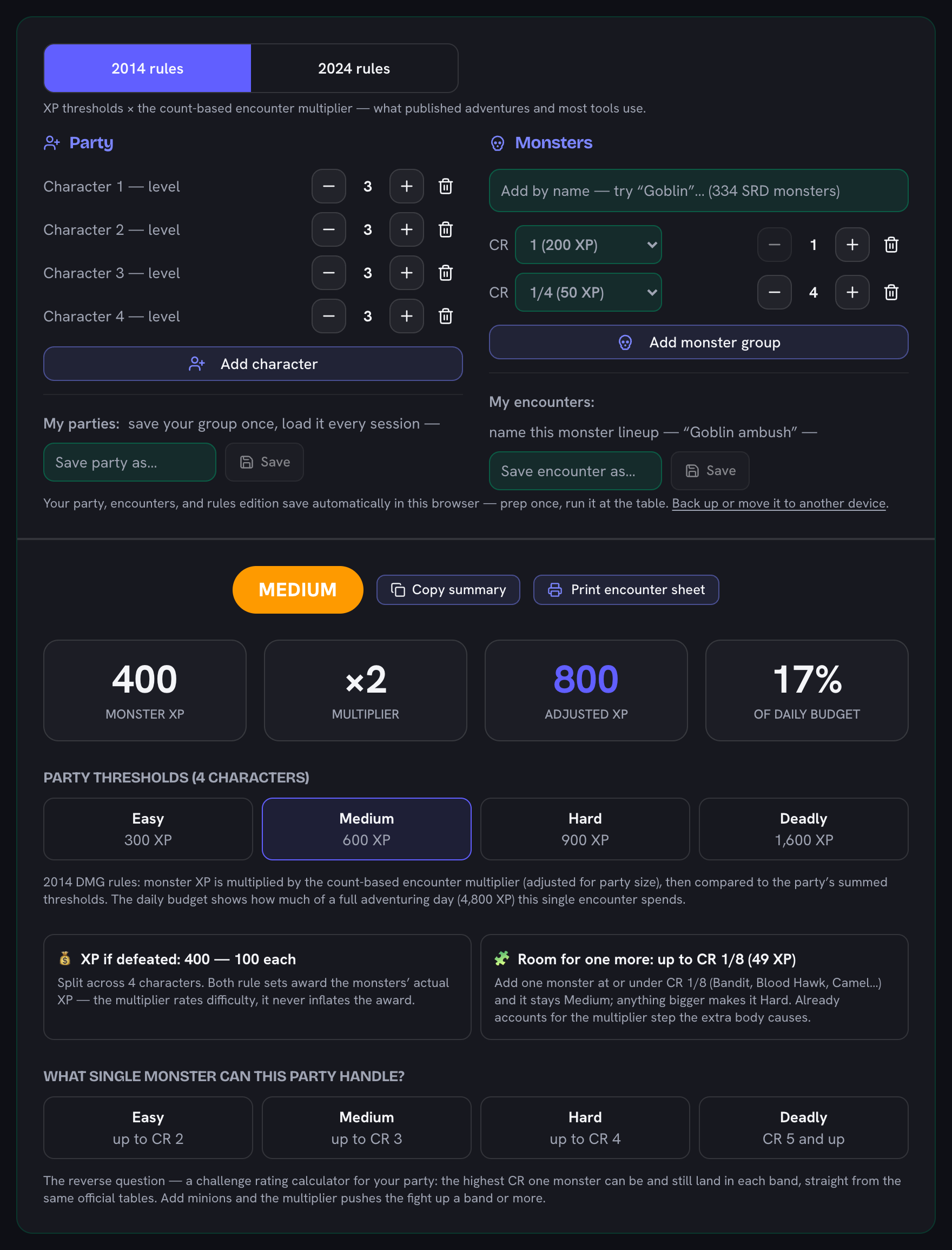
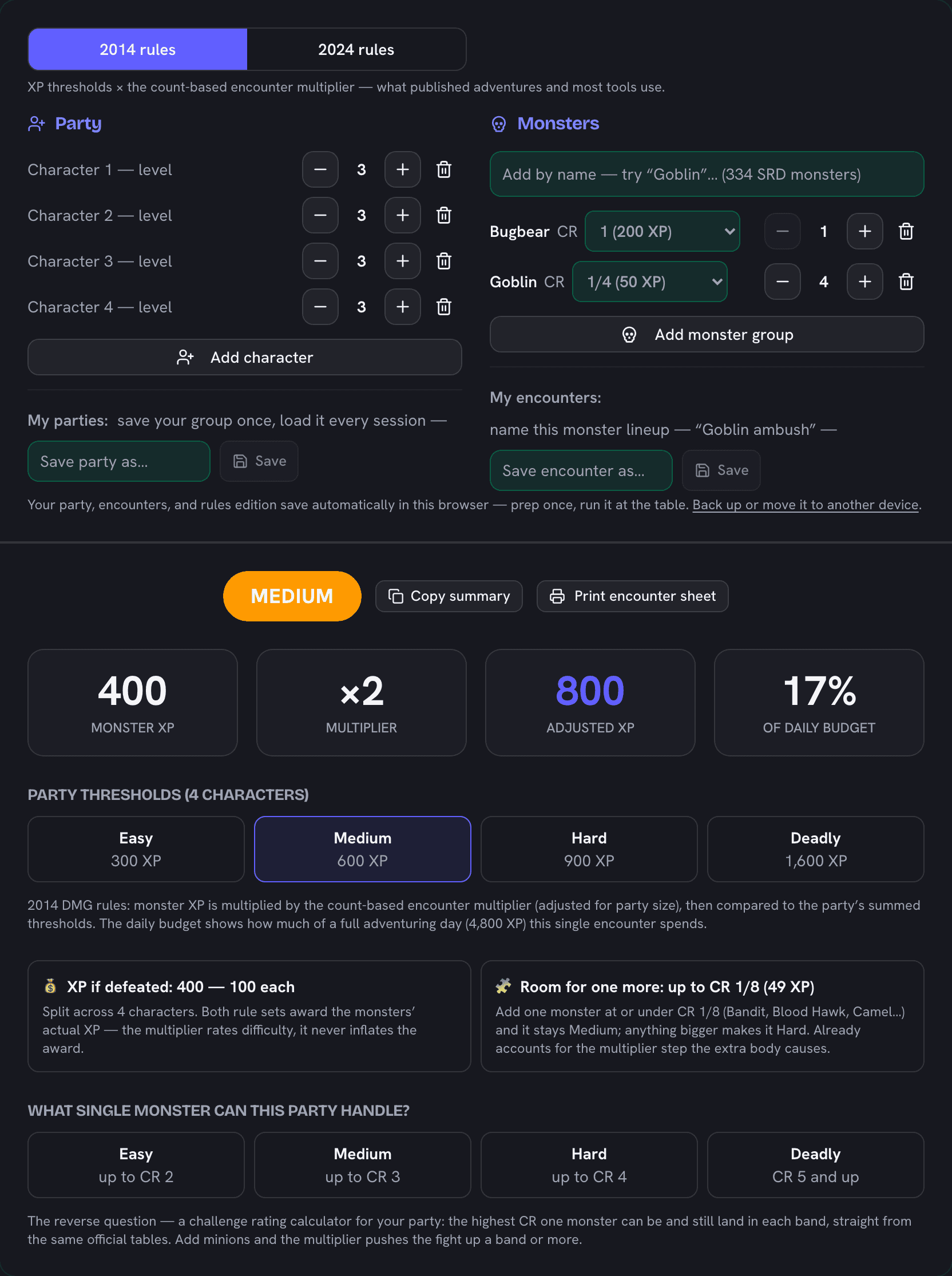
Under the 2014 rules, sum your party’s XP thresholds, total the monsters’ XP, multiply that by the encounter multiplier (×1 for one monster up to ×4 for fifteen or more), then read off the highest band it reaches — easy, medium, hard or deadly. A bugbear and four goblins (400 XP × 2 = 800 adjusted XP) is a Medium fight for four 3rd-level characters. Enter your party and monsters for the verdict, or switch to the 2024 Low/Moderate/High XP budgets.
Was this tool helpful?
Support this site

More tools

How to calculate D&D encounter difficulty

Balance a 5e fight in three steps — the calculator shows every DMG number, so you learn the math instead of just trusting a verdict.

  1. Set your party

    Enter each character’s level and add or remove seats for the exact table size. The calculator sums the party’s easy, medium, hard, and deadly XP thresholds from the 2014 Dungeon Master’s Guide.

    The D&D encounter difficulty calculator with a four-character party set up, showing the party XP thresholds and the encounter verdict
  2. Add the monsters

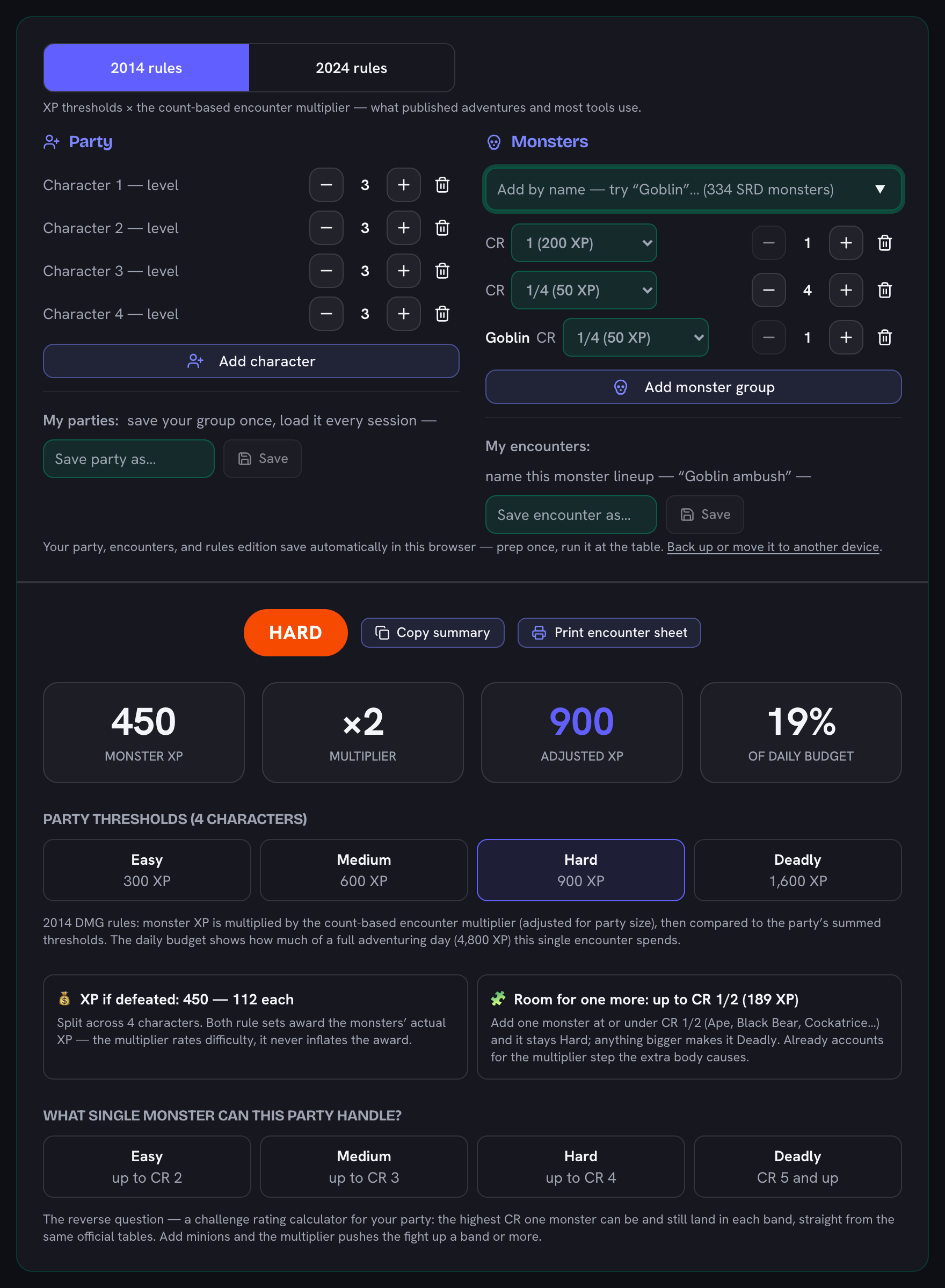
    Search the 334 SRD monsters by name, or add groups by challenge rating. The tool applies the count-based encounter multiplier — the step everyone forgets — to the raw monster XP.

    The calculator after adding a Goblin monster group, with the adjusted XP and difficulty updating live
  3. Read the difficulty verdict

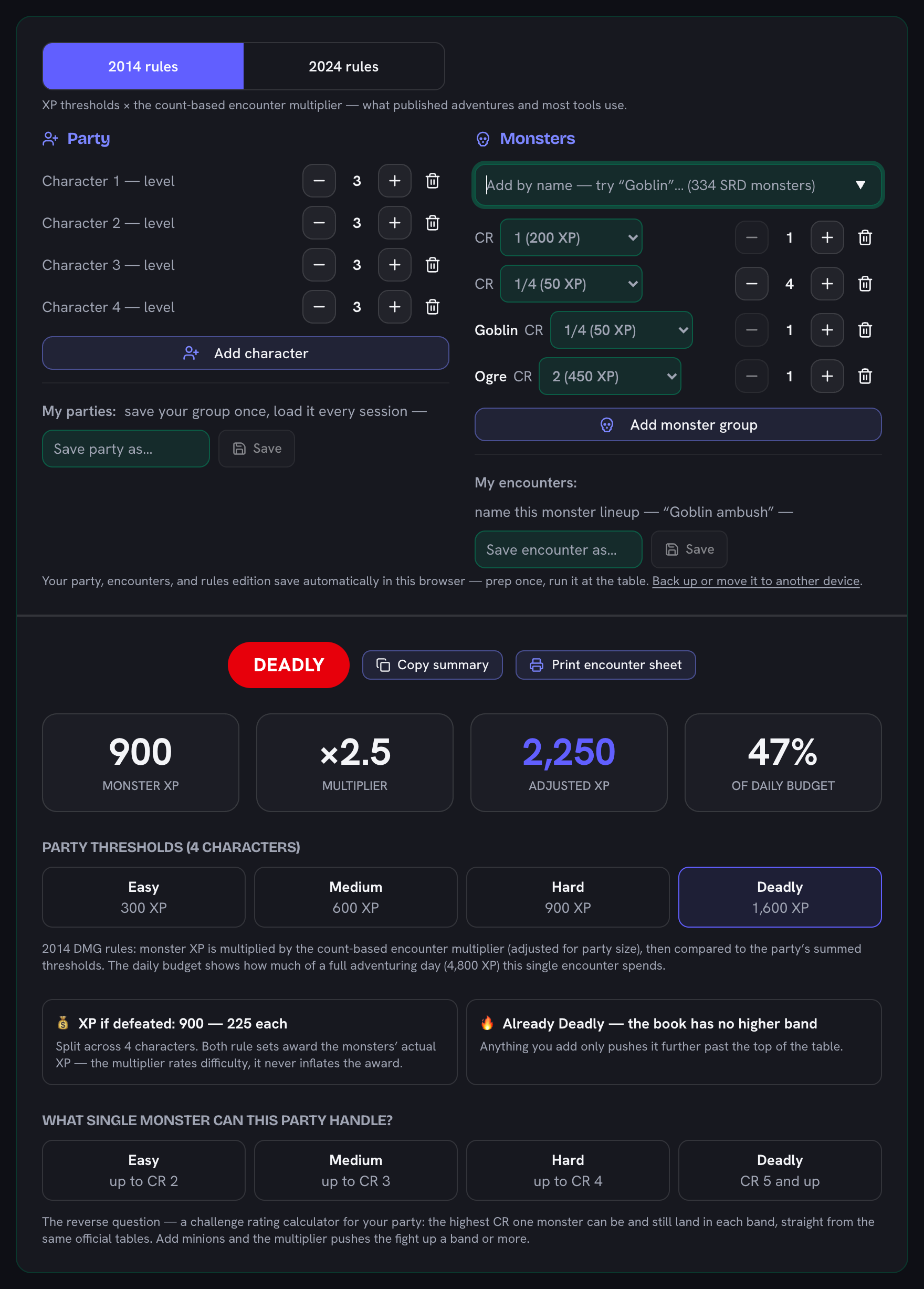
    You get an instant easy / medium / hard / deadly rating, with every intermediate number shown: the party thresholds, the raw XP, the multiplier, and the adjusted total that decides the verdict.

    The calculator showing a Deadly verdict after adding more monsters, with the ×2.5 encounter multiplier producing 2,250 adjusted XP

The Math the DMG Actually Uses

Encounter balancing in 5e is a real algorithm, published in the 2014 Dungeon Master’s Guide — most tools just hide it. This calculator shows every intermediate number: the party’s summed XP thresholds, the raw monster XP, the count-based encounter multiplier, and the adjusted total that decides the easy/medium/hard/deadly verdict. Seeing the pieces is what teaches you to eyeball encounters without a tool — the mark of a practiced DM.

The multiplier is the step everyone forgets, and it’s the one that kills parties. Eight orcs are “only” 800 XP on paper, but at ×2.5 they adjust to 2,000 — a deadly encounter for a 4th-level party that a naive XP sum calls hard. The reverse trap: one big monster with no allies takes no multiplier at all, which is why lone bosses famously underperform. Give the dragon two guards and the same XP suddenly plays a full band harder.

It also answers the question backwards — the challenge rating calculator panel reads your party and reports the highest CR a single monster can be for each band, so “can they take a CR 6?” gets an instant, table-accurate answer instead of a guess.

XP Thresholds and the Adventuring Day

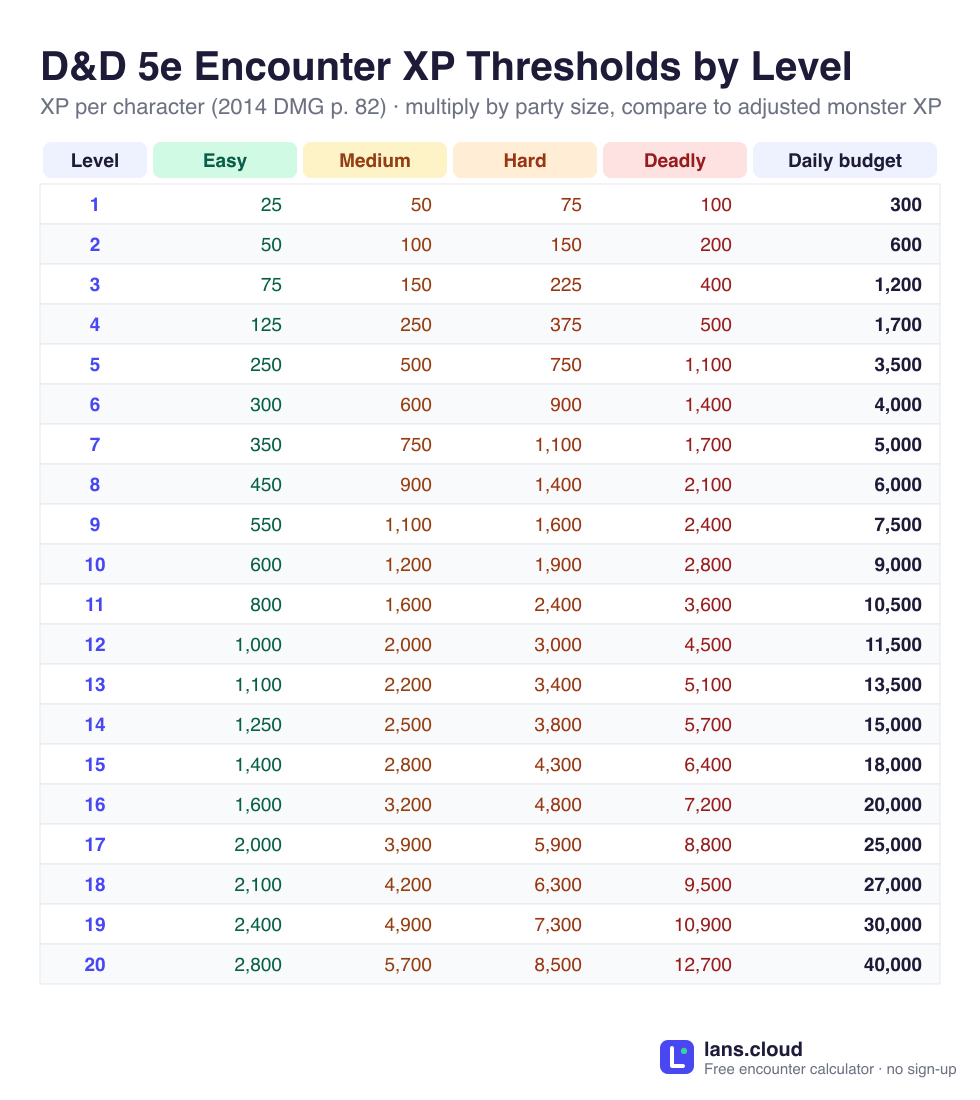
Both tables below are generated from the same data the calculator runs on — the complete 2014 DMG numbers for every level and every challenge rating. The daily budget column is the DMG’s answer to “how many encounters make a dungeon?”: roughly six to eight medium-to-hard fights, or fewer bigger ones, before the party needs a long rest.
XP thresholds and daily budget per character (2014 DMG)

LevelEasyMediumHardDeadlyDaily budget
1255075100300
250100150200600
3751502254001,200
41252503755001,700
52505007501,1003,500
63006009001,4004,000
73507501,1001,7005,000
84509001,4002,1006,000
95501,1001,6002,4007,500
106001,2001,9002,8009,000
118001,6002,4003,60010,500
121,0002,0003,0004,50011,500
131,1002,2003,4005,10013,500
141,2502,5003,8005,70015,000
151,4002,8004,3006,40018,000
161,6003,2004,8007,20020,000
172,0003,9005,9008,80025,000
182,1004,2006,3009,50027,000
192,4004,9007,30010,90030,000
202,8005,7008,50012,70040,000

Per character — the calculator sums these across your party. Daily budget is the adventuring-day XP total.

D&D 5e encounter XP thresholds chart for character levels 1–20, showing the Easy, Medium, Hard, and Deadly XP thresholds per character from the 2014 Dungeon Master's Guide page 82, plus the adventuring-day XP budget for each level.
The full 5e XP threshold table as one chart — save or print it for the DM screen.Download PNG

The 2024 Rules: Budgets Instead of Multipliers

The 2024 DMG rebuilt encounter math around one table: an XP budget per character for Low, Moderate, and High difficulty. Multiply by the party size, spend the budget on monsters at face XP value, and you’re done — no multiplier, no adventuring-day accounting. Switch the calculator to 2024 rules to use it; the table below is the complete budget list, and comparing the two modes on the same fight is the fastest way to feel how the editions differ.

XP budget per character (2024 DMG)

LevelLowModerateHigh
15075100
2100150200
3150225400
4250375500
55007501,100
66001,0001,400
77501,3001,700
81,0001,7002,100
91,3002,0002,600
101,6002,3003,100
111,9002,9004,100
122,2003,7004,700
132,6004,2005,400
142,9004,9006,200
153,3005,4007,800
163,8006,1009,800
174,5007,20011,700
185,0008,70014,200
195,50010,70017,200
206,40013,20022,000

Per character — multiply by party size (the calculator sums per member, so mixed-level parties work). Raw monster XP, no multiplier.

Challenge Rating to XP

Enter monsters by CR and the calculator applies the official XP values — from a CR 0 rat’s 10 XP to a CR 30 Tarrasque-tier 155,000. When a stat block gives XP directly, it always matches this table.

Monster XP by challenge rating

CRXP
010
1/825
1/450
1/2100
1200
2450
3700
41,100
51,800
62,300
72,900
83,900
95,000
105,900
117,200
128,400
1310,000
1411,500
1513,000
1615,000
1718,000
1820,000
1922,000
2025,000
2133,000
2241,000
2350,000
2462,000
2575,000
2690,000
27105,000
28120,000
29135,000
30155,000

Monster Manual / DMG values — the same mapping the CR dropdown uses.

Balancing Tips From the Table

Deadly is a ceiling, not a target: a steady diet of deadly fights produces dead characters, while all-medium days let casters nova every fight. Mix bands across the adventuring day and watch the budget percentage this tool reports. Rolling up characters first? The D&D stat roller handles 4d6-drop-lowest and point buy, and the dice roller covers everything else the session throws at you.

Frequently Asked Questions

How do you calculate encounter difficulty in D&D 5e?

Four steps from the 2014 Dungeon Master’s Guide: (1) look up each character’s XP thresholds for their level and sum them across the party; (2) add up the XP of every monster; (3) multiply that total by the encounter multiplier based on how many monsters there are (×1 for one, up to ×4 for fifteen or more); (4) compare the adjusted XP to the party’s thresholds — the highest band it reaches is the difficulty. This calculator does all four steps and shows each intermediate number.

What is the encounter multiplier and why does it exist?

Action economy. Six wolves are far deadlier than their summed XP suggests because they take six turns to the party’s four. The DMG models this by multiplying total monster XP: ×1.5 for a pair, ×2 for 3–6 monsters, ×2.5 for 7–10, ×3 for 11–14 and ×4 for 15+. Small parties (fewer than three characters) shift the multiplier one step up; large parties (six or more) shift it one step down.

What counts as a deadly encounter in 5e?

An encounter whose adjusted XP meets or exceeds the party’s summed deadly threshold. Deadly means genuinely lethal — a real chance a character dies without smart play or luck. It does not mean unwinnable: published adventures use deadly encounters for climactic fights, and a party at full resources usually survives one.

How much XP should an adventuring day contain?

The 2014 DMG budgets roughly 300 XP per 1st-level character up to 40,000 per 20th-level character across a full adventuring day (the table on this page lists all twenty levels). This calculator shows each encounter as a percentage of that budget, so you can see whether your dungeon day will exhaust the party or leave the fighter napping.

Does this calculator use the 2024 (5.5e) encounter rules?

Yes — switch to “2024 rules” and the calculator uses the new XP Budget per Character table (Low / Moderate / High, verified against the 2024 DMG): raw monster XP compared straight to the party’s summed budget, with no encounter multiplier and no adventuring-day budget. The 2014 mode remains the default because published adventures and most tables still use its math.

Can I add monsters by name instead of CR?

Yes — type a monster name ("Goblin", "Owlbear", "Adult Red Dragon") and pick it from the list: the calculator adds a named group with the right challenge rating filled in. The list is the complete 334-monster bestiary of the System Reference Document 5.1 by Wizards of the Coast LLC, used under the Creative Commons Attribution 4.0 license; monsters outside the SRD (or homebrew) still work the classic way — set their CR by hand.

Can I save my party and my encounters?

Yes — name your party once ("Tuesday group") and each monster lineup ("Goblin ambush", "Boss: young dragon") and they save automatically in your browser, along with your rules edition. Prep the whole session in advance, then load encounters one by one at the table. Nothing is uploaded anywhere.

Can I print an encounter sheet to run the fight at the table?

Yes — "Print encounter sheet" produces a one-page DM sheet: the difficulty verdict with the full math, the monster roster with XP per creature, and a blank initiative & HP tracker with one row per monster (Goblin 1, Goblin 2, …) plus a row per character. Prep on screen, print, and run the encounter with a pencil.

Is this a challenge rating (CR) calculator?

Yes, in both directions. Forward: pick each monster’s CR and the calculator converts it to XP (the full CR-to-XP table is below the article), sums the encounter, and rates it against your party’s thresholds or budget. Reverse: the “what single monster can this party handle?” panel shows the highest CR that still lands in each difficulty band for your exact party. Because the same CR-to-XP data drives both editions, it works as a 2024 CR calculator exactly as readily as a 2014 one — just flip the rules toggle. What it does not do is invent a CR for a homebrew monster — for that, use the Dungeon Master’s Guide monster-building tables, then bring the CR here.

What CR monster can my party handle?

Enter your party’s levels and the calculator answers directly: for each difficulty band it shows the highest challenge rating a single monster can be — for example, four 3rd-level characters handle up to CR 3 as a medium fight and CR 4 as hard, with CR 5 tipping into deadly (2014 rules). The panel uses the same official tables as the main calculator and updates as you edit the party, including the small-party and large-party multiplier adjustments.

Can I use this as a D&D XP calculator?

Yes — it is one at heart: every monster’s CR converts to its official XP value, the encounter total and (under 2014 rules) the multiplier-adjusted XP are shown as separate numbers, and it also answers the after-the-fight question — the XP each character earns if the party wins. Both rule sets award the monsters’ actual XP split evenly (the 2014 multiplier rates difficulty, it never inflates the award), and the same number prints on the encounter sheet. The reference tables below list XP thresholds per level, the adventuring-day budget, and the complete CR-to-XP mapping.

How much more can I add before the difficulty goes up?

The calculator tells you directly: the "room for one more" panel shows the biggest single monster you can still add — as an XP number and the matching CR, with SRD examples at that CR — before the encounter tips into the next band. Under 2014 rules this already accounts for the multiplier step the extra body causes (six goblins to seven jumps the multiplier from ×2 to ×2.5, which eats headroom fast); under 2024 rules it is the plain XP left in the current budget.

Does it work for D&D 3.5 or Pathfinder?

No — the math here is specifically fifth edition, with both the 2014 XP-threshold system and the 2024 XP-budget system built in. D&D 3.5 and Pathfinder use Challenge Rating and Encounter Level differently, so their numbers are not interchangeable with 5e’s.

What changed between the 2014 and 2024 encounter rules?

Three things: the multiplier is gone (eight orcs now cost exactly 8 × 100 XP), the four bands (easy/medium/hard/deadly) became three (Low/Moderate/High) with no “easy”, and the adventuring-day XP budget was dropped entirely. The 2024 budgets roughly track the old hard/deadly range, so the same fight often rates a step scarier under 2014 math — compare both modes on the same setup and you’ll see exactly where they disagree.

D&D encounter difficulty calculator rating a bugbear and four goblins against a level-3 party of four as Medium: 400 XP, ×2 multiplier, 800 adjusted
Every step visible: monster XP, the ×2 multiplier, adjusted XP against the party's thresholds — and the verdict.