lans.cloud

Cipher Encoder & Decoder

Free cipher encoder and decoder that shows every step: Caesar, ROT13, Atbash, A1Z26, Morse, Vigenère, and keyword substitution — each letter explained as it transforms, entirely in your browser.

Was this tool helpful?
Support this site

The Steps Are the Point

Most cipher tools give you the answer; this one shows the work. Every letter gets a row in the steps table — what came in, what went out, and exactly why — so instead of trusting a black box you can watch a Caesar shift wrap Z around to C, see the Vigenère key advance letter by letter, or follow a keyword alphabet replace the ordinary one. Decoding a message you can explain beats decoding one you can't.

Seven Ciphers, One Ladder

The set is ordered like a curriculum. Caesar teaches the idea of a shift; ROT13 shows the special case that undoes itself; Atbash mirrors the alphabet; A1Z26 turns letters into numbers; Morse swaps the alphabet for another one entirely; Vigenère introduces the concept that changed cryptography — a key — and keyword substitution shows how a single memorable word can scramble the whole alphabet. Everything runs in your browser; nothing you type is transmitted anywhere.

For Classrooms and Puzzle Makers

Code-breaking is a beloved classroom activity for a reason: it is spelling, pattern-matching, and logic wearing a trench coat. Put the steps table on the projector while the class cracks a message together, or flip it around and let students encode messages for each other. Planning a treasure hunt or escape room? The companion escape room cipher generator produces printable clue cards from any secret message. And a caution with a wink: these ciphers protected empires for centuries, but today they are toys — use the password generator for anything that actually needs to stay secret.
Crack a Caesar Without the Key

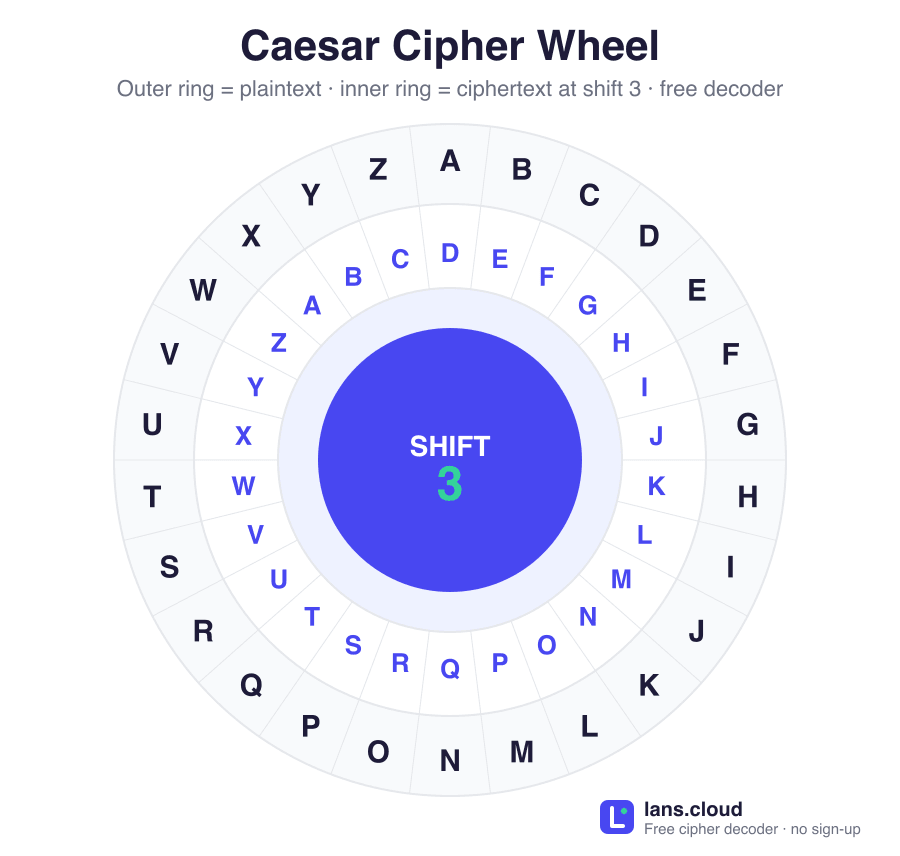
The Caesar cipher's weakness is its greatest lesson: there are only 25 possible shifts, so you can simply try them all. Below, the ciphertext PHHW DW GDZQ is decoded under every shift — scan the column and one row snaps into English. This brute-force idea (and its big brother, frequency analysis: E is the most common English letter, so the most common ciphertext letter probably means E) is the first chapter of real cryptanalysis.

All 25 shifts of PHHW DW GDZQ, computed

Shift backResult
1OGGV CV FCYP
2NFFU BU EBXO
3MEET AT DAWN← readable!
4LDDS ZS CZVM
5KCCR YR BYUL
6JBBQ XQ AXTK
7IAAP WP ZWSJ
8HZZO VO YVRI
9GYYN UN XUQH
10FXXM TM WTPG
11EWWL SL VSOF
12DVVK RK URNE
13CUUJ QJ TQMD
14BTTI PI SPLC
15ASSH OH ROKB
16ZRRG NG QNJA
17YQQF MF PMIZ
18XPPE LE OLHY
19WOOD KD NKGX
20VNNC JC MJFW
21UMMB IB LIEV
22TLLA HA KHDU
23SKKZ GZ JGCT
24RJJY FY IFBS
25QIIX EX HEAR

Computed by the same Caesar function the tool runs. In a classroom, hand out a ciphertext and let teams race through the shifts.

Morse code chart (A–Z, 0–9)

CharacterMorse
0-----
1.----
2..---
3...--
4....-
5.....
6-....
7--...
8---..
9----.
A.-
B-...
C-.-.
D-..
E.
F..-.
G--.
H....
I..
J.---
K-.-
L.-..
M--
N-.
O---
P.--.
Q--.-
R.-.
S...
T-
U..-
V...-
W.--
X-..-
Y-.--
Z--..

The exact table the encoder uses. Letters are separated by spaces, words by a slash.

A1Z26 chart

LetterNumber
A1
B2
C3
D4
E5
F6
G7
H8
I9
J10
K11
L12
M13
N14
O15
P16
Q17
R18
S19
T20
U21
V22
W23
X24
Y25
Z26

A=1 through Z=26 — the beginner cipher for treasure hunts.

The seven ciphers at a glance

CipherHow it worksExample (shift 3 / key KEY)
Caesar shiftEvery letter moves a fixed number of places down the alphabet.HELLO → KHOOR
ROT13Caesar with shift 13 — encoding and decoding are the same move.HELLO → URYYB
AtbashThe alphabet mirrored: A↔Z, B↔Y, C↔X…HELLO → SVOOL
A1Z26 (numbers)Each letter becomes its position in the alphabet: A=1 … Z=26.HELLO → 8-5-12-12-15
Morse codeDots and dashes; letters separated by spaces, words by " / ".HELLO → .... . .-.. .-.. ---
VigenèreA keyword sets a different Caesar shift for every letter position.HELLO → RIJVS
Keyword substitutionA keyword builds a scrambled alphabet that replaces the normal one.HELLO → FBJJN

Examples computed live by the same engine the tool runs — they can never drift from the tool's actual behavior.

Frequently Asked Questions

How do I decode a Caesar cipher step by step?

Pick Caesar shift, set the shift value, paste the coded text, and switch to Decode. The steps table shows every letter moving back through the alphabet — H shifted −3 becomes E, and so on. Don’t know the shift? Try each of the 25 values; one of them will suddenly read as words.

How does the Vigenère cipher work?

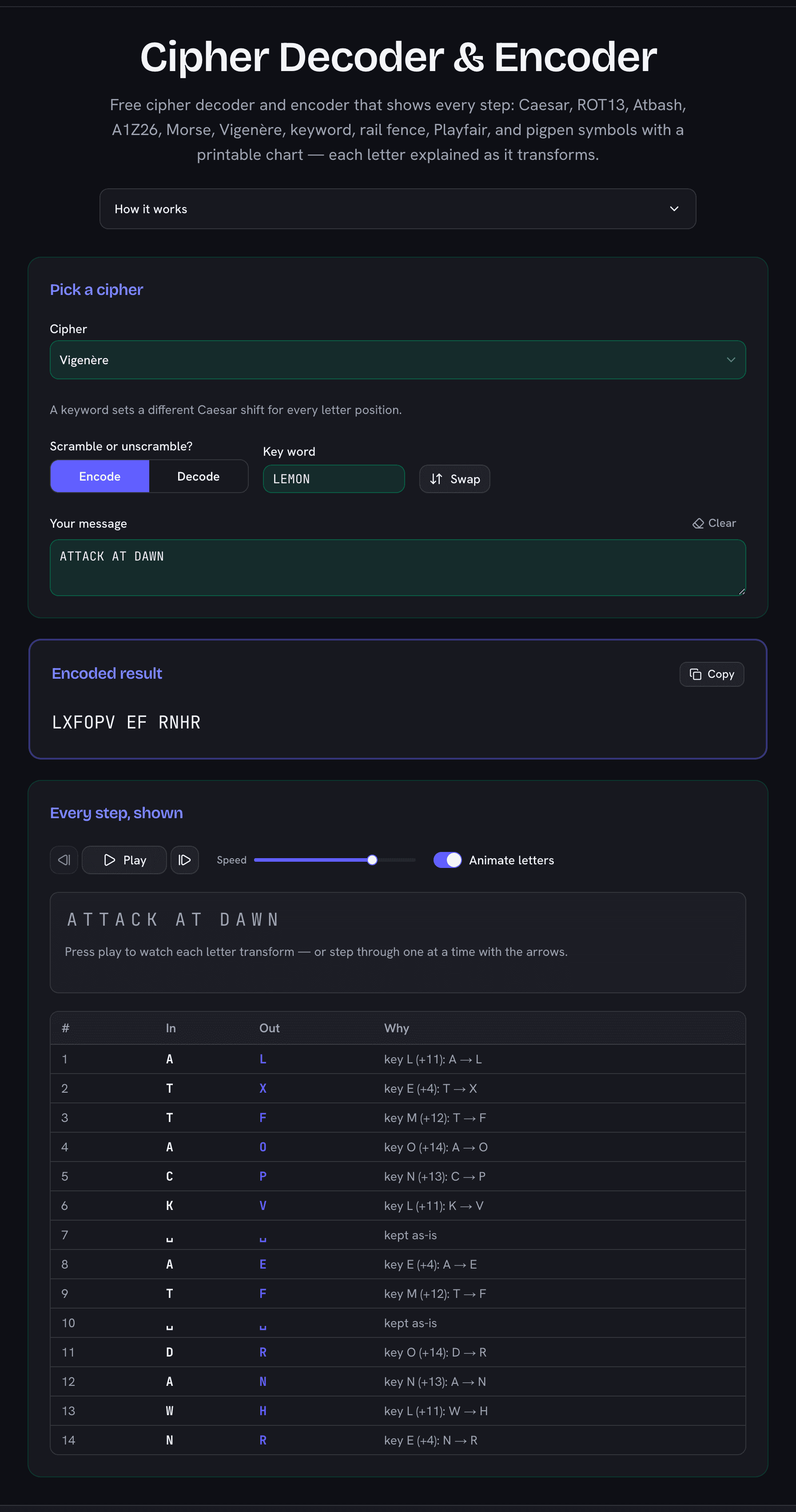
A keyword repeats along your message, and each key letter sets that position’s Caesar shift: key letter A shifts 0, B shifts 1, and so on. The steps table shows the key letter and exact shift applied to every character — the textbook ATTACKATDAWN with key LEMON becomes LXFOPVEFRNHR, and you can watch each letter do it.

Is anything I type sent anywhere?

No. Every cipher runs in your browser — messages, keys, and results never touch a server. That makes it safe for classroom secrets and party games alike (but do not use classical ciphers for real security: all of them are breakable in seconds by modern methods).

Which cipher should a beginner start with?

Caesar is the gateway: one rule, instantly visible in the steps. Then Atbash (a mirror), A1Z26 (numbers), Morse (a different alphabet entirely), and finally Vigenère — the first cipher where a key genuinely matters, which is why it stayed “unbreakable” for three centuries.

Can I use this to make an escape room or treasure hunt?

Yes — encode your clues here, or use the companion escape room cipher generator, which turns a secret message into printable clue cards with hints and an answer key.

Cipher encoder showing ATTACK AT DAWN becoming LXFOPV EF RNHR with the Vigenère key LEMON and a step-by-step table explaining each letter
The textbook Vigenère example, live: every letter gets a row showing the key letter, the shift, and why.