Fair Minutes Without the Spreadsheet
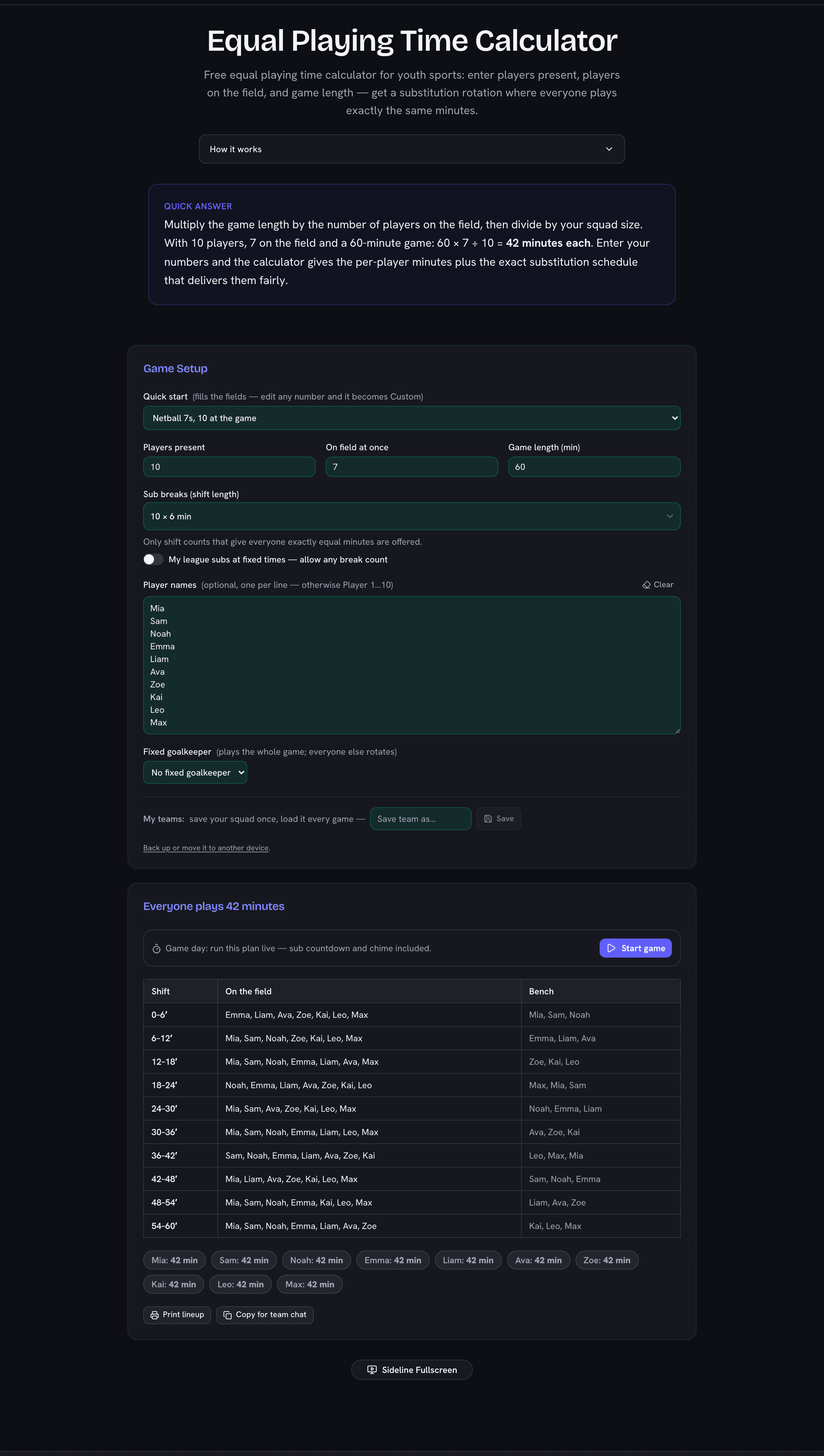
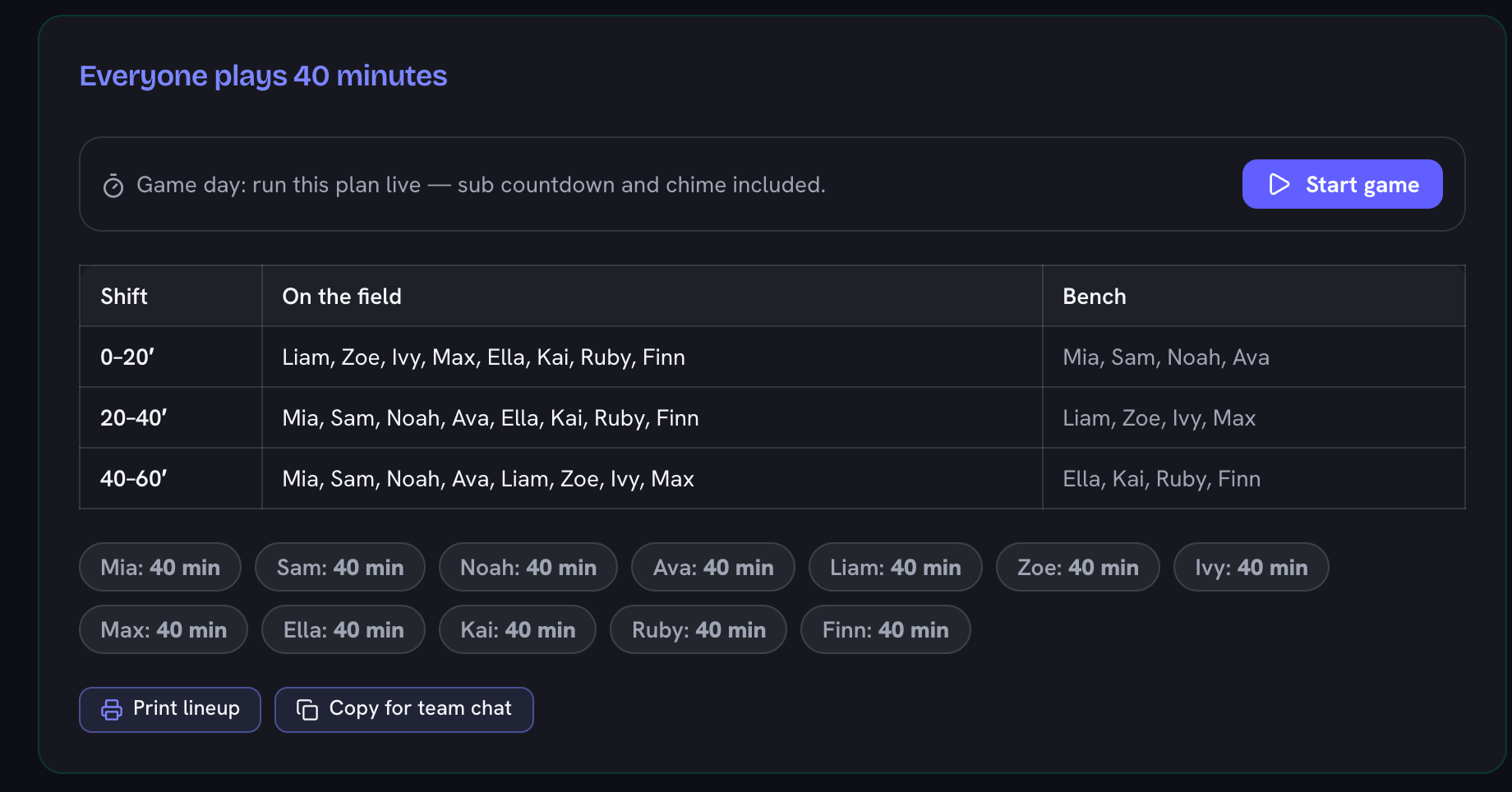
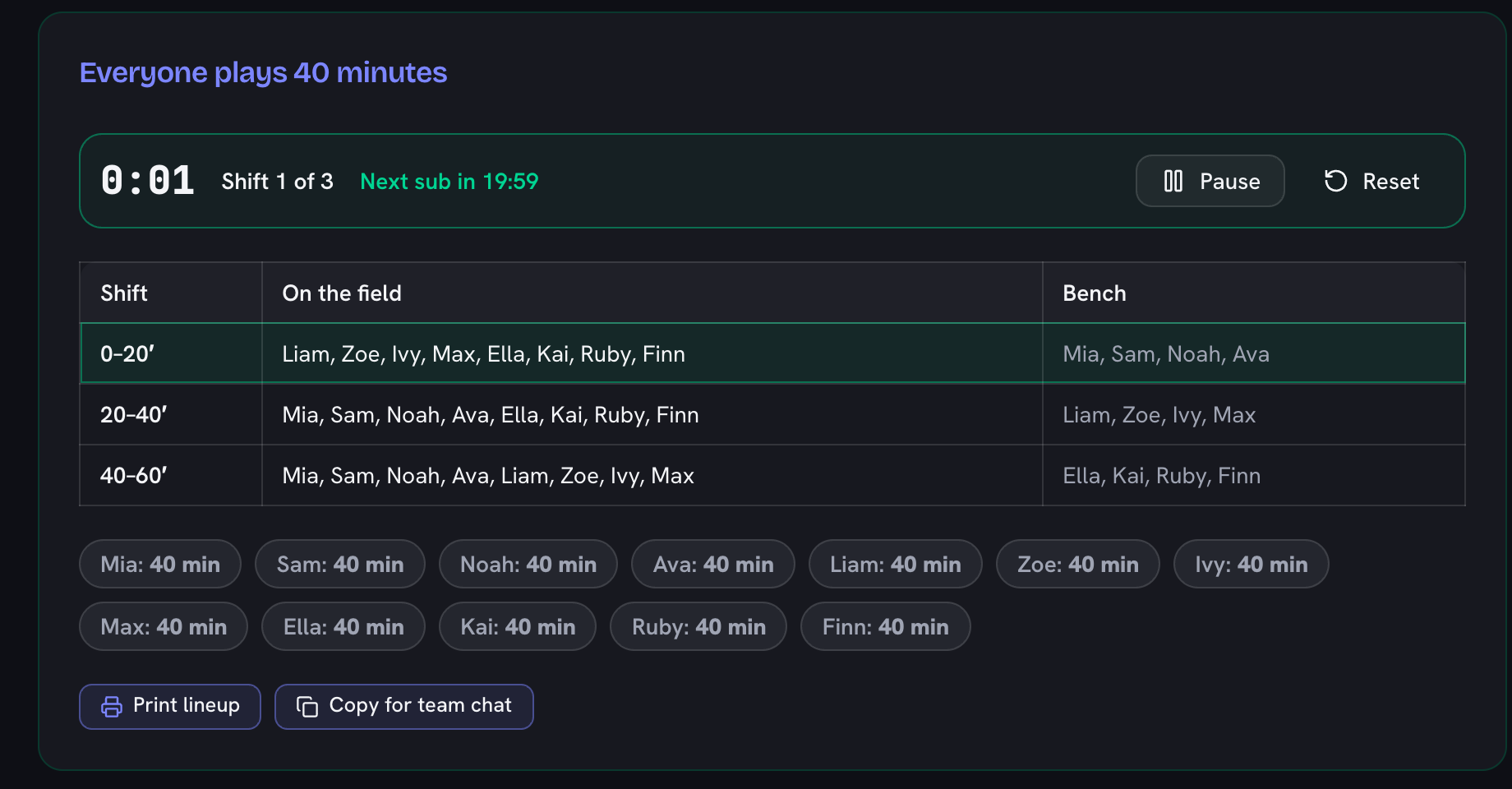
Every youth coach knows the post-game conversation to avoid: a parent, a stopwatch, and a child who sat too long. Equal playing time is usually a league rule and always good development practice — but juggling it live, while actually coaching, is how it goes wrong. This calculator doubles as a substitution schedule maker: it produces the whole plan before kickoff — who starts, who comes on at every break, and the exact equal minutes everyone ends up with.
The rotation uses a simple round-robin: each shift, the next group in roster order takes its turn on the bench. Because the calculator only offers shift counts where the bench cycles through the roster completely, the fairness is mathematical, not approximate — no solver, no near-enough.
Typical Youth Formats
Equal minutes in common youth formats
| Format | Minutes per player | Simplest fair rotation |
|---|---|---|
| Soccer 5v5 (U8), 8 at the game | 25 min | 8 shifts of 5 min |
| Soccer 7v7 (U10), 10 at the game | 35 min | 10 shifts of 5 min |
| Soccer 9v9 (U12), 12 at the game | 45 min | 4 shifts of 15 min |
| Soccer 11v11, 15 at the game | 51.3 min | 15 shifts of 4.7 min |
| Basketball 5s, 8 at the game | 20 min | 8 shifts of 4 min |
| Basketball 5s, 10 at the game | 16 min | 2 shifts of 16 min |
| Volleyball 6s, 9 at the game | 40 min | 3 shifts of 20 min |
| Flag football 5v5, 9 at the game | 22.2 min | 9 shifts of 4.4 min |
| Netball 7s, 10 at the game | 42 min | 10 shifts of 6 min |
Computed by the same engine as the calculator — pick more shifts above for shorter, more frequent rotations.
Coaching With the Rotation
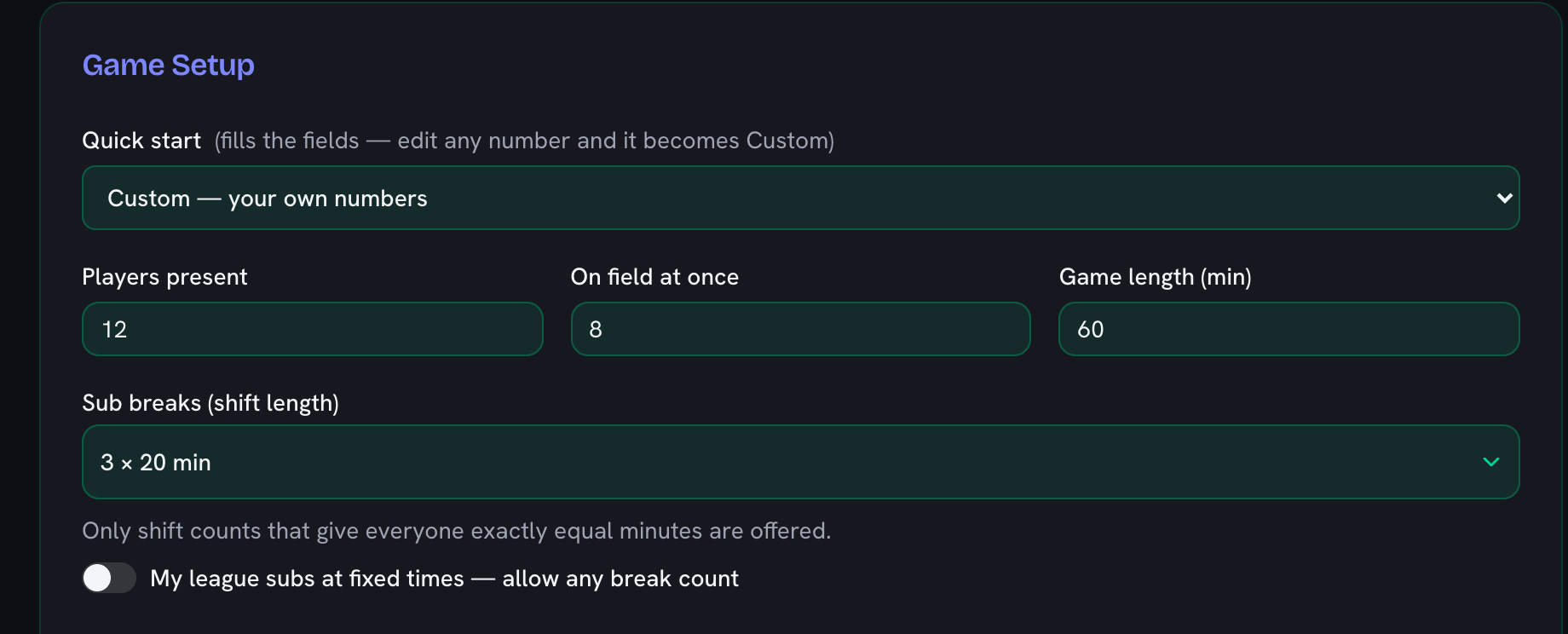
Print the table or keep the sideline fullscreen open on your phone. Two practical tips: first, enter names in roster order and tell the players their number — substitutions become “threes off, sixes on” instead of a negotiation. Second, if your league subs only at quarters or halves, switch on “My league subs at fixed times” and pick the break count that matches — the calculator then spreads the bench as evenly as the maths allows, shows the exact spread, and tells you which players get the extra shift — the honest way to rotate players evenly when the numbers don’t divide. Pair it with the random team picker for fair sides at training, or the team snack schedule generator for the other job that lands on the coach.