The Four Minutes That Started It All
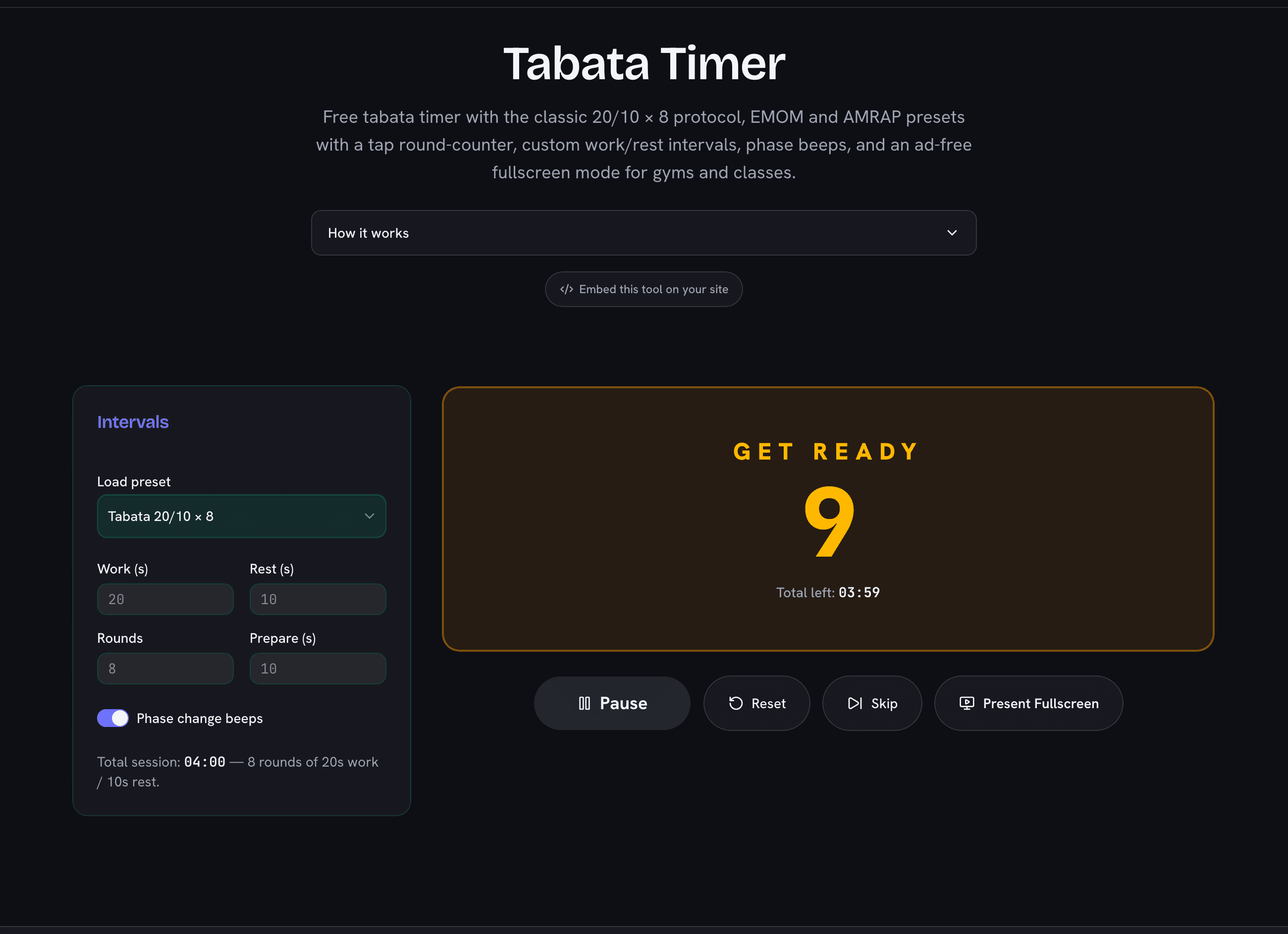
In 1996, Dr. Izumi Tabata and colleagues published a study comparing an hour of moderate cycling against a brutal alternative: eight rounds of twenty seconds at maximal effort with ten seconds of rest — four minutes of actual work. The interval group improved both aerobic capacity and anaerobic capacity; the steady-state group improved only the former. That 20/10 × 8 structure became the most famous interval protocol in fitness, and it is this timer’s default preset, second for second.
The catch the internet forgets: the original protocol was performed at an intensity few people can sustain. The honest version for most of us — still highly effective — is picking an effort you can barely hold for all eight rounds. The timer keeps the structure honest; the intensity is your job.
Built for Actually Working Out
- Color-coded phases: green means work, blue means rest — readable mid-burpee from across the room, especially in the ad-free fullscreen mode.
- Audio cues: a double beep starts work, a low tone starts rest, and the last three seconds of every phase tick down — so you never have to look at the screen.
- Drift-free timing: the timer tracks real timestamps, not ticks, so it stays accurate even in a background tab (the countdown shows in the tab title too).
- Skip and pause: interrupted mid-session? Pause keeps your place; Skip jumps to the next phase when the doorbell wins.
Interval Ideas Beyond the Classic
Tabata 20/10 × 8 — burpees, air squats, kettlebell swings, or bike sprints; one exercise for all eight rounds is the original recipe. 30/15 × 10 — a friendlier ratio for circuits: rotate through 3–4 exercises. 45/15 × 8 — strength-endurance work like planks, wall sits, and slow squats. 40/20 × 6 — hill or shuttle sprints with a walk-back rest. Pair any of them with our bodyweight workout generator to fill the work slots with movements.