lans.cloud

Warmup Sets Calculator

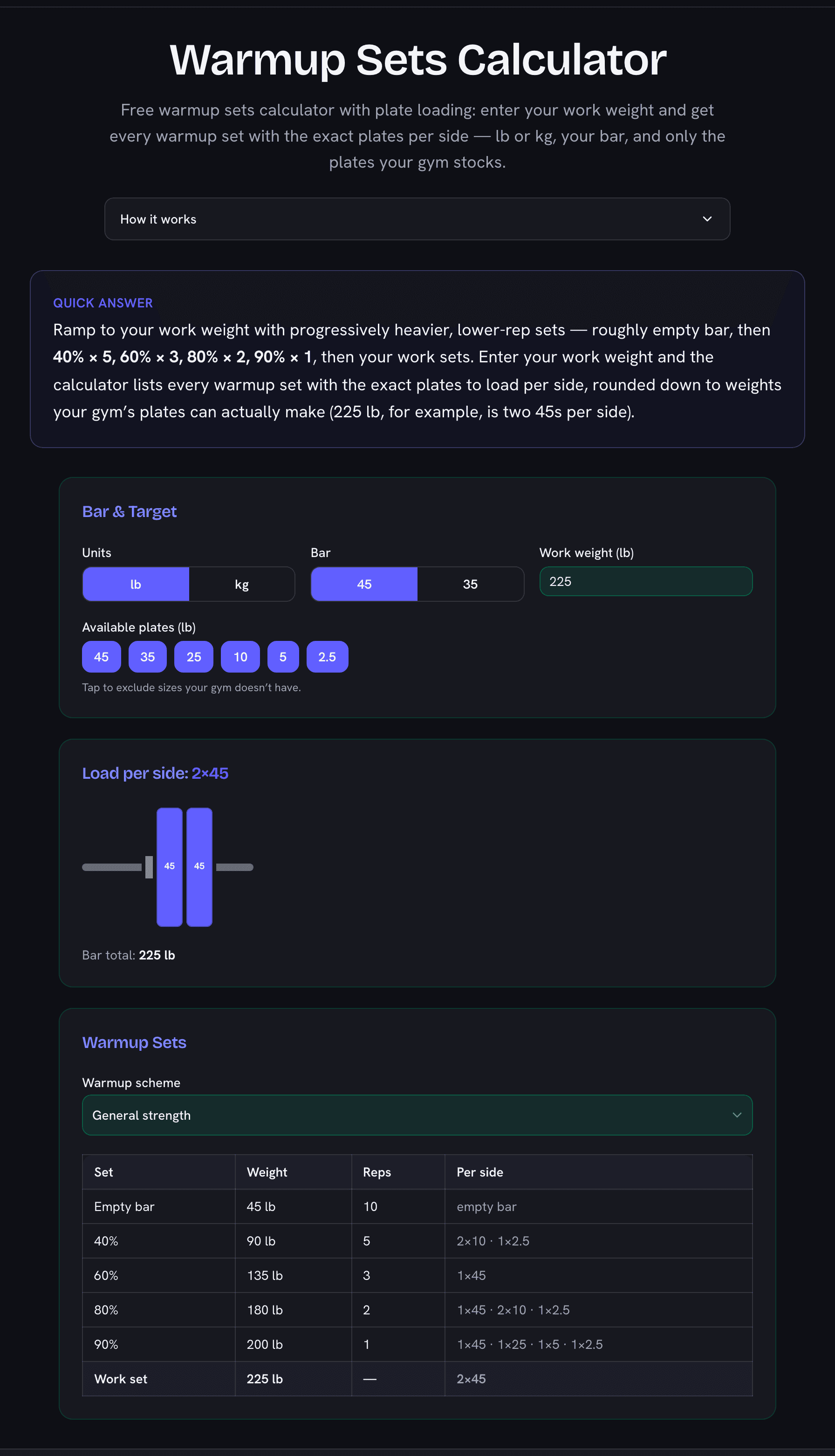
Free warmup sets calculator with plate loading: enter your work weight and get every warmup set with the exact plates per side — lb or kg, your bar, and only the plates your gym stocks.

Bar & Target

Tap to exclude sizes your gym doesn't have.

Load per side: 2×45
Bar total: 225 lb
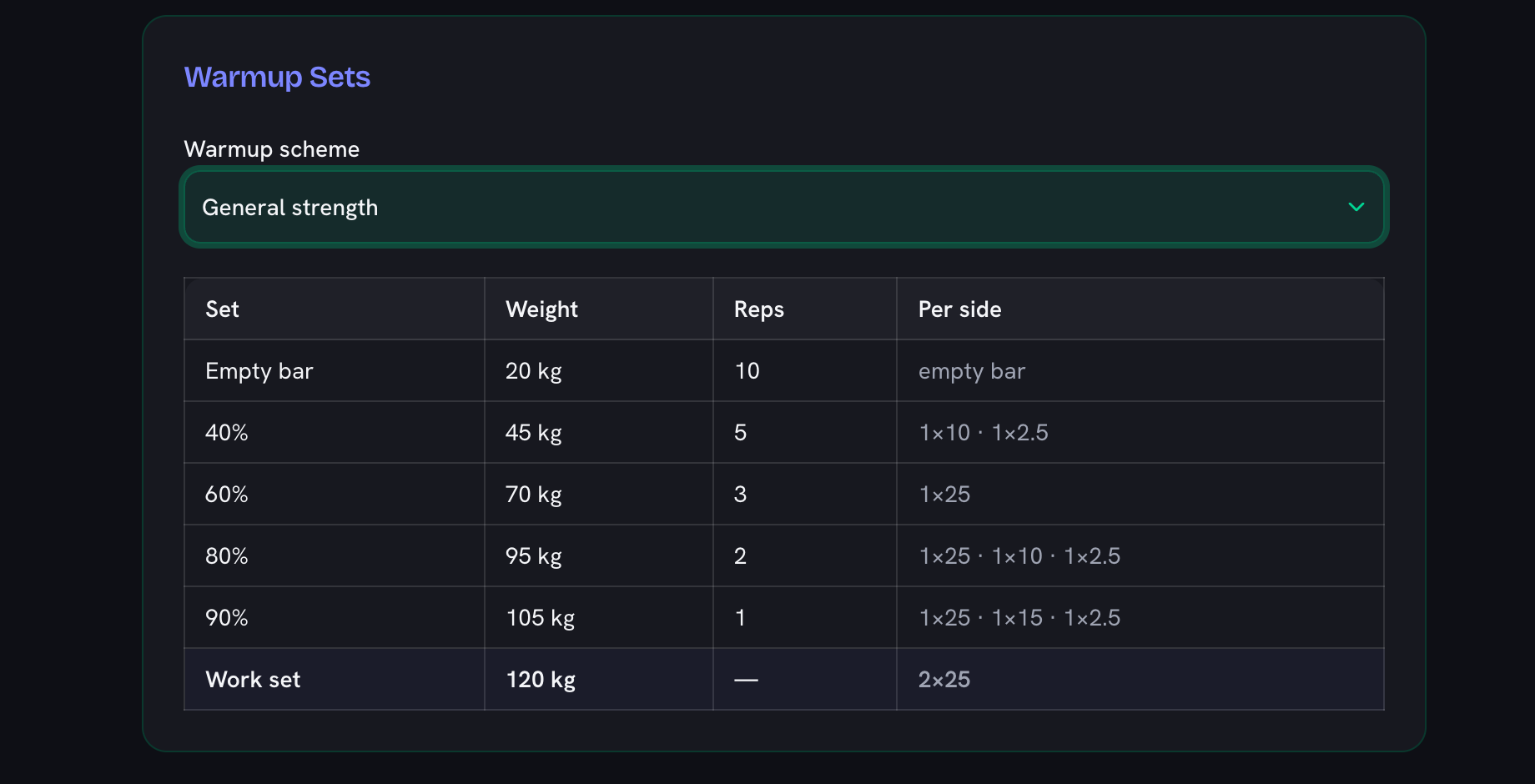
Warmup Sets
SetWeightRepsPer side
Empty bar45 lb10empty bar
40%90 lb52×10 · 1×2.5
60%135 lb31×45
80%180 lb21×45 · 2×10 · 1×2.5
90%200 lb11×45 · 1×25 · 1×5 · 1×2.5
Work set225 lb2×45

Stop Doing Plate Math Between Sets

Every lifter knows the moment: you are three warmup sets deep, slightly gassed, and trying to work out what 80% of 237.5 is and which plates build it. That arithmetic is exactly what goes wrong under fatigue — and loading errors are how you end up grinding an accidental PR during a warmup. This calculator does the whole ramp in advance: every set, its weight, its reps, and the exact plates per side, using only the sizes your gym actually stocks.

The Milestone Chart

Plates per side for the classic milestones

Weight (lb)Per side (45 lb bar)Weight (kg)Per side (20 kg bar)
95 lb1×2560 kg1×20
135 lb1×4580 kg1×25 · 1×5
185 lb1×45 · 1×25100 kg1×25 · 1×15
225 lb2×45120 kg2×25
275 lb2×45 · 1×25140 kg2×25 · 1×10
315 lb3×45160 kg2×25 · 1×20
365 lb3×45 · 1×25180 kg3×25 · 1×5
405 lb4×45200 kg3×25 · 1×15

Computed by the same loader the calculator uses — standard full plate sets.

Warming Up Without Wasting Energy

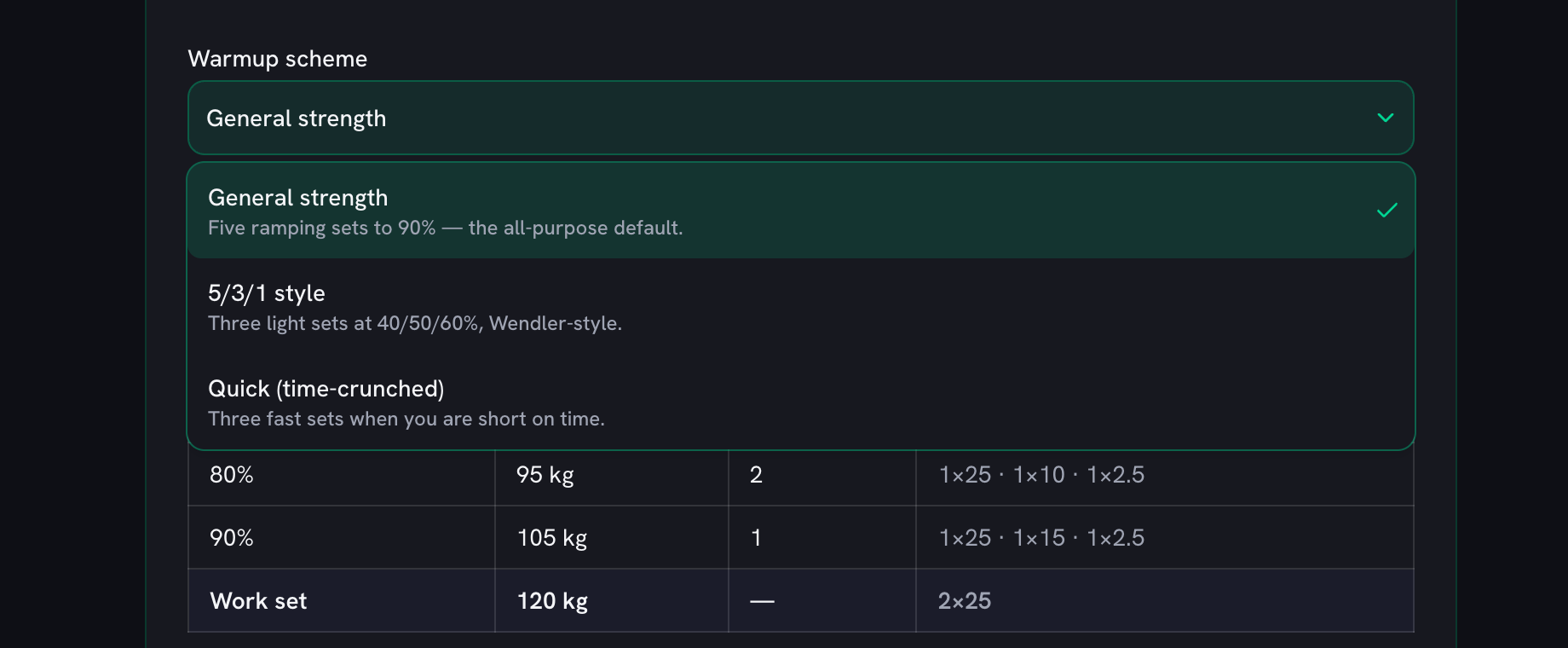
The purpose of a warmup ramp is practice, not exhaustion: each set rehearses the exact bar path at a weight light enough to recover from in seconds. That is why good schemes cut the reps as the percentage climbs — five reps at 40%, a single at 90%. The 5/3/1-style option stops at 60% for programs whose first work set is itself submaximal, and the quick scheme covers lunchtime sessions. Pair the ramp with the tabata timer for conditioning finishers, or the bodyweight workout generator for days away from the bar.


Frequently Asked Questions

What plates do I load for 225?

Two 45 lb plates per side on a standard 45 lb bar — the famous "two plates". Three per side makes 315, four makes 405. The calculator shows the per-side breakdown for any weight, including the awkward ones like 185 (one 45 + one 25 per side).

How should I warm up to my work weight?

The classic ramp: empty bar for reps, then roughly 40% × 5, 60% × 3, 80% × 2, 90% × 1, then your work sets — fewer reps as the bar gets heavier, so you groove the movement without burning energy. The calculator builds this automatically and rounds every set to weights your plates can actually make.

My gym has no 2.5 lb plates — now what?

Tap any plate size to exclude it and every set recalculates with what remains. The smallest jump you can make is always twice your smallest plate, and the calculator tells you when a target is unreachable and loads the closest weight below it.

Does it work in kilograms?

Yes — switch to kg for the standard 25/20/15/10/5/2.5/1.25 kg plate set on a 20 kg (or 15 kg) bar. 100 kg loads as one 25 and one 15 per side; the milestone chart shows lb and kg equivalents side by side.

Why do warmup sets round down instead of up?

Warming up slightly lighter than the plan costs nothing; warming up heavier eats into your work sets. So every percentage rounds down to the nearest loadable weight — only your work set is shown exactly as entered.

Was this tool helpful?