Fluency Is the Bridge Between Decoding and Comprehension
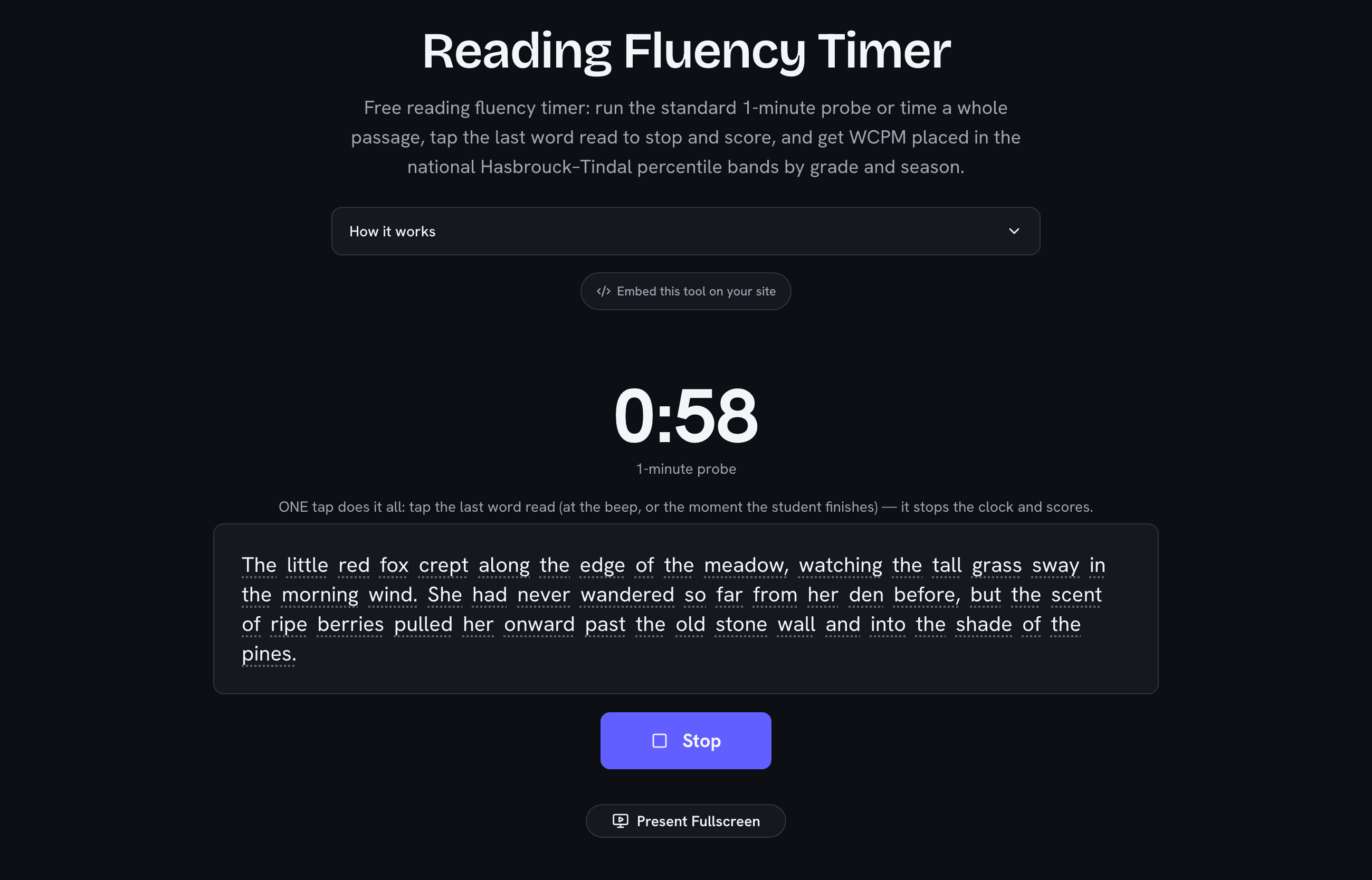
A student who reads accurately but slowly spends their whole working memory on the words and has nothing left for the meaning. That is why schools track words correct per minute: it is the single best quick indicator that decoding has become automatic. The standard measure is the one-minute probe — read aloud for exactly sixty seconds, subtract the errors, done. This timer runs the probe (with a beep at the minute), does the arithmetic, and places the score in the national percentile bands for the grade and season so you see at a glance whether practice is paying off.
The Complete National Norms (Hasbrouck–Tindal 2017)
Oral reading fluency norms — WCPM by grade, percentile, and season
| Grade | %ile | Fall | Winter | Spring | Wk. growth |
|---|
| Grade 1 | 90th | — | 97 | 116 | 1.2 |
| 75th | — | 59 | 91 | 2 |
| 50th | — | 29 | 60 | 1.9 |
| 25th | — | 16 | 34 | 1.1 |
| 10th | — | 9 | 18 | 0.5 |
| Grade 2 | 90th | 111 | 131 | 148 | 1.2 |
| 75th | 84 | 109 | 124 | 1.3 |
| 50th | 50 | 84 | 100 | 1.6 |
| 25th | 36 | 59 | 72 | 1.1 |
| 10th | 23 | 35 | 43 | 0.6 |
| Grade 3 | 90th | 134 | 161 | 166 | 1 |
| 75th | 104 | 137 | 139 | 1.1 |
| 50th | 83 | 97 | 112 | 0.9 |
| 25th | 59 | 79 | 91 | 1 |
| 10th | 40 | 62 | 63 | 0.7 |
| Grade 4 | 90th | 153 | 168 | 184 | 1 |
| 75th | 125 | 143 | 160 | 1.1 |
| 50th | 94 | 120 | 133 | 1.2 |
| 25th | 75 | 95 | 105 | 0.9 |
| 10th | 60 | 71 | 83 | 0.7 |
| Grade 5 | 90th | 179 | 183 | 195 | 0.5 |
| 75th | 153 | 160 | 169 | 0.5 |
| 50th | 121 | 133 | 146 | 0.8 |
| 25th | 87 | 109 | 119 | 1 |
| 10th | 64 | 84 | 102 | 1.9 |
| Grade 6 | 90th | 185 | 195 | 204 | 0.6 |
| 75th | 159 | 166 | 173 | 0.4 |
| 50th | 132 | 145 | 146 | 0.3 |
| 25th | 112 | 116 | 122 | 0.3 |
| 10th | 89 | 91 | 91 | 0.1 |
Hasbrouck, J. & Tindal, G. (2017), An Update to Compiled ORF Norms, Technical Report #1702, Behavioral Research and Teaching, University of Oregon (ERIC: ED594994). Grade 1 has no fall norms by design. The in-app comparison uses this exact table. Orientation, not diagnosis — always interpret alongside accuracy and comprehension.
Running Repeated Readings That Work
The highest-yield fluency intervention is embarrassingly simple: the same passage, read three or four times across a week, with the WCPM recorded each time. Students race their own Tuesday score, not each other. Keep accuracy above 95% — if it drops lower, the passage is too hard and speed practice just rehearses errors. Time the reads here, log the scores anywhere, and pair it with the spelling test practice tool for the word-work half of the routine.