lans.cloud Tools

Play the Sprouts Game Online — 2 Player

Play the sprouts game online — Conway’s pencil-and-paper classic for 2 players on one screen. Draw real curves, the rules check themselves. Free, no sign-up.

Set up your Sprouts game

A game with n dots lasts at most 3n−1 lines — 3 dots is the classic coffee-break game, 6 dots is a real battle.

Normally, whoever draws the last possible line wins. Misère flips it: force your opponent to run out of moves first.

Back up or move it to another device.

Was this tool helpful?
Support this site

The Pencil-and-Paper Classic, Drawn for Real

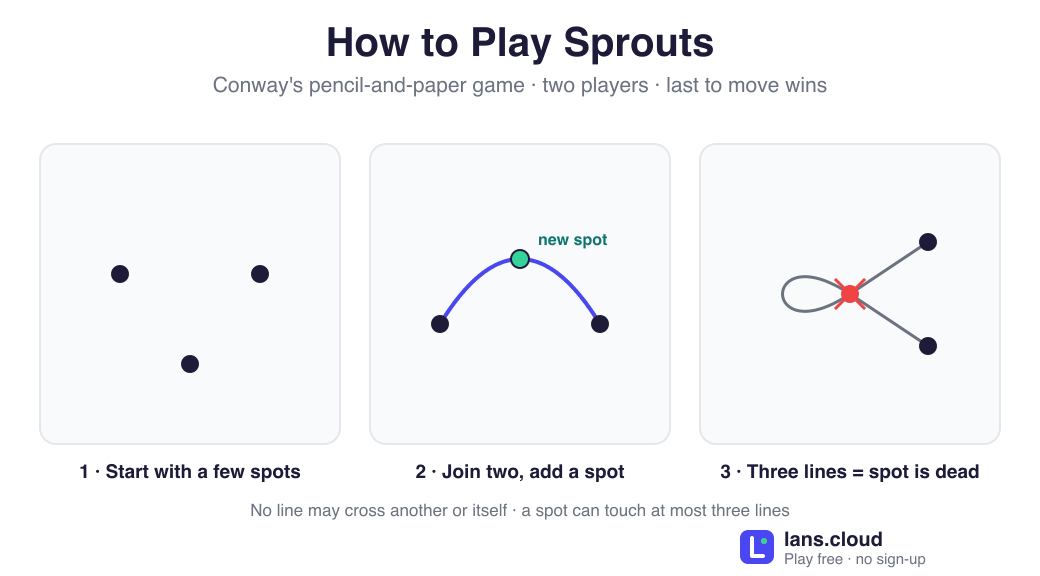
Sprouts is the rare game whose rules fit on a napkin but whose analysis fills research papers. Start with a few dots. Each turn, draw a curve from one dot to another — or from a dot back to itself — and place a new dot on the curve you just drew. Curves may never cross, and no dot may have more than three curve-ends touching it. When a player has no legal line left to draw, the game is over: under normal rules the player who drew the last line wins, and under misère rules that player loses. This page plays it the way it was meant to be played — you actually draw the curves, with a finger, stylus, or mouse — while the rules enforce themselves: crossings are rejected, each dot’s remaining lives are shown as pips, and the game announces the winner the moment no legal move remains anywhere on the board.

Invented at Cambridge, Analyzed Ever Since

Sprouts was invented in 1967 at the University of Cambridge by John Horton Conway — of Game of Life fame — and Michael S. Paterson, and it spread through mathematics departments long before it reached puzzle books, helped by Martin Gardner’s Scientific American column. The charm is that a doodling game turns out to be pure topology: because lines can’t cross, every move carves the paper into regions, and dots stranded in different regions can never be connected again. Playing well means thinking about walls, not just dots.

Why a Game Can’t Outlive Its Lives: the 3n−1 Theorem

Give every dot three lives — one for each line it can still accept. A game with n dots starts with 3n lives. Every move spends two lives (one at each end of the new curve, or two on the same dot for a loop) and creates one new dot that arrives with two of its three lives already used. Net effect: every single move burns exactly one life from the board. The game must stop before the lives hit zero, so no game with n dots can last longer than 3n−1 moves — and a matching argument about the dots that survive shows it can’t end before 2n moves either. The “lines drawn” counter under the board is this theorem made visible: a 3-dot game promises you between 6 and 8 lines, every time. The table below is computed from the same counting functions the game itself runs on.

Who Wins, and Why It Took a Computer to Find Out

Sprouts is deceptively hard to analyze — the number of possible positions explodes with every curve. In 1991, David Applegate, Guy Jacobson and Daniel Sleator brute-forced the game at Bell Labs and found the pattern: with perfect play, the first player wins exactly when the starting dots leave a remainder of 3, 4, or 5 when divided by 6. Julien Lemoine and Simon Viennot later verified the pattern holds for dozens more starting sizes, and no exception has ever been found. If you enjoy games where the winning strategy is genuinely knowable, our Nim game plays the same role with an unbeatable computer opponent — while Hex sits at the opposite extreme: proven to favour the first player, yet nobody knows how.

How to Actually Win at Sprouts

Beginners watch dots; winners watch regions. Every curve you draw splits the paper, and a dot with lives left is only useful to whoever can still reach it. The classic technique is to wall off a private corner: enclose a live dot so only moves inside that pocket remain, then count whether the moves left in each region add up in your favour — sprouts is ultimately a parity battle over who runs out of moves first. Loops are your walls; spend them deliberately. And mind the endgame: a dot with one life can still loop onto itself, which beginners forget and experts bank as a spare move. For a gentler introduction to move-counting instincts, the four in a row game trains the same look-ahead muscle, and the rest of the browser games collection has something for every recess.
The sprouts counting theorems, by starting dots

Starting dotsStarting livesShortest possible gameLongest possible gamePerfect-play winner (normal rules)
2 dots64 lines5 linesSecond player
3 dots96 lines8 linesFirst player
4 dots128 lines11 linesFirst player
5 dots1510 lines14 linesFirst player
6 dots1812 lines17 linesSecond player

Lives = 3n; game length is bounded by 2n and 3n−1 moves — computed from the same lives arithmetic the game engine enforces. The winner column is the computer-proven Applegate–Jacobson–Sleator result (first player wins iff n mod 6 is 3, 4, or 5).

Frequently Asked Questions

How do you play the game of sprouts?

Start with a few dots. On your turn, draw a line from one dot to another (or from a dot back to itself), then a new dot is placed on the line you just drew. Two rules limit everything: lines may never cross — not each other and not themselves — and no dot may ever have more than three lines touching it. A loop counts as two lines on its dot, and each new dot is born with two lines already through it. In the normal game, whoever draws the last possible line wins; on this page every rule is checked automatically as you draw.

How many moves can a sprouts game last?

A game starting with n dots lasts at most 3n−1 moves and at least 2n moves — one of the neatest counting theorems in recreational math. Think of every dot as having three “lives” (one per line it can still take). The game starts with 3n lives, every move uses up two but creates a new dot with one life left, so each move costs exactly one life overall — and the game must end before the lives run out. A 3-dot game therefore never lasts longer than 8 lines, and the move counter on this page shows the theorem happening live.

Who wins sprouts with perfect play?

For the normal rules (last line wins), computer analysis by Applegate, Jacobson and Sleator showed the first player can force a win exactly when the number of starting dots leaves a remainder of 3, 4, or 5 after dividing by 6 — so the first player wins the 3-, 4- and 5-dot games, and the second player wins with 2 or 6 dots. Later computations by Lemoine and Viennot pushed the analysis much further and every known result fits the same pattern. Misère sprouts (last line loses) follows no such clean rule.

Can lines cross in sprouts?

No — that is the heart of the game. A new line may not cross any existing line, may not cross itself, and may not pass through a dot. That single restriction is what makes sprouts a game of territory: every line you draw walls off part of the paper, and dots trapped in different regions can never be joined again. This page rejects illegal lines the moment you finish drawing them and tells you which rule was broken.

What is the Brussels sprouts game?

Brussels sprouts is Conway’s joke variant: you start with crosses instead of dots, join free arms with a line, and add a crossbar on each new line. It looks like a deeper game, but it is completely predetermined — a game with n crosses always lasts exactly 5n−2 moves no matter what anyone does, so the winner is fixed before the first move. Under normal rules, start with an odd number of crosses and the first player always wins. It makes a great classroom reveal after real sprouts.