lans.cloud Tools

Yarn Substitution Calculator

Free yarn substitution calculator: verify any substitute yarn — by weight class, gauge, or wraps per inch — with a traffic-light verdict, hook and needle sizes, and the exact yards and skeins to buy.

Quick answer

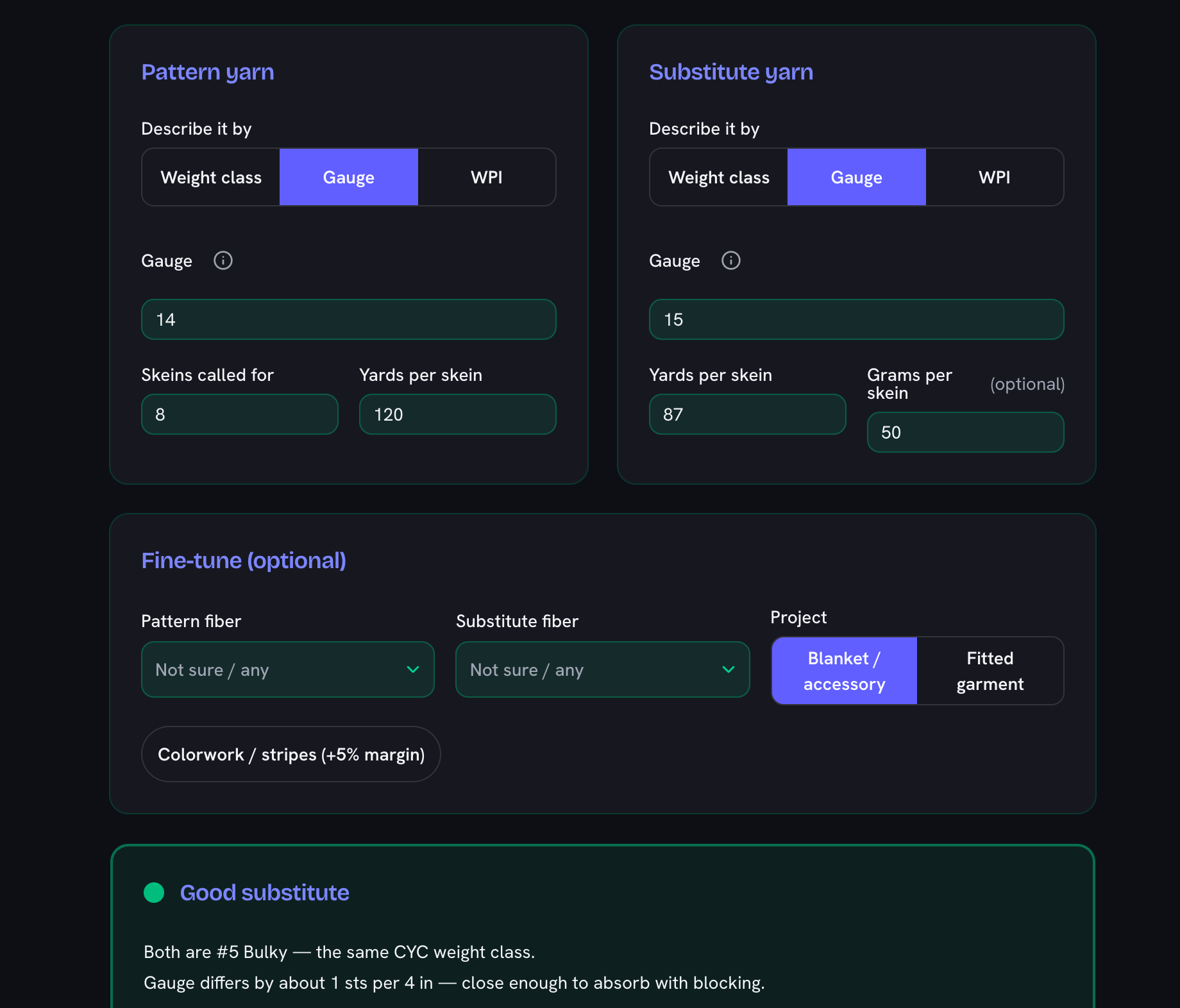
To substitute yarn safely, match the weight class (or gauge within ±1 stitch per 4 inches), then buy by total yardage, never skein count— pattern skeins × yards per skein, plus a 10–15% margin. Enter both yarns by weight class, measured gauge, or wraps per inch and this calculator returns a traffic-light verdict, the hook and needle range, and the exact skeins to buy.
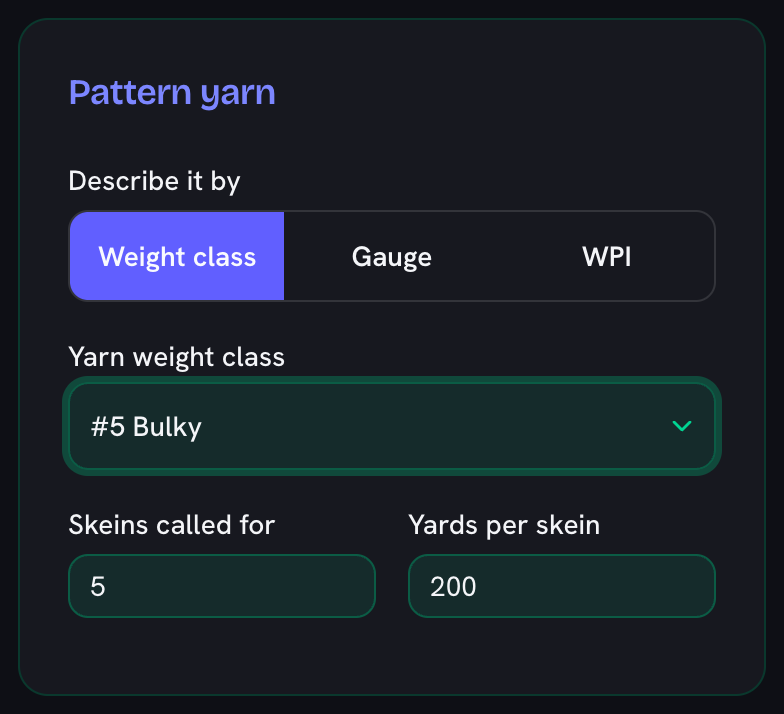
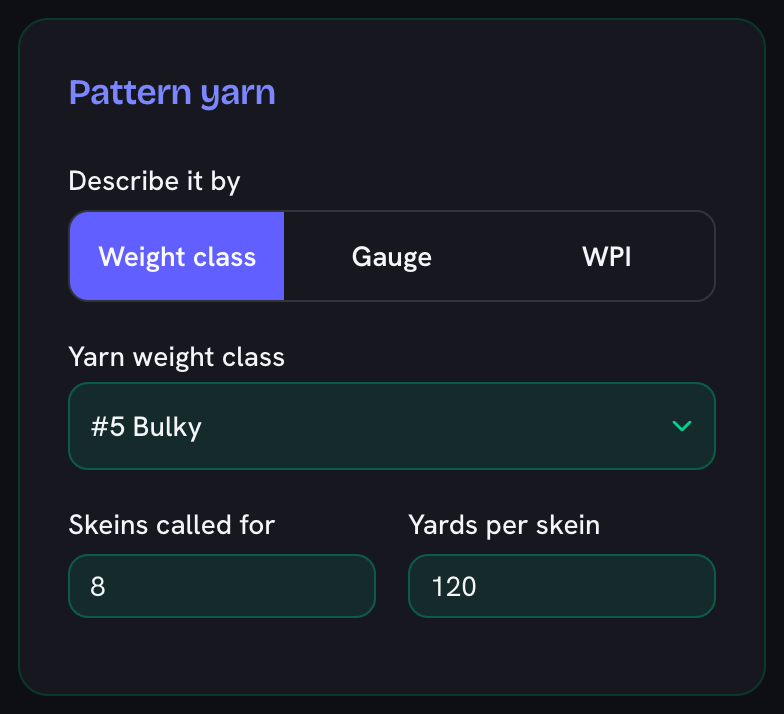
Pattern yarn
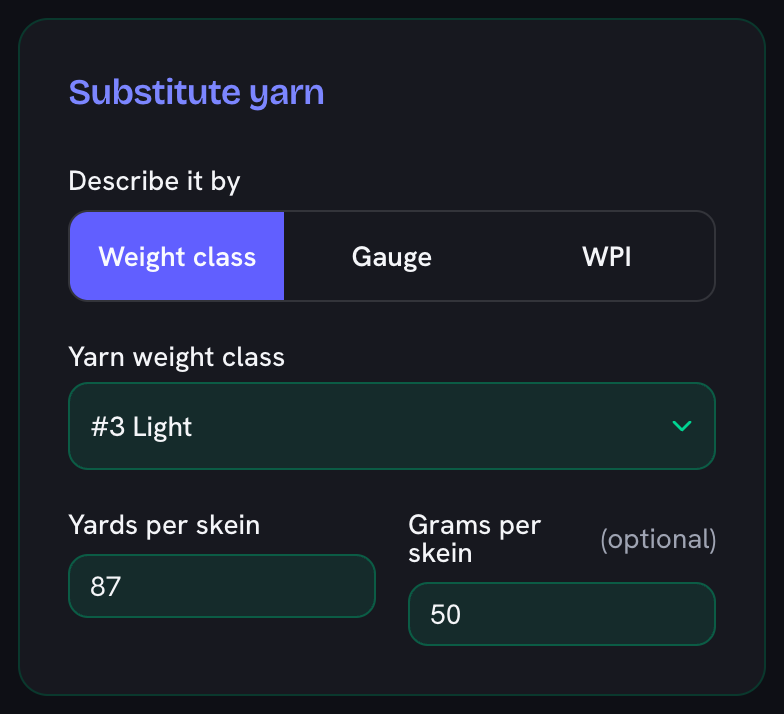
Substitute yarn
Fine-tune (optional)
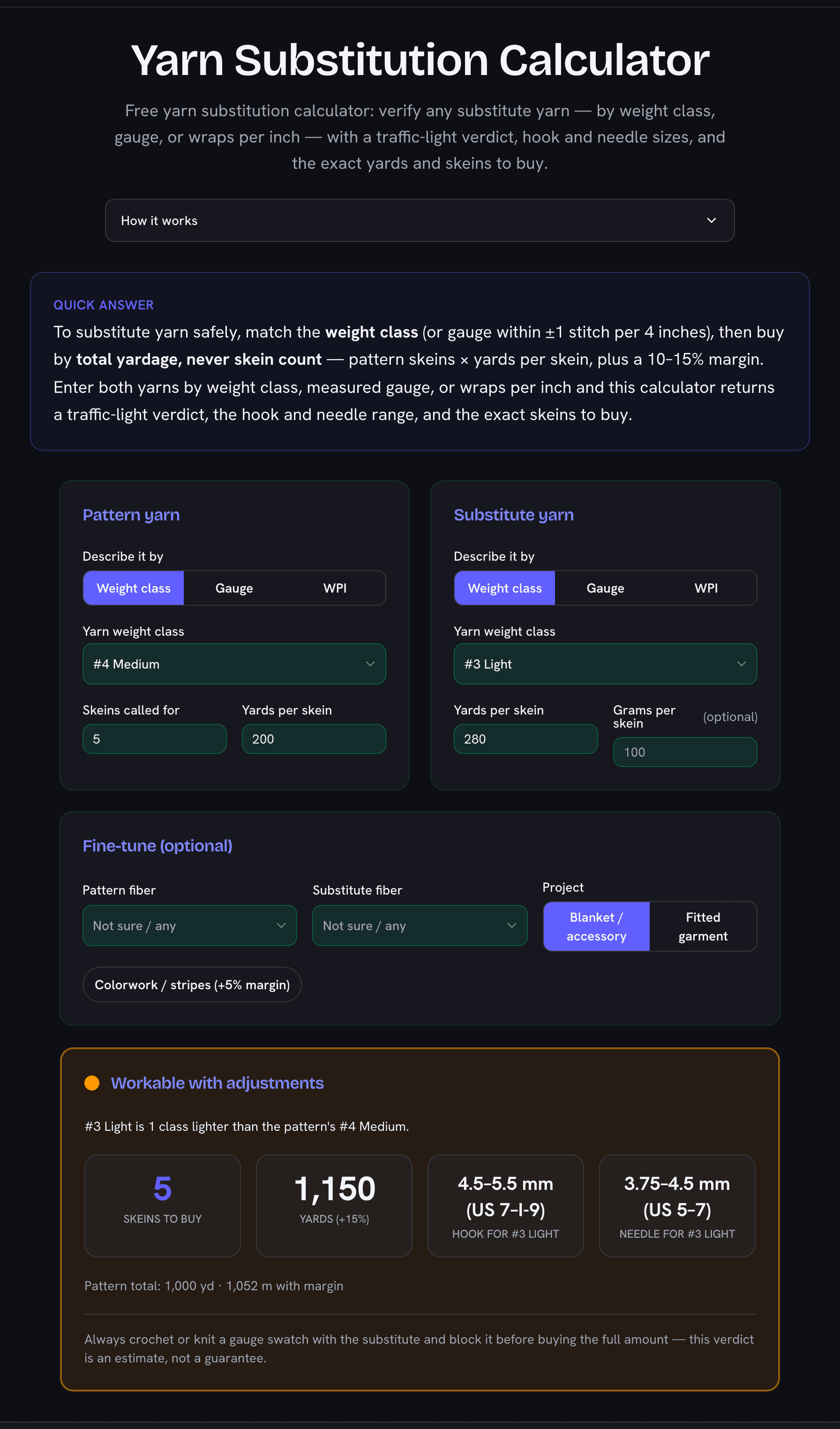
Workable with adjustments
  • #3 Light is 1 class lighter than the pattern's #4 Medium.
5
skeins to buy
1,150
yards (+15%)
4.5–5.5 mm (US 7–I-9)
hook for #3 Light
3.75–4.5 mm (US 5–7)
needle for #3 Light

Pattern total: 1,000 yd · 1,052 m with margin

Always crochet or knit a gauge swatch with the substitute and block it before buying the full amount — this verdict is an estimate, not a guarantee.

Was this tool helpful?
Support this site

Brand Databases Find Yarns — This Calculator Verifies Them

Substitution databases match one branded yarn to another from a catalog. That works until your yarn has no catalog entry: handspun, indie-dyed, discontinued, or the unlabeled ball at the bottom of the stash. This tool checks the swap itself — any yarn against any pattern — using the Craft Yarn Council standard that every label already follows. Describe both yarns by weight class, a measured gauge swatch, or wraps per inch, and the verdict tells you whether the fabric will behave. Already know the yarn and just need quantities for a blanket? The crochet yarn calculator prices a project from scratch.

CYC yarn weight classes — gauge, hooks, needles, WPI

Weight classKnit sts/4″Crochet sc/4″NeedleHookWPI~yd/100g
#0 Lace (Cobweb, thread, 2-ply)33–4032–421.5–2.25 mm (US 000–1)1.6–2.25 mm (US steel 6–B-1)19–35600–1000
#1 Super fine (Sock, fingering, baby, 4-ply)27–3221–322.25–3.25 mm (US 1–3)2.25–3.5 mm (US B-1–E-4)14–18350–450
#2 Fine (Sport, baby)23–2616–203.25–3.75 mm (US 3–5)3.5–4.5 mm (US E-4–7)12–14300–350
#3 Light (DK, light worsted)21–2412–173.75–4.5 mm (US 5–7)4.5–5.5 mm (US 7–I-9)11–12230–290
#4 Medium (Worsted, afghan, aran)16–2011–144.5–5.5 mm (US 7–9)5.5–6.5 mm (US I-9–K-10.5)9–11190–220
#5 Bulky (Chunky, craft, rug)12–158–115.5–8 mm (US 9–11)6.5–9 mm (US K-10.5–M-13)7–9100–140
#6 Super bulky (Super chunky, roving)7–116–98–12.75 mm (US 11–17)9–15 mm (US M-13–Q)5–660–90
#7 Jumbo (Jumbo, arm-knitting roving)1–61–512.75–25 mm (US 17+)15–25 mm (US Q+)1–430–50

The calculator's own canon table — Craft Yarn Council standard classes with community-standard WPI and yardage ranges. Real labels vary ±10%.

Substitute by Yardage, Never by Skein Count

The most expensive substitution mistake is buying the pattern “8 skeins” in a different yarn. Skeins are not a unit: a pattern calling for 8 skeins of a 200-yard worsted needs 1,600 yards of fabric. Substitute a 280-yard DK skein and the buy list becomes 7 skeins (15% margin included) — not 8. The calculator always converts through total yardage, and if you enter grams per skein it prices the buy in grams too. Planning a whole blanket instead? The granny square blanket calculator works out squares and yardage from bed sizes.

No Label? Count Wraps Per Inch

Wrap the mystery yarn snugly around a ruler — strands touching, not squashed — for exactly one inch and count the wraps. Nine to eleven wraps is a worsted; fourteen to eighteen a fingering. The WPI mode maps the count to a weight class using the table above, which is precisely what a brand database cannot do for a yarn that is not in its catalog. It is a ±1–2 wrap art, so treat the class as a starting point and let a gauge swatch settle it.

Fiber Changes the Fabric

Two yarns at identical gauge can behave completely differently. Wool stretches and recovers — patterns silently assume it. Cotton has no memory: ribbing relaxes and fabric grows. Acrylic refuses blocking, so what comes off the hook is final. Silk, bamboo, and alpaca drape heavily and lengthen fitted pieces. The fine-tune panel folds these behaviors into the verdict, and warns hardest when you are substituting into a fitted garment. Choosing colors as well as fibers? The granny square pattern generator previews whole-blanket combinations before you buy. Whatever the verdict says: crochet a swatch, block it, and measure — ten minutes of swatching beats re-buying a project.
Frequently Asked Questions

Is there a website that tells you what yarn to substitute?

Brand databases like YarnSub suggest named alternatives for a specific branded yarn. This calculator does the other half of the job: it verifies whether ANY yarn — including handspun, indie-dyed, or a stash ball with no label — is a safe swap, by comparing weight class, gauge, or wraps per inch and computing the exact yardage to buy.

How do I substitute yarn by yardage instead of skeins?

Multiply the pattern's skein count by its yards per skein for the total, then divide by your substitute's yards per skein and round up. Example: 8 skeins × 200 yd = 1,600 yd; with the 15% safety margin that is 1,840 yd, so a 280 yd substitute needs 7 skeins — not 8.

Can I substitute DK for worsted?

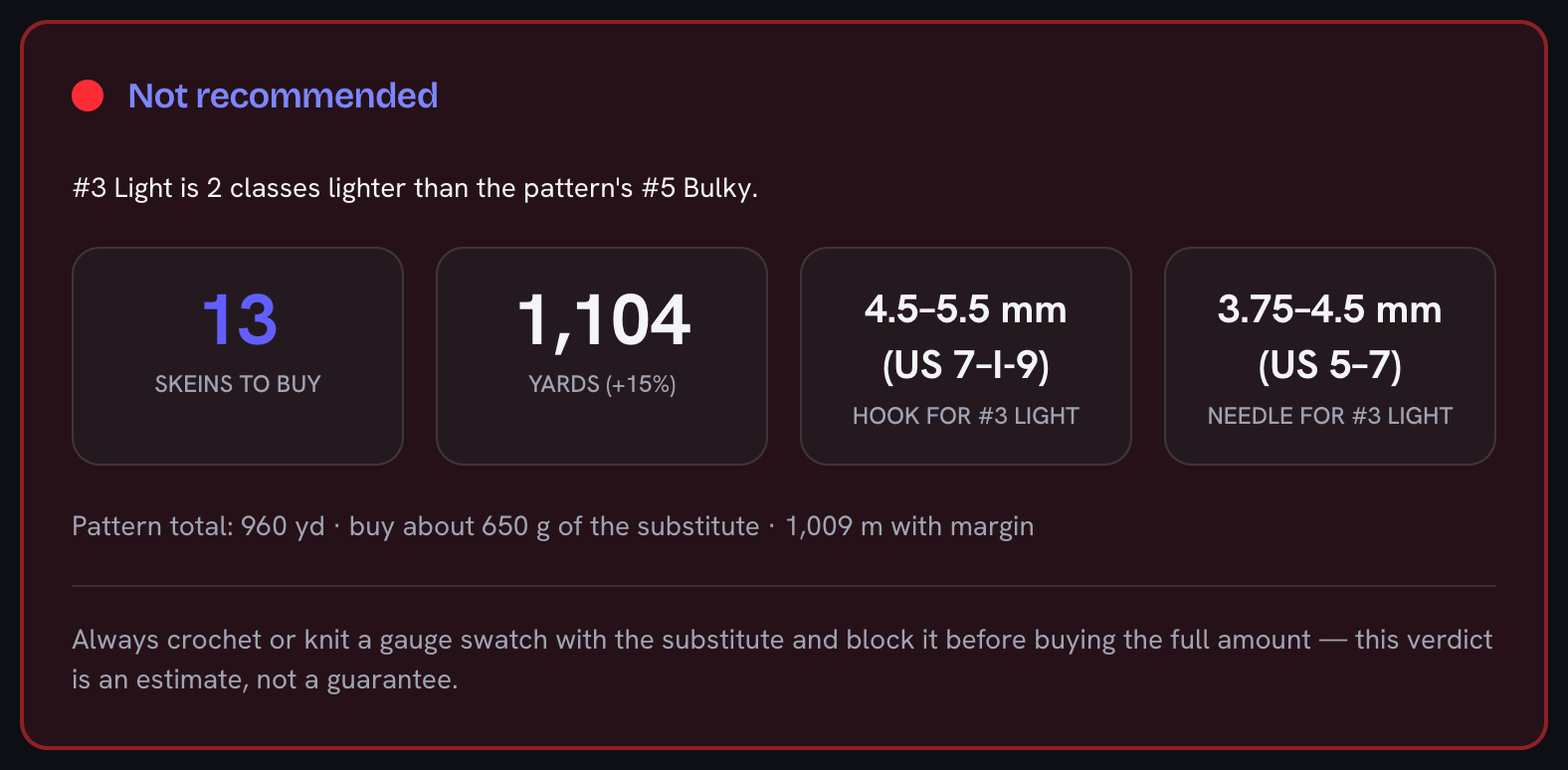
Usually, with adjustments — they are adjacent CYC classes (#3 and #4), so the calculator rates the swap yellow: expect to go up a hook or needle size to hit gauge, buy about 15% extra yardage, and swatch before committing. Two classes apart (say DK for bulky) turns red.

What weight is my yarn if it has no label?

Use wraps per inch: wrap the yarn snugly around a ruler for one inch, count the wraps, and read the class off the chart — 9–11 wraps is worsted, 12–14 sport, 14–18 fingering. The calculator has a WPI mode that does the mapping for you; it is the one method that works for handspun and mystery stash yarn.

How much extra yarn should I buy when substituting?

Add 10% to the pattern total as a baseline, or 15% when you change weight class or work colorwork — then round up to whole skeins while the dye lot still matches. The calculator applies the right margin automatically.

Does fiber matter when substituting yarn?

Yes — elasticity and drape change the fabric even at identical gauge. Wool is springy and blocks to shape; cotton has no memory and grows; acrylic cannot be reshaped by blocking; silk and bamboo drape like liquid; alpaca droops under its own weight. Blends are the safest all-round substitutes, and fiber matters far more for fitted garments than blankets.

Yarn substitution calculator comparing a worsted pattern yarn with a DK substitute, showing a yellow verdict and skeins to buy
Two yarns in — traffic-light verdict, hook and needle range, and skeins to buy out.