lans.cloud

Addition Timed Test

Free addition timed test online with a subtraction mode: pick fact families 1–12, race the clock or the 1-minute sprint, get instant grading and a drill round built from every missed fact. No sign-up.

Was this tool helpful?
Support this site

The Timed Test, Minus the Worksheet Pile

Addition fact fluency is built the same way everywhere: a page of problems, a timer, a score. This is that — online, auto-graded, and endless. Pick the fact families you're working on (adding with 2s this week? just the 2s), choose practice, a classic timed test, or the one-minute sprint, and type. Every run ends with the two numbers that matter: your score and your correct-facts-per-minute rate.

The part paper can't do: the drill loop. Missed facts aren't just marked wrong — they become the next round. Miss 8 + 5 and 7 + 6, and one tap builds a short drill of exactly those families until they're automatic. That feedback loop is why five minutes here beats a stack of photocopies.

Doubles First — the Chart Worth Memorizing

Ask any first-grade teacher: the addition table isn't memorized fact by fact, it's built from anchor strategies, and the strongest anchor is the doubles. Once 6 + 6 is automatic, 6 + 7 is “one more.” The chart below is generated by the same engine that builds your test problems.
Doubles and doubles-plus-one addition facts

Double=Near double=
1 + 121 + 23
2 + 242 + 35
3 + 363 + 47
4 + 484 + 59
5 + 5105 + 611
6 + 6126 + 713
7 + 7147 + 815
8 + 8168 + 917
9 + 9189 + 1019
10 + 102010 + 1121
11 + 112211 + 1223
12 + 122412 + 1325

Learn the doubles column until it's instant, then derive the near-doubles — most of the addition table follows.

Subtraction Rides Along

Subtraction facts are the same families in reverse — 13 − 6 lives in the 6-family with 6 + 7. The − mode builds problems as inverse facts, so answers stay whole and non-negative, exactly the form schools drill. Working on multiplication instead? The multiplication timed test is this tool's big sibling with × and ÷, and the test grade calculator turns any paper score into a percentage. For younger fluency work, the reading fluency timer measures words per minute the same way this measures facts.

Frequently Asked Questions

Is there a free addition timed test I can take online?

Yes — this one runs entirely in your browser: choose which numbers to practice adding (1 through 12), pick 10 to 100 problems or the one-minute sprint, and type answers against the clock. It grades instantly, shows exactly which facts were missed, and builds a drill round from just those facts. No account, no printing, no ads inside the test.

Does it include subtraction?

Yes — switch to − and the test builds subtraction problems as inverse facts of the same families (12 − 5 belongs to the 5-family, just like 5 + 7), so answers are always non-negative whole numbers. Practicing a fact family in both directions is how the facts actually stick.

How many addition problems should a first grader do in a minute?

Common fluency benchmarks land around 15–25 correct facts per minute for first grade, rising toward 30+ by the end of second grade — but schools set their own targets. The sprint mode reports correct answers per minute after every run, so you can measure against whatever benchmark your school uses and watch the number climb week to week.

What are doubles and doubles-plus-one facts?

The backbone strategy for learning addition: children memorize the doubles first (4 + 4 = 8) and then derive the neighbors from them (4 + 5 is one more than 4 + 4, so 9). The reference chart on this page lists every double and near-double through 12 — practice the doubles families here until they’re automatic and most of the addition table follows.

What is the difference between practice and test mode?

Practice mode corrects you immediately — a wrong answer shows the right one before moving on, which is how new facts should be learned. Timed test mode saves the grading for the end, like the paper version handed out on Friday. The one-minute sprint is the fluency measure: as many facts as you can, correct answers per minute reported.

Does this replace printable addition timed tests?

For practice, it does more than paper: it grades itself, it never runs out of problems, and it turns every missed fact into a targeted drill round instead of a red mark. If your school still sends home printable versions, this is the practice loop that makes those go well.

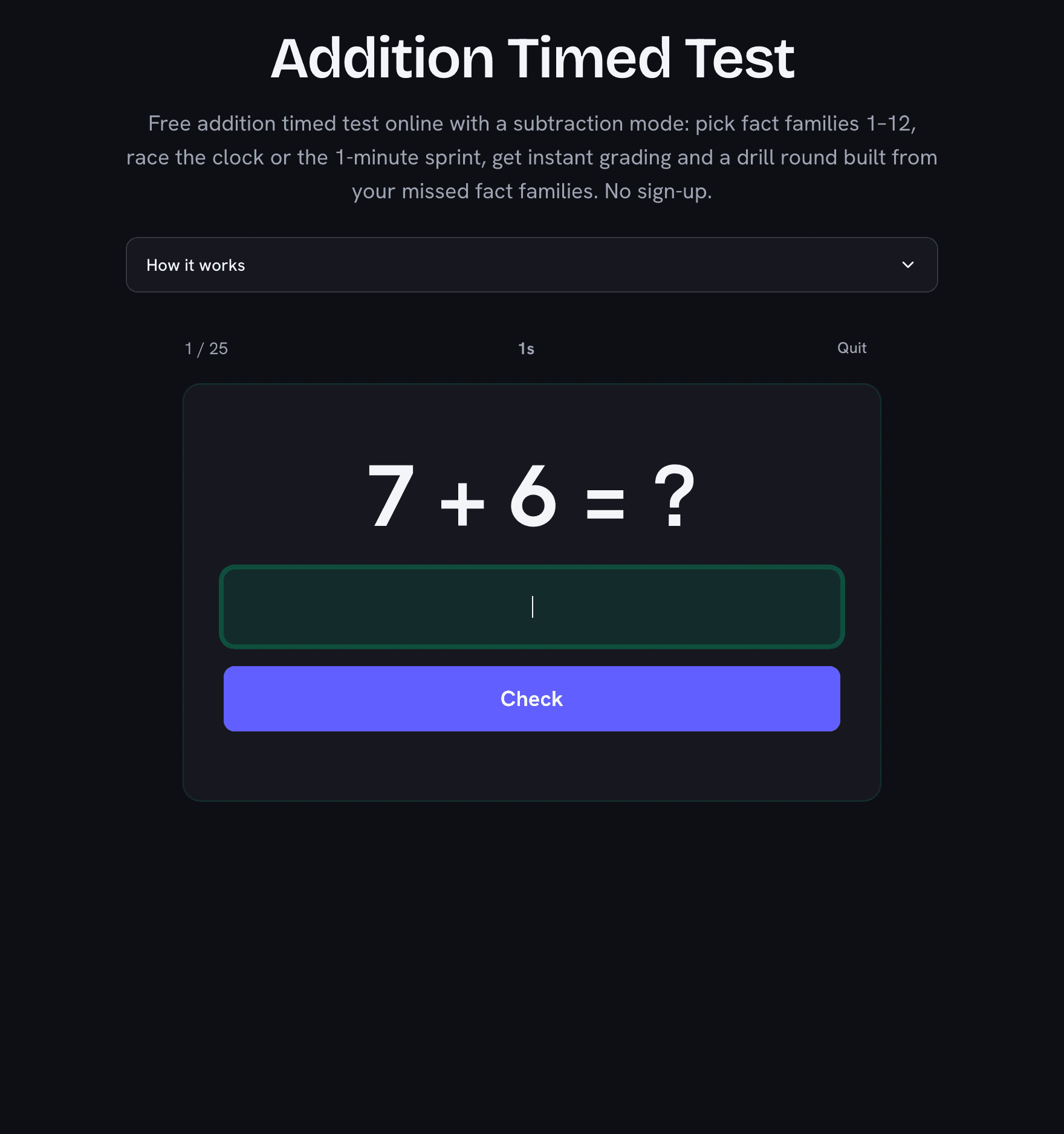
Addition timed test mid-quiz: the problem 1 + 6 in large type with the answer box and Check button
One fact at a time, keyboard-first — Enter checks, the clock runs, and missed facts come back as a drill.