lans.cloud

Multiplication Timed Test

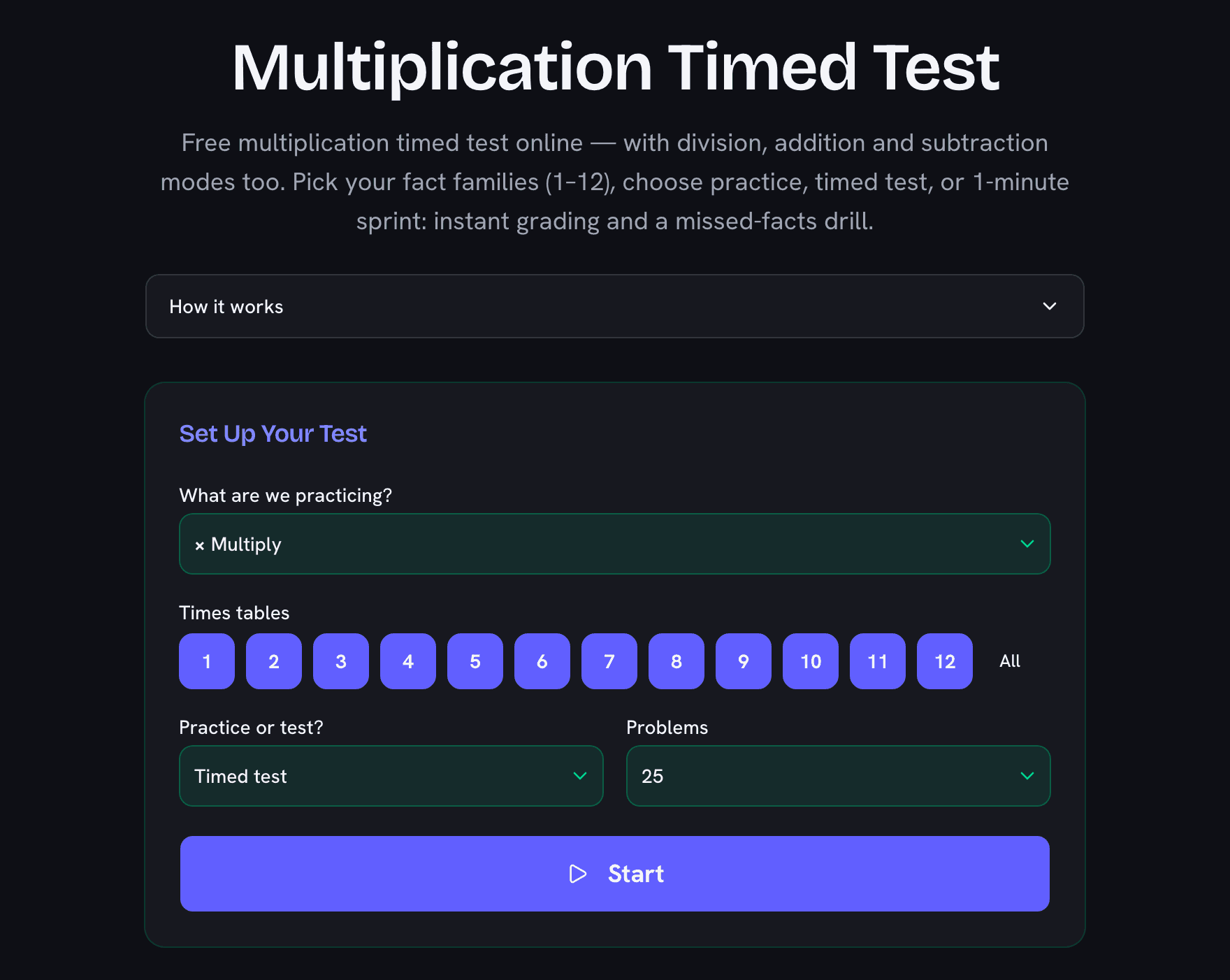
Free multiplication timed test online: pick your times tables (1–12), choose practice, timed test, or 1-minute sprint — instant grading, a drill built from your missed facts, no printing.

Set Up Your Test

Fluency Is Speed Plus Accuracy

Knowing 7 × 8 and knowing it instantlyare different skills — and the instant kind is what frees working memory for long division, fractions, and algebra later. Timed tests measure exactly that. This one keeps the classic format teachers use (mixed facts, running clock) but adds what paper can't: the moment you finish, it knows which facts cost you, and one click builds a drill from precisely those. Three or four short rounds beat one long grind — end on the missed-facts drill and the next full test almost always scores higher.

The Reference Grid

Times tables 1–12 at a glance

×123456789101112
1123456789101112
224681012141618202224
3369121518212427303336
44812162024283236404448
551015202530354045505560
661218243036424854606672
771421283542495663707784
881624324048566472808896
9918273645546372819099108
10102030405060708090100110120
11112233445566778899110121132
121224364860728496108120132144

Generated, not typed — the same arithmetic the test grades with.

For Parents and Teachers

The three modes map to how facts are actually learned: Practice for learning (instant correction), Timed test for the weekly check (feedback held to the end, like the real thing), and the 1-minute sprintfor fluency tracking — write the correct-per-minute number on the fridge and watch it climb. Settings persist in the browser, so Tuesday's setup is still there on Thursday. Pair it with the spelling test practice for the other half of homework, or the classroom timer for group rounds.
Frequently Asked Questions

How does the online multiplication timed test work?

Pick which times tables to include (1–12, any combination), choose 10 to 100 problems, and start. Type each answer and press Enter — the timer runs while you work, and the results show your score, total time, correct-facts-per-minute, and exactly which facts you missed, with a one-click drill for just those.

What is a good time for a 100-problem multiplication test?

A common classroom target is 100 mixed facts in 5 minutes (20 per minute) with 90%+ accuracy; fluent students often finish in 2–3 minutes. The correct-per-minute number in your results makes progress comparable across different test lengths.

How is this better than printable timed tests?

No printing, instant grading, and — the part paper can’t do — an automatic drill built from exactly the facts you missed. Practice mode shows the correct answer immediately after a mistake, which is where the actual memorization happens.

Which times tables should my child practice?

Typical progression: 2, 5, and 10 first, then 3, 4, and 6, then the hard middle (7, 8, 9), with 11 and 12 last. The table picker lets you drill exactly one table or any mix — most missed facts cluster around 6×7, 7×8, and 8×12.

What is the 1-minute sprint mode?

Answer as many facts as you can in 60 seconds — the fluency-probe format many schools use. The score to beat is your own last run; correct-per-minute is the headline number.

Was this tool helpful?