lans.cloud Tools

Practice Your Locker Combination Online

Practice your locker combination online on a virtual Master-style dial: guided steps that explain every mistake, a no-hints test mode, and a timed challenge. Your combo is saved only on your device — no app, works on school Chromebooks.

Quick answer

Right – left – right. Turn the dial right (clockwise) at least two full turns and stop on your first number; turn left one whole turn, passing your first number once, and stop on your second number; then turn right straight to your third number and pull the shackle. You can rehearse exactly that sequence on the virtual lock above with your real combination — it stays on your device.
Was this tool helpful?
Support this site

More tools

The Second Number Is Where Everyone Gets Stuck

A combination padlock is three stacked wheels, and the right–left–right ritual exists to set them one at a time. The opening turns to the right drag all three wheels around together — that is why you need at least 2 full turns before your first number, and why a lock that “doesn’t work” usually just wasn’t cleared. The famous trap comes next: turning left, your second number glides past the marker and instinct says stop. Not yet. You have to sail past your first number one full time and catch the second number on its second appearance. Stop early and the middle wheel isn’t set; the lock stays shut and nobody can tell you why. The guided mode here calls that moment out as it happens (“not this time — keep going around”), which is the correction a hallway full of first-day sixth graders never gets.

The Same Three Steps, Counted Out

How a 40-number combination lock opens

StepTurnHow farStop on
Step 1Right (clockwise)At least 2 full turns to clear the lock, then keep goingYour FIRST number
Step 2Left (counter-clockwise)One whole turn — pass your first number once — then keep goingYour SECOND number
Step 3Right (clockwise)Straight there — do NOT pass itYour THIRD number, then pull

The rules the virtual dial enforces — the same ones printed on the card that came with the lock.

Worked example: combination 15–32–7, dial starting at 0

StepTurnTravelStop on
Step 1Right (clockwise)2 full turns + 25 clicks (105 clicks in total)15
Step 2Left (counter-clockwise)1 full turn + 17 clicks (57 clicks in total)32
Step 3Right (clockwise)25 clicks (25 clicks in total)7

Computed by the same code that validates the dial above, so the counts can never drift from how the lock actually behaves.

How to Practice Opening a Locker Before the First Day

Locker assignments usually arrive a few days before classes start, which means a lot of sixth graders meet a Master-style dial for the first time in a crowded hallway with four minutes between bells. Nobody wants a lecture at that point. They want the sequence to already be boring — and four short evenings is normally enough to get it there. The order matters more than the hours: learn the turns while something is checking them, then prove you remember them with nothing checking, then make it fast.

A four-evening plan to practice opening a locker

WhenModeWhat to doHow you know it worked
Four evenings outGuidedType the real combination in and dial it with every step prompted. When a mistake message appears, read it before starting over — each one names a specific thing the lock does.You can recite right–left–right without looking at the screen.
Three evenings outGuidedSame mode, but stop reading the banner ahead of time — dial first, then glance at it to check you were right.The banner tells you nothing you did not already know.
Two evenings outTestHide the combination and open it from memory, in silence. Peek if you stall, then close the lock and start the run again from the clearing turns.5 clean opens in a row — the streak counter keeps score between visits.
The night beforeTimedRun the timed challenge until the clock stops being interesting. Hallway pressure is mostly hurry, so this is the rung that matters on the first day.Under 20 seconds without pausing to think which way to turn.

The modes and both goals come from the tool itself — 5 clean opens in a row and an open under 20 seconds are the numbers it actually counts, not a rule of thumb.

What the practice record counts

The dial keeps score of that plan for you. Every open is counted, and an open extends the clean streak only if you made no mistakes and did not start over since your last successful open. Pressing “Start over” after a mistake does not wash it off. 5 in a row is the mark worth chasing, because that is roughly where the turns stop being something you think about. The practice record under the lock holds the current streak, your longest one, total opens and how many separate days you have practiced, all kept in this browser. So tomorrow evening carries on from tonight instead of starting at zero. A parent can run the same four rungs alongside without ever touching the real locker.

No App, Nothing to Install — Works on a School Chromebook

Locker-practice apps exist, and the app stores are usually the first thing a search turns up, but school devices generally can’t install them. This is a plain web page instead: it runs in the browser on a Chromebook, an iPad, or a phone, with a draggable dial where one click is one number, and keyboard turning for trackpad users. The clicks and the open are synthesized in the browser rather than played from a recording. Leave them on: counting the clicks by ear is how the sequence stops needing your eyes. Nothing is uploaded — the combination, the mistakes, the streak and your best time all live on your device. It sits alongside our other back-to-school warm-ups: the multiplication timed test and addition timed test for math facts, the spelling test practice for Friday’s list, and a classroom timer to pace the whole routine, all free and sign-up-free.
How to open a combination lock, step by step

The same sequence works on every standard 40-number school padlock — and it is exactly what the virtual lock above checks.

  1. Clear the lock

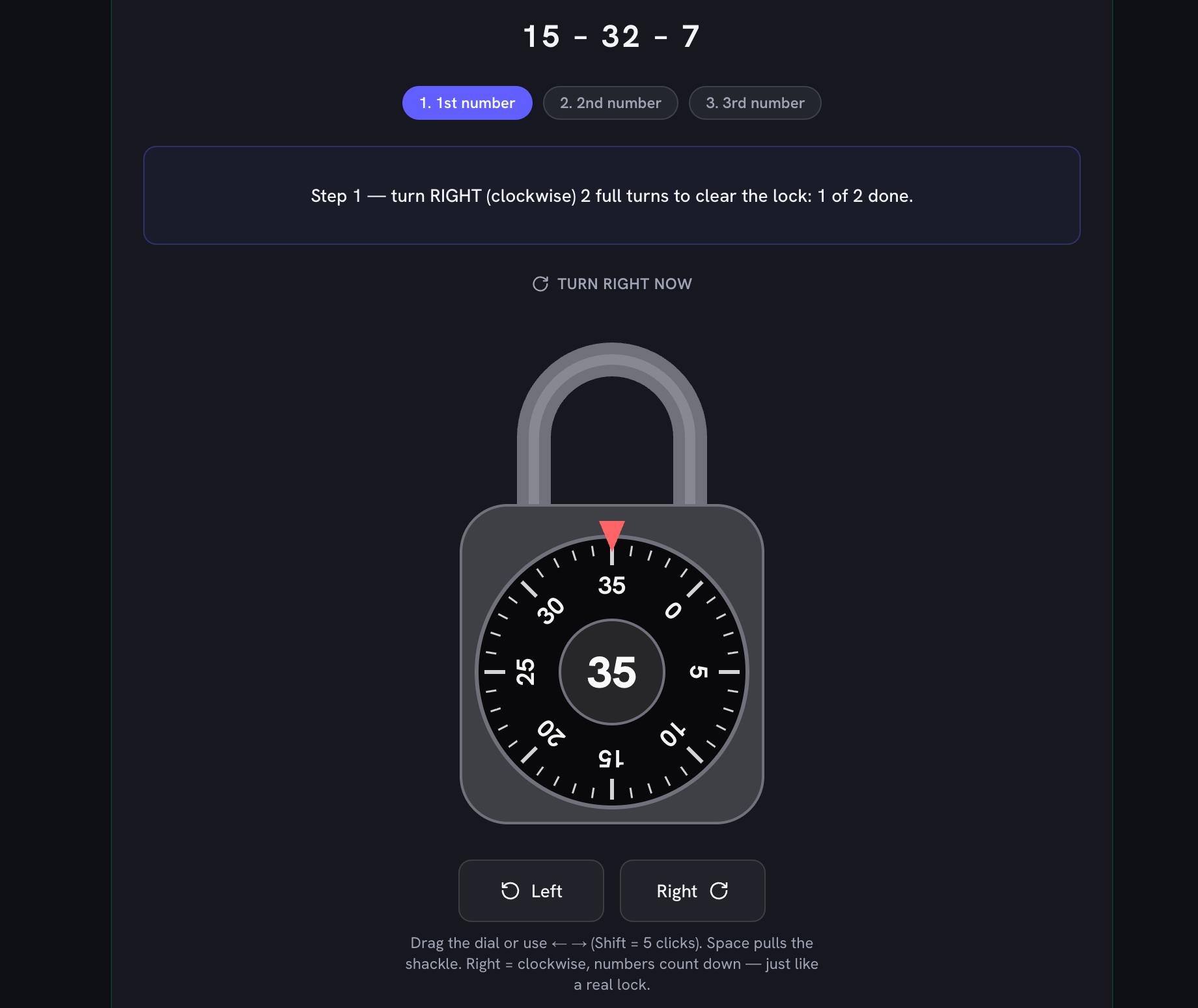
    Turn the dial right (clockwise) at least 2 full turns. This resets the wheels inside — skipping it is the number-one reason lockers refuse to open.

    The virtual padlock part-way through its clearing turns, with the guided banner counting one of two full turns done
  2. Stop on your first number

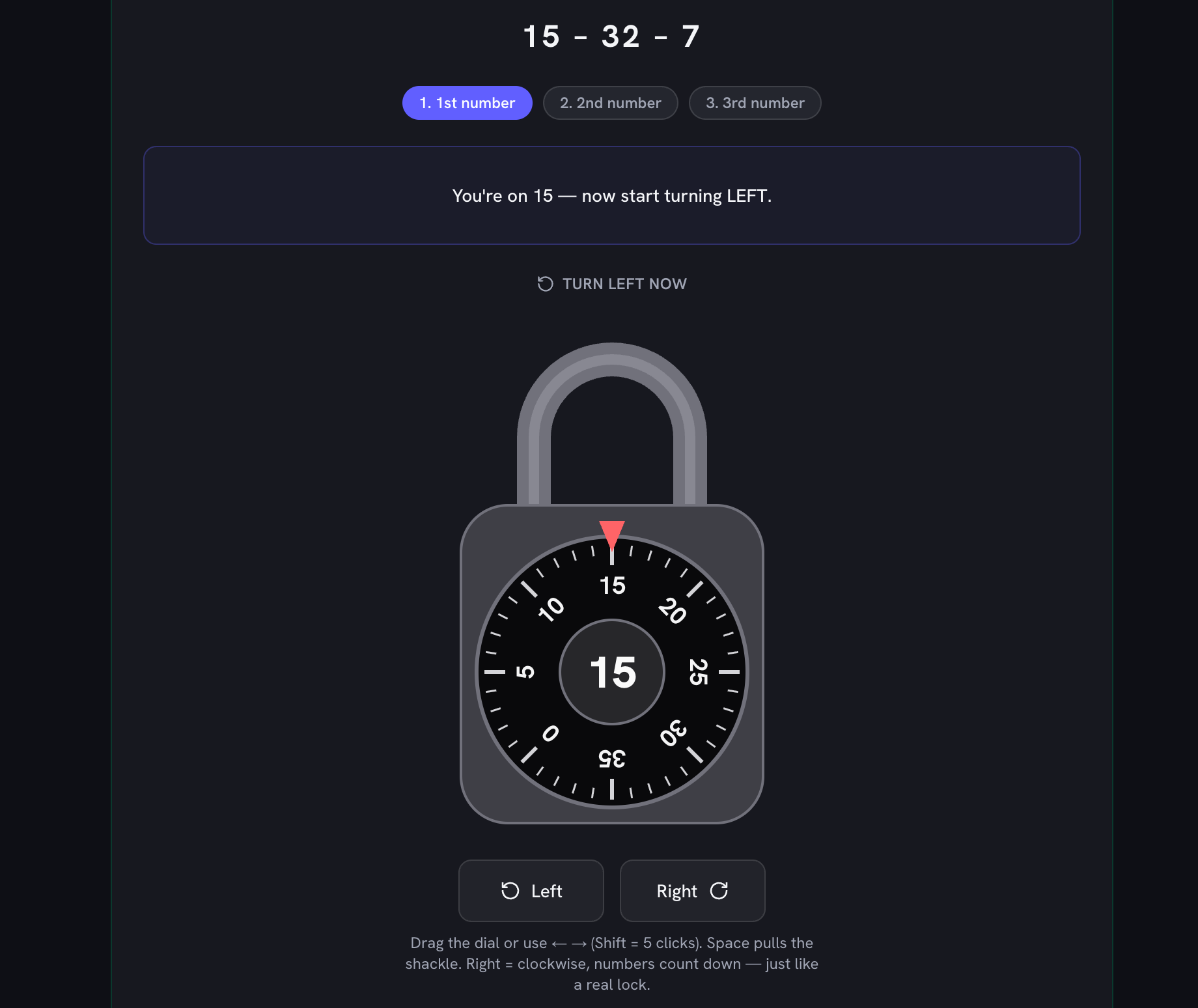
    Keep turning right and stop exactly when your first number lines up with the marker at the top.

    The dial stopped with the first number of the combination, 15, under the red marker, with the banner and the turn cue beneath it both saying to start turning left
  3. Turn left past your first number to the second

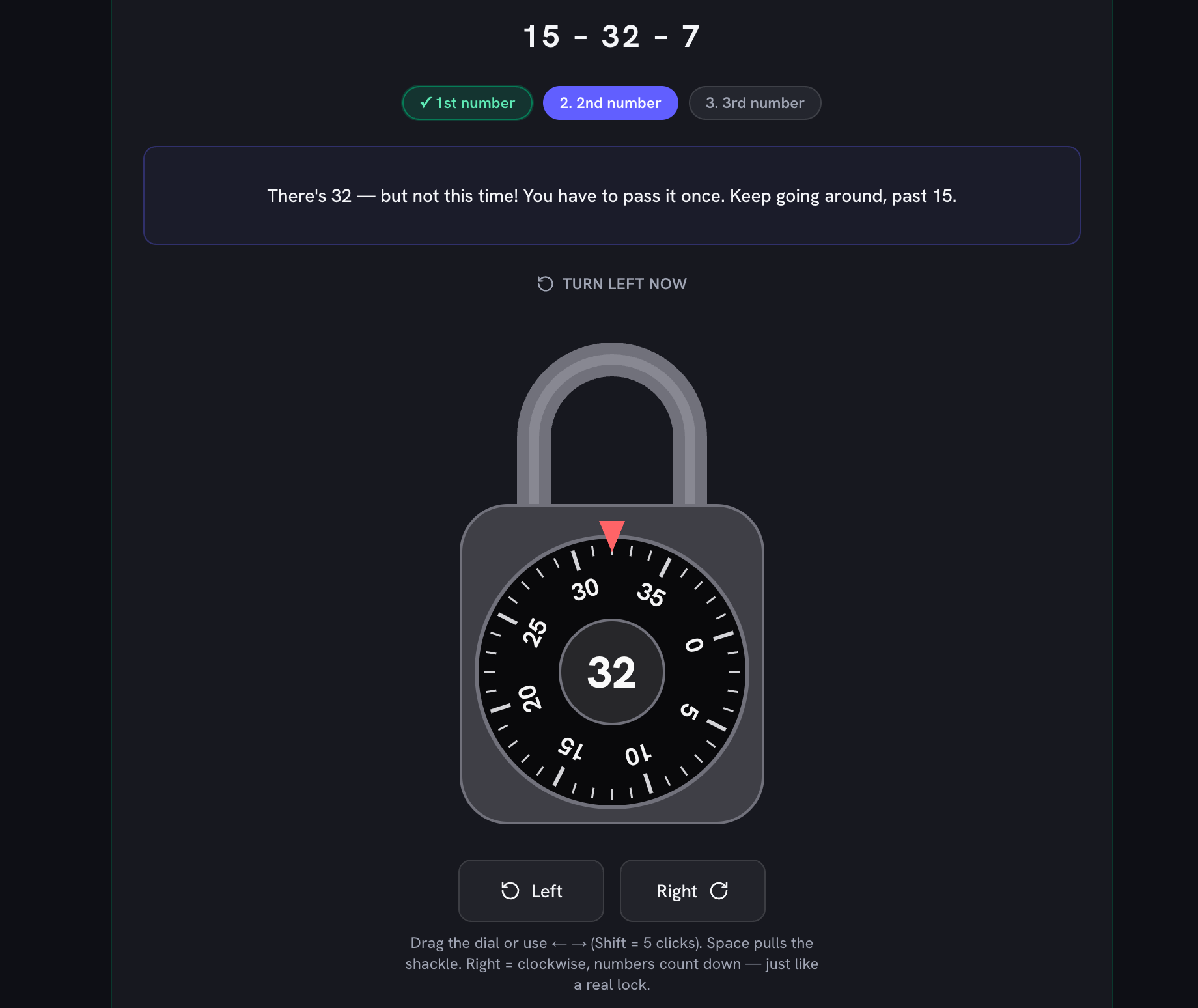
    Turn left (counter-clockwise) one whole turn — you will pass your first number once — and keep going until you stop on your second number. Do not stop the first time your second number appears.

    The second number, 32, sitting under the marker on its first pass while the guided banner warns that this is not the time to stop and to keep going around
  4. Turn right to your third number and pull

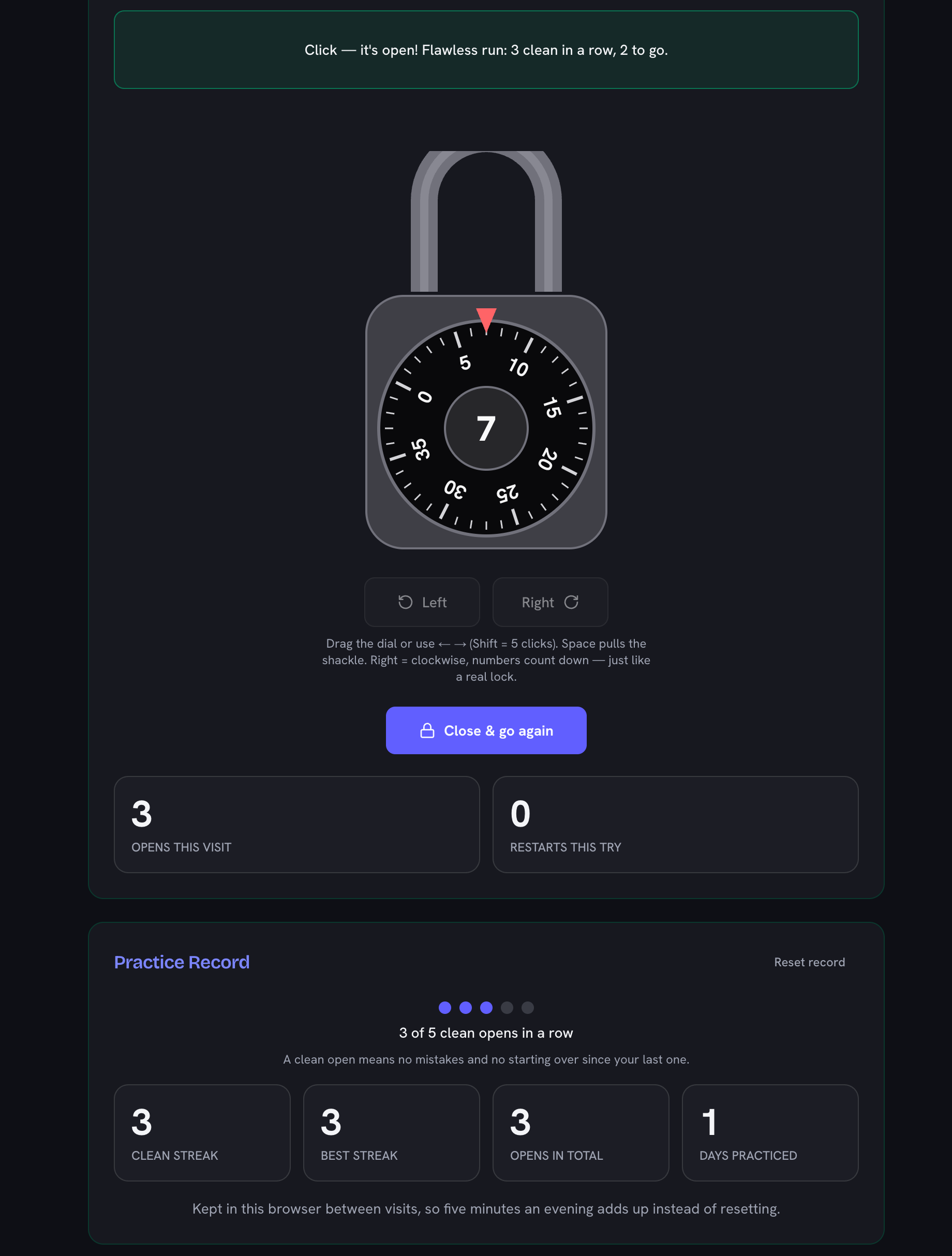
    Turn right straight to your third number without passing it, then pull the shackle. Click.

    The shackle sprung open on the third number, 7, with the practice record below it showing three clean opens in a row out of five

Frequently Asked Questions

How do I practice my locker combination without a lock?

Use the virtual lock on this page: type in your real combination (it is saved only in your browser, never uploaded), then dial the on-screen wheel exactly like the real thing — right two full turns to your first number, left past your first number to the second, right to the third, pull. Guided mode walks you through each step and explains any mistake; test mode checks whether you can do it from memory.

How do I practice opening a locker before school starts?

Rehearse on the locker simulator on this page in three stages: guided mode first, where every turn is prompted and every mistake explained; then test mode, which hides the combination and stays silent, exactly like standing in the hallway; then the timed challenge until an open takes under 20 seconds. Five clean opens in a row usually means it has become muscle memory, and the practice record on this page counts that streak between visits — clean meaning you made no mistakes and did not start over since your last successful open. A five-minute session each evening the week before school is plenty.

Is this locker simulator the same as a real combination lock?

It behaves like one in the ways that matter for practice: a 40-number dial, wheels that only set if you clear them with full turns to the right, a second number you have to catch on its second pass, and no way to back up after an overshoot. Reverse on the last turn or pull early and it stays shut, exactly like the real thing — the combination lock simulator here is checking mechanics, not just comparing three numbers. What it cannot give you is the feel of the shackle, so the first real open still takes a second longer. Its random practice combinations keep the three numbers at least four apart, either way around the dial, because numbers packed close together are easy to overshoot while you are still learning the last few clicks.

How many days before school should we start practicing?

Four short evenings is plenty, and the part that matters is that the last one lands the night before rather than that there were fourteen of them. The plan on this page splits them up: two evenings learning the turns in guided mode, one proving it from memory in test mode, one on the clock. The days-practiced counter in the practice record makes it obvious whether the week actually happened or whether it was all one hopeful session.

How do you open a combination lock on a school locker?

Three steps, always right–left–right: turn the dial right (clockwise) at least two full turns and stop on the first number; turn left (counter-clockwise) one whole turn, passing the first number once, and stop on the second number; then turn right directly to the third number and pull the shackle open.

How many times do I turn right first?

At least two full turns before you stop on your first number — many schools teach three to be safe, and extra turns never hurt. The full turns "clear" the wheels inside the lock; skipping them is why a correctly-remembered combination still fails.

Why does my locker not open even with the right combination?

Almost always one of three mechanics mistakes: you did not make the full clearing turns right at the start, you stopped on your second number the FIRST time it came around instead of passing your first number once, or you dialed past a number and backed up (a real lock cannot rewind — you must start over). The guided mode on this page catches each of these the moment they happen.

What do I do if I turn past my number?

If you pass your first number while clearing, nothing is lost — just keep turning right until it comes around again. But if you overshoot your second or third number, backing up will not work on a real lock: start over from the two full right turns. Turning slowly on the last few numbers is the habit to build.

Does this work on a school Chromebook?

Yes. It is a normal web page — no app store, no download, no account — so it runs on school Chromebooks, iPads, and phones alike. You can drag the dial with a finger or trackpad, or use the arrow keys.

Is it safe to type my real locker combination in here?

Yes — the combination is stored only in your own browser (localStorage) so it is still there next visit, and it is never sent anywhere. Nothing about your lock leaves the device; you can also practice on a random combination instead.