Five Leveling Systems, One Classroom Library
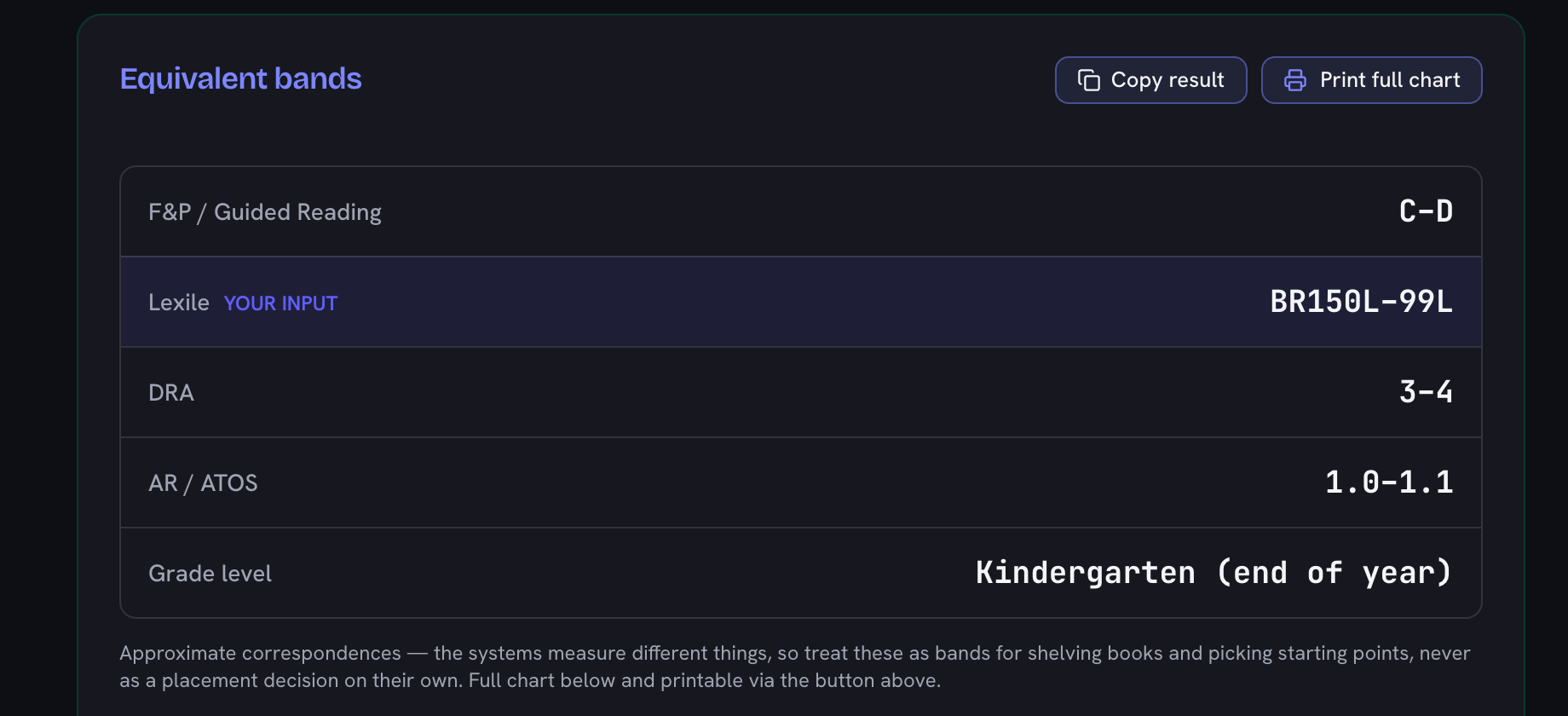
Most elementary classrooms juggle at least three reading-level systems at once: the books arrive labeled with Guided Reading letters, the benchmark assessment reports a DRA number, the library software wants Lexile bands, and half the class reads AR books with ATOS levels on the back. This converter puts the common correspondences in one place — enter the level you know and read off the equivalent band in every other system, with the full reading level conversion chart (Lexile to F&P, DRA, AR, and grade) printed below and available as a one-page printable for the wall by the classroom library.
What Each System Actually Measures
- Lexile (BR–1600L): a quantitative measure from MetaMetrics based on sentence length and word frequency, running on one continuous scale from roughly 0L to about 1600L — most school texts top out around 1400L, and BR (“Beginning Reader”) measures sit below 0L. It says nothing about themes, pictures, or layout — a formula, not a judgment.
- Fountas & Pinnell / Guided Reading (A–Z+): a qualitative text gradient — trained levelers weigh vocabulary, structure, content load, and print features to place a book on the A–Z ladder. Two books with the same Lexile can land on different letters.
- DRA (A/1–80): the level a student earns on the Developmental Reading Assessment, where accuracy, fluency, and comprehension are scored on benchmark passages. It describes a reader’s assessed performance, not just the text.
- AR / ATOS (0.5–9.0+): Renaissance’s readability formula behind Accelerated Reader, expressed as a grade equivalent — a 2.6 book reads like month six of second grade.
- Grade level: the coarsest lens — where a typical reader sits at the beginning, middle, or end of each school year.
Why Every Conversion Is Approximate
Because the systems measure different things, there is no exact exchange rate — only observed overlap. Publishers, districts, and vendors each publish their own correlation chart, and they disagree by half a band here and a full letter there. That is why this tool converts to bands, not points: a 520L book is around level M, not exactly M. The table here is curated from the most widely published alignments — the Fountas & Pinnell text level gradient grade goals, the standard Lexile grade bands, and the DRA and ATOS correlations reproduced in countless district leveling charts — and rounded to clean, contiguous bands so every value has exactly one home.
The honest rule of thumb: convert to shelve books and pick starting points, never to make placement decisions. A running record with the actual child beats any chart.
Leveling a Library at Back-to-School
The heaviest conversion season is August and September: beginning-of-year benchmarking hands you DRA or F&P levels while the book bins are labeled in something else. A quick workflow — benchmark the class, convert each reader’s level to the band your bins use, and start book shopping one band below the assessed level so early-year confidence builds before the stretch. Those same first weeks bring the rest of the assessment pile too — a reading fluency timer for words-per-minute, spelling test practice for the opening word lists, and a test grade calculator for scoring it all, and a reading log generator for the take-home minutes sheet — so the level conversion is one piece of a busier back-to-school routine. Print the full chart, tape it inside the library cupboard, and the mid-year volunteers can shelve returns without asking.
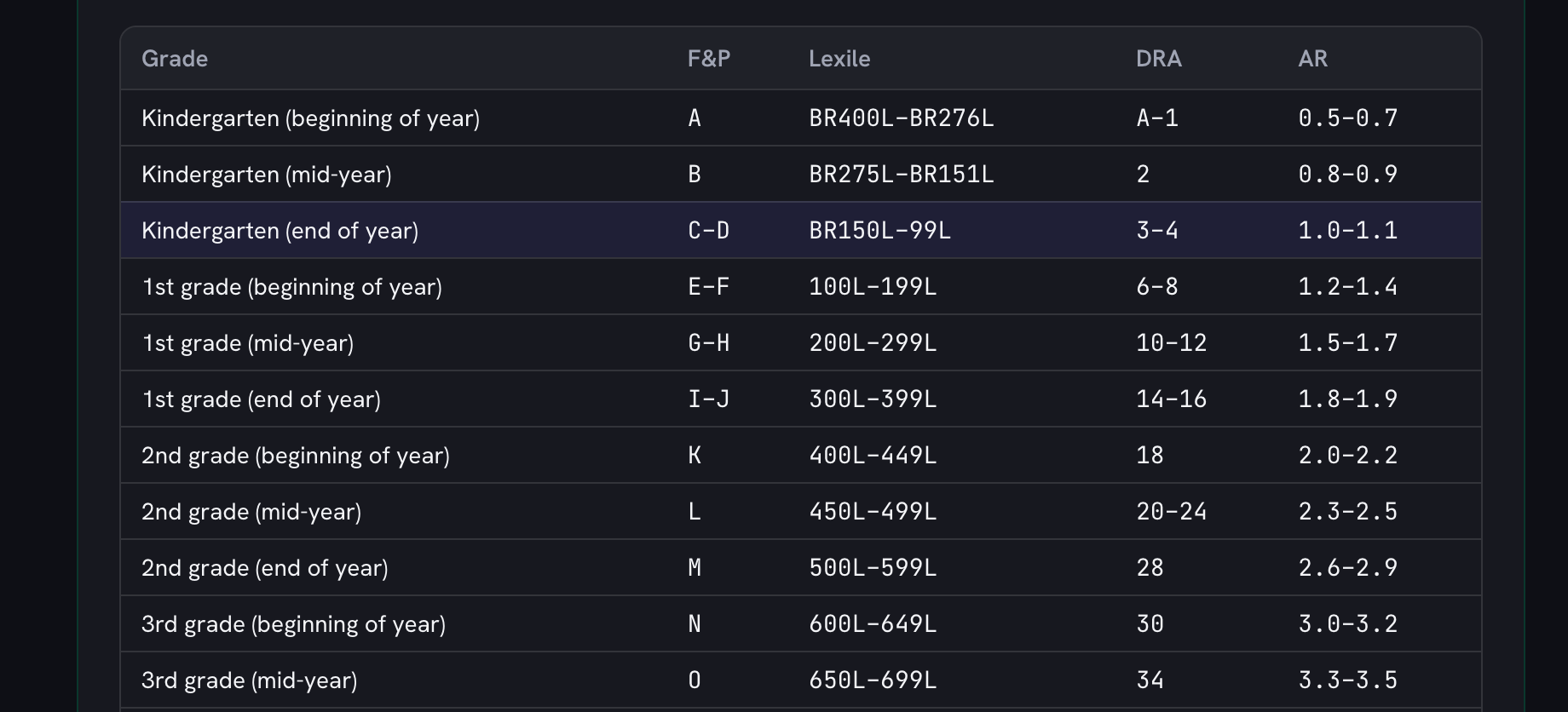
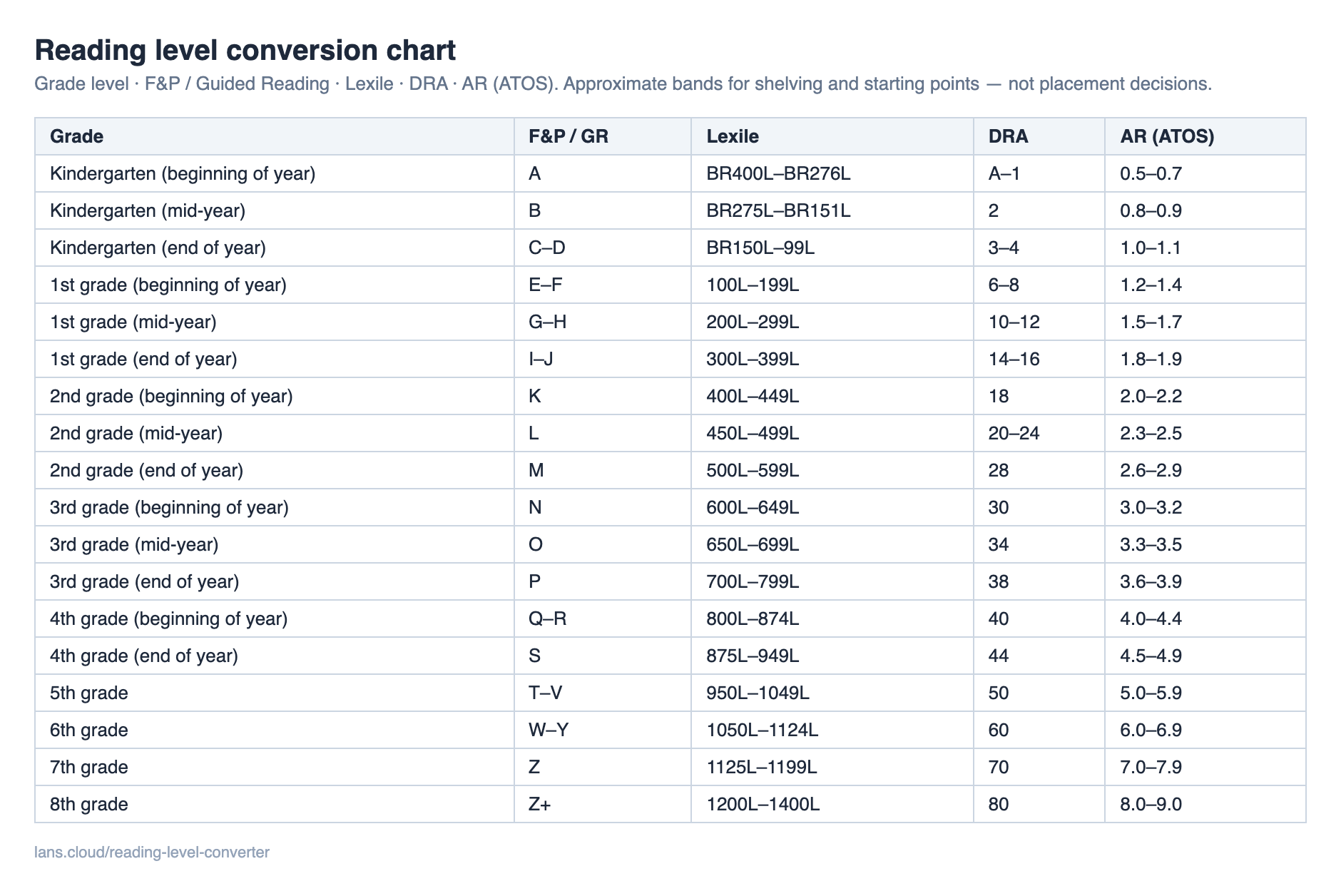
The Full Reading Level Conversion Chart
The complete correspondence table the converter runs on — grade by grade from kindergarten to 8th, with F&P/Guided Reading letters, Lexile bands (BR = Beginning Reader), DRA levels, and AR/ATOS ranges. It is generated from the same data the tool uses, so chart and converter always agree.