lans.cloud Tools

Case Converter

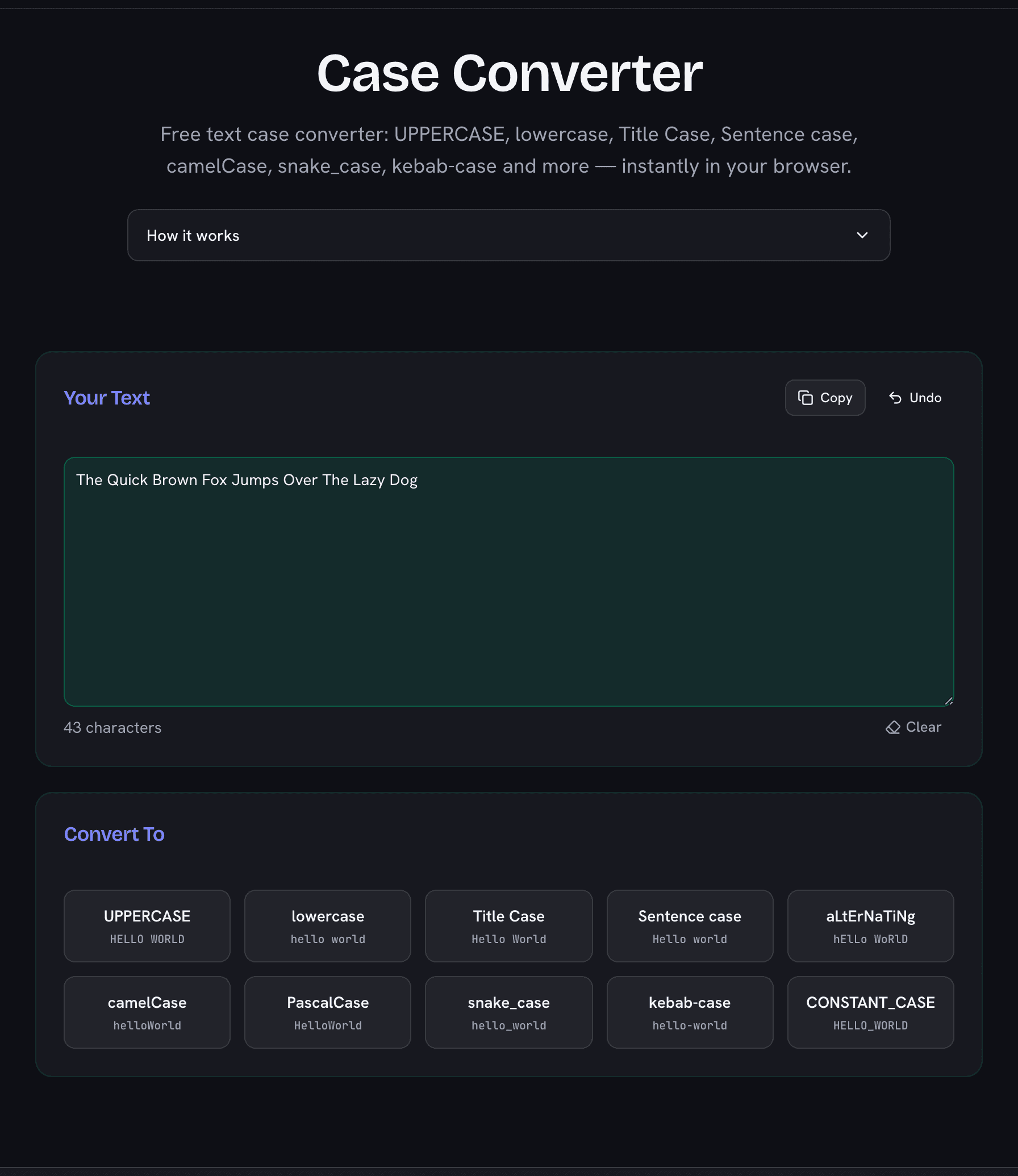
Free text case converter: UPPERCASE, lowercase, Title Case, Sentence case, camelCase, snake_case, kebab-case and more — instantly in your browser.

Was this tool helpful?
Support this site

More tools

How to change the case of text

Four steps, and nothing you paste leaves your browser.

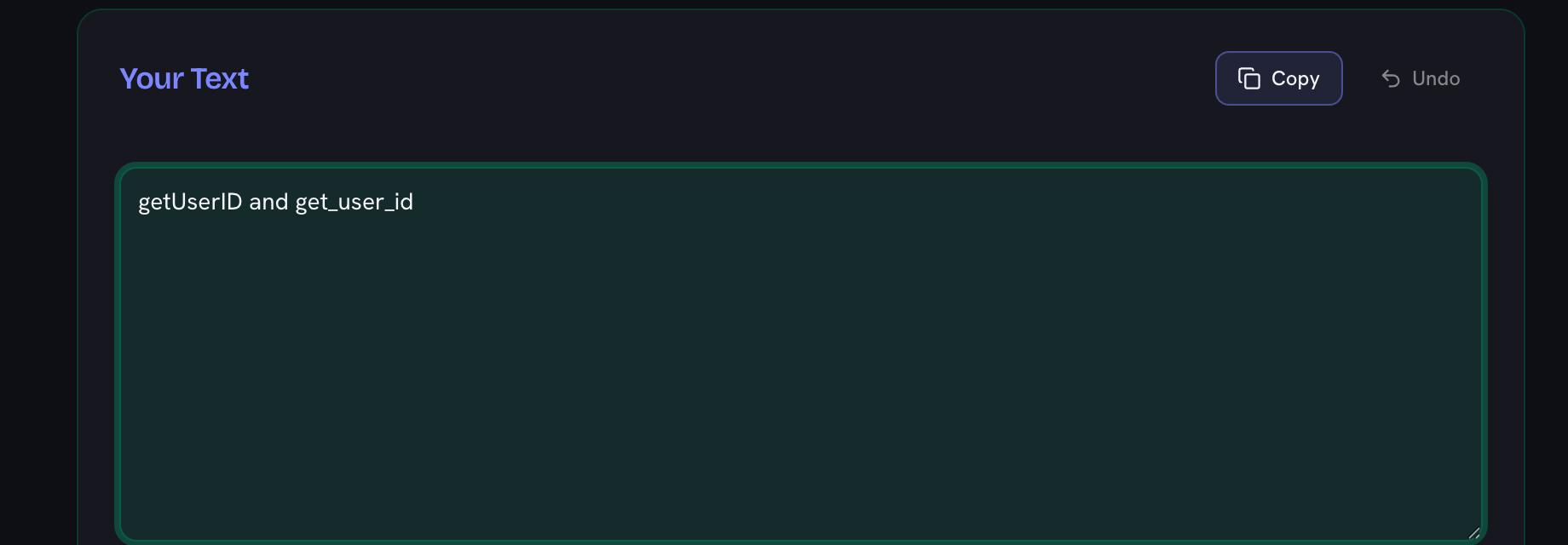
  1. Paste or type your text

    Drop in anything from a single heading to a whole document. Everything runs in your browser and nothing you paste is sent to a server. It is kept in this browser’s local storage so it survives a refresh, so use the clear button if you are on a shared machine.

    The Your Text box with getUserID and get_user_id typed into it, and Copy and Undo buttons above
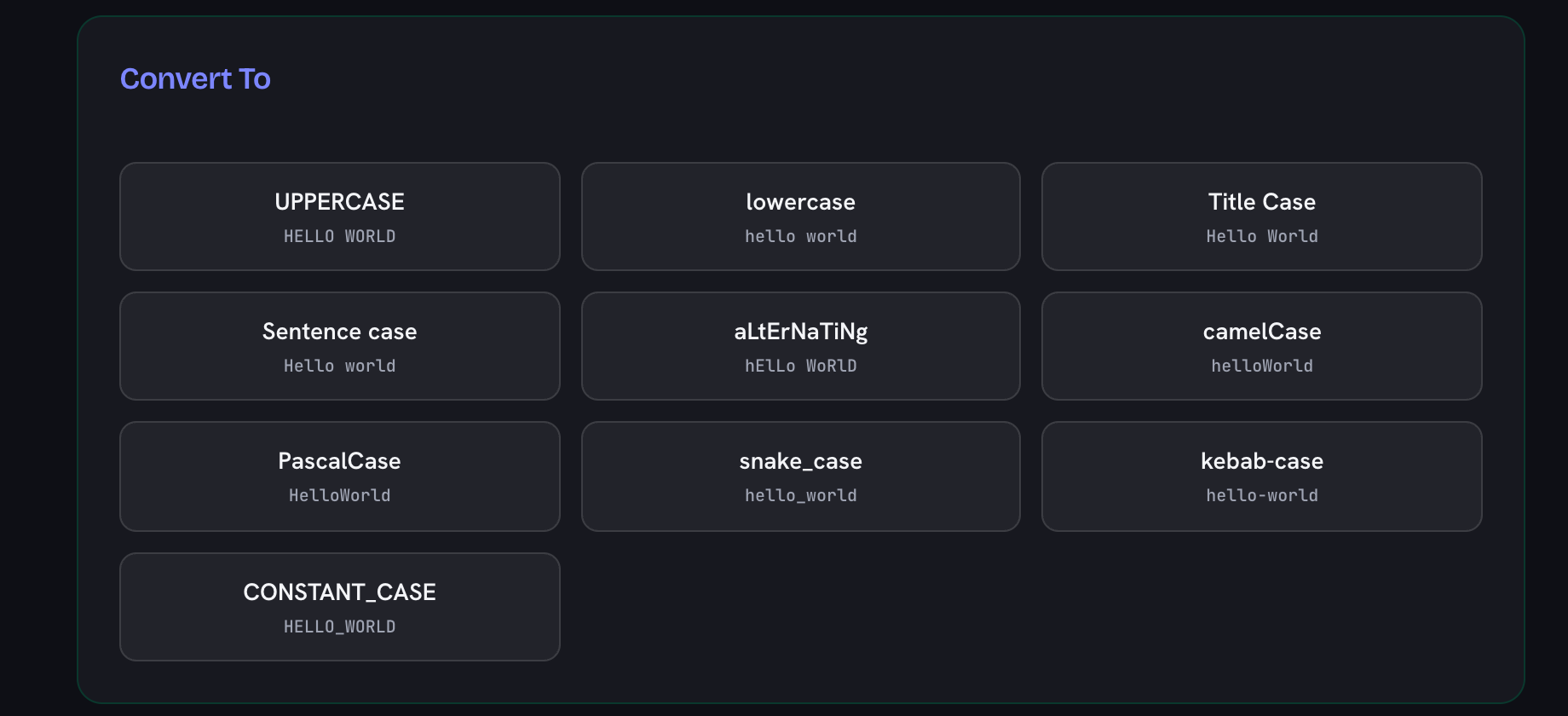
  2. Pick the style you need

    Choose one of the ten styles — each button shows what "Hello World" looks like in it. If you are writing prose you want Title Case or Sentence case; if you are naming something in code you want camelCase, PascalCase, snake_case, kebab-case or CONSTANT_CASE, and the table below says which one each language expects.

    The Convert To grid of ten buttons — UPPERCASE, lowercase, Title Case, Sentence case, aLtErNaTiNg, camelCase, PascalCase, snake_case, kebab-case and CONSTANT_CASE — each showing Hello World written that way
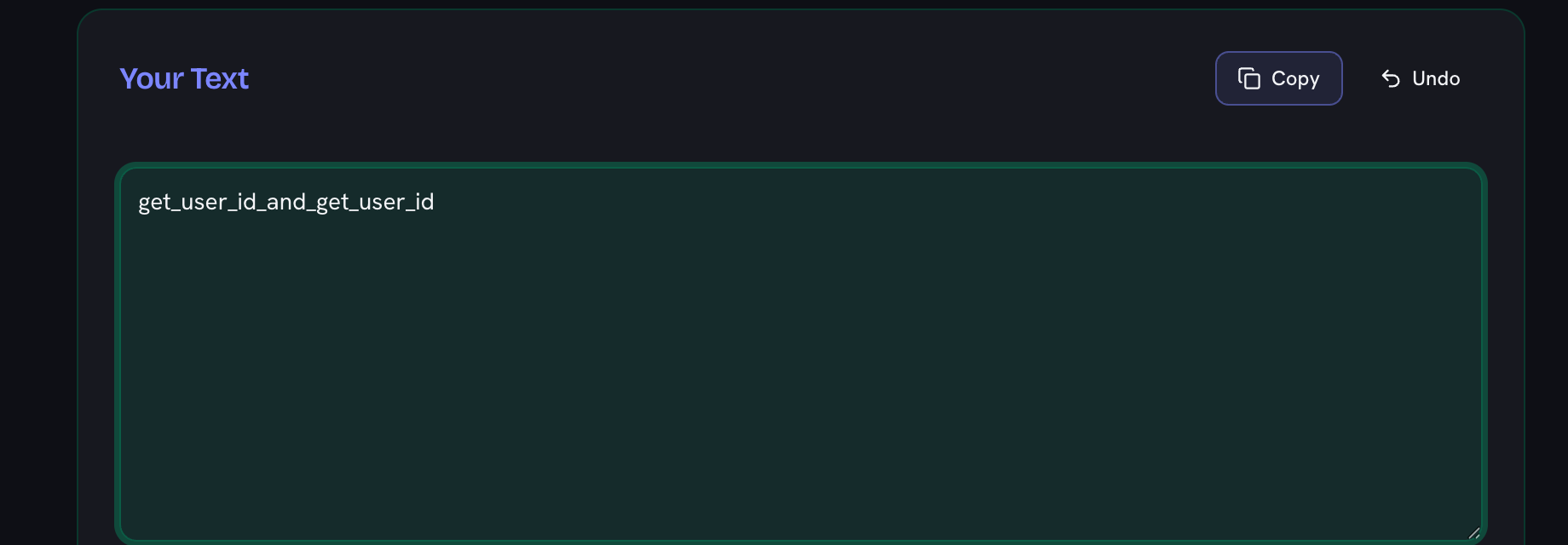
  3. Check how the words were split

    The converter detects word boundaries across spaces, hyphens, underscores and existing camelCase humps, so "getUserID" and "get_user_id" both become the same words before the new style is applied. Glance at the result to confirm acronyms broke where you wanted.

    After snake_case is applied, getUserID and get_user_id have both become get_user_id in the box, with the ID acronym kept as one word
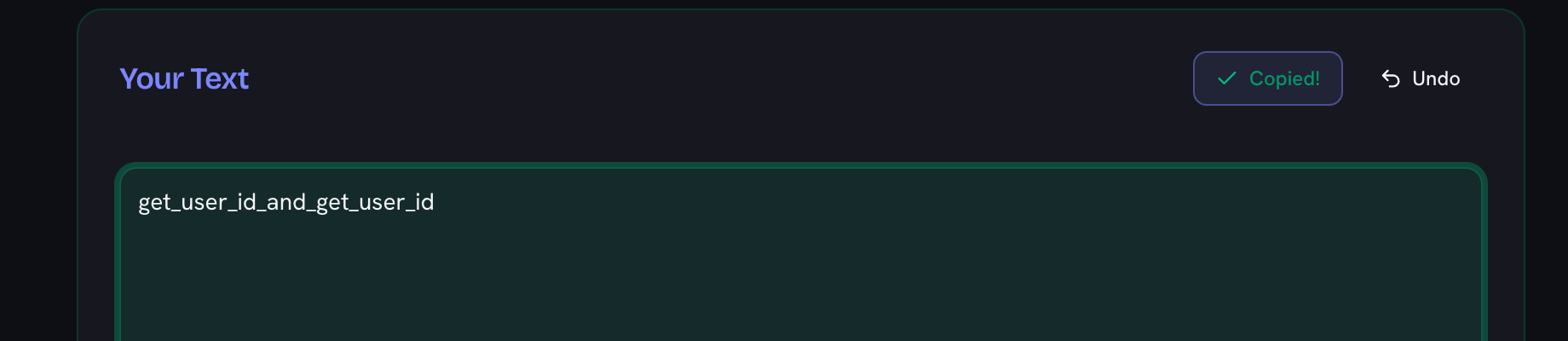
  4. Copy the result

    Copy the converted text straight out. Your text stays in this browser between visits rather than being cleared on refresh, which is convenient for a document you keep coming back to and worth clearing when it is not.

    The Copy button switched to a tick reading Copied!, beside the Undo button above the converted text

Change Text Case Instantly

Accidentally left caps lock on? Need a headline in Title Case, a variable in camelCase, or a URL slug in kebab-case? This free case converter transforms any text into ten different capitalization styles with one click — no retyping, no manual fixes, and no upload: everything runs in your browser.

Paste your text, hit the style you need, and copy the result. The Undo button restores the previous version, so you can try several styles without losing your original.

The Ten Styles Explained

  • UPPERCASE / lowercase — every letter up or down; the classic caps lock fix.
  • Title Case — Every Word Capitalized; for headlines, book titles, and navigation labels.
  • Sentence case — only sentence starts capitalized; for turning SHOUTED text back into normal prose.
  • aLtErNaTiNg CaSe — the sarcastic meme case.
  • camelCase / PascalCase — programming identifiers in JavaScript, Java, C#, and friends.
  • snake_case / CONSTANT_CASE — Python variables and configuration constants.
  • kebab-case — URL slugs, CSS classes, and file names.

Smart Word Detection

For the programming styles, the converter understands more than spaces: it splits on hyphens, underscores, and punctuation, and it recognizes existing camelCase boundaries — so someVariableName becomes some_variable_name in one click. That makes it a quick refactoring companion when moving identifiers between languages with different conventions.
Every case style applied to "the quick brown fox jumps"

StyleResult
UPPERCASETHE QUICK BROWN FOX JUMPS
lowercasethe quick brown fox jumps
Title CaseThe Quick Brown Fox Jumps
Sentence caseThe quick brown fox jumps
aLtErNaTiNgtHe QuIcK bRoWn FoX jUmPs
camelCasetheQuickBrownFoxJumps
PascalCaseTheQuickBrownFoxJumps
snake_casethe_quick_brown_fox_jumps
kebab-casethe-quick-brown-fox-jumps
CONSTANT_CASETHE_QUICK_BROWN_FOX_JUMPS

Generated by the converter's own functions at build time.

Which style to use, and where the rule comes from

StyleConventionally used forSource of the rule
camelCaseVariables and functions in JavaScript, TypeScript, Java, Swift and Kotlin. JSON keys in Google- and Microsoft-style APIs, though snake_case is just as common elsewhere (GitHub, Stripe) — the JSON spec itself says nothing about key naming.Language style guides (e.g. Google and Airbnb for JavaScript)
PascalCaseClass names in most languages, React and Vue component names, TypeScript types and interfaces, C# methods, Go exported identifiers.PEP 8 calls it CapWords for classes; Go uses the capital to MEAN exported
snake_caseVariables and functions in Python, Ruby and Rust. Database table and column names across SQL dialects, where it sidesteps quoting entirely: PostgreSQL folds unquoted identifiers to lowercase, the SQL standard folds to uppercase, and MySQL compares them case-insensitively.PEP 8 for Python; Rust API guidelines; SQL convention rather than a rule
kebab-caseCSS class names and custom properties, URL slugs, HTML attributes, and npm package names, where lowercase is enforced rather than merely preferred.CSS and HTML convention; npm rejects uppercase in new package names
CONSTANT_CASEConstants in Python, Ruby, Rust, Java, C, PHP and Kotlin, and environment variables, where the shouting form is near universal across shells and deployment tooling.PEP 8, Rust and Java agree; Go and C# are the exceptions, using MixedCaps and PascalCase respectively
Title CaseHeadlines and titles in published prose. Both guides capitalise the first and last word and all principal words; they differ on the short ones. AP capitalises prepositions and conjunctions of four or more letters. Chicago lowercased prepositions regardless of length until the 18th edition (2024) raised it to five or more, so "Much Ado About Nothing" but "A Room with a View".AP Stylebook; Chicago Manual of Style 18th ed. §8.160
Sentence caseBody copy, and increasingly UI text: buttons, menu items, form labels and headings in modern design systems, because it is easier to scan and translates more predictably.Google's Material Design guidance recommends sentence case for UI
UPPERCASEAcronyms, and visual emphasis applied in CSS rather than in the text itself. Retyping it in the source destroys the original casing permanently, and long all-caps runs are harder to read, especially for dyslexic readers. The widely repeated claim that screen readers spell all-caps words out letter by letter does not hold up in testing.Readability and reversibility: prefer text-transform to retyping
lowercaseNormalising text before comparing or de-duplicating it, tags and labels, and brand styling that deliberately avoids capitals.Convention
aLtErNaTiNgNot a convention at all: it is the mocking-tone meme format. Included because people genuinely come looking for it.Internet usage

Conventions, not laws — a project's own style guide always wins. The npm lowercase restriction and Go's exported-identifier rule are the two entries here that are genuinely enforced rather than merely conventional.

Frequently Asked Questions

How do I convert text from UPPERCASE to lowercase?

Paste your text into the box and click the lowercase button — the whole text converts instantly. Click Copy to grab the result, or Undo to restore the previous version.

What is the difference between Title Case and Sentence case?

Title Case capitalizes the first letter of every word ("The Quick Brown Fox"), which suits headlines and titles. Sentence case capitalizes only the first word of each sentence ("The quick brown fox."), which suits normal prose.

What are camelCase, snake_case, and kebab-case for?

They are naming styles used in programming: camelCase (JavaScript variables), PascalCase (class names), snake_case (Python variables), kebab-case (URLs and CSS classes), and CONSTANT_CASE (constants). The converter detects word boundaries in your text — including existing camelCase — and rebuilds it in the chosen style.

Can I undo a conversion?

Yes — the Undo button restores the text exactly as it was before your last conversion, so experimenting is risk-free.

Is my text sent to a server?

No. Conversion happens entirely in your browser, and your text is saved only to your own device so it is still there when you return.

Text case converter with ten conversion styles including camelCase, snake_case, and Title Case
One click converts your text between ten cases — with undo if you change your mind.