lans.cloud Tools

Roman Numeral Converter

Free Roman numeral converter. Convert numbers to Roman numerals and back, live in both directions — up to 3,999,999 with vinculum (overline) notation — with strict validation.

Quick answer

42 in Roman numerals is XLII (50−10 = XL, plus II for 2). Type any whole number from 1 to 3,999,999 and its Roman numeral appears instantly (with vinculum overlines above 3,999), or type a numeral like MMXXVI and get 2026 back. Every input is validated against the strict standard form, so IIII, VV, or IC are flagged as invalid.
Convert Both Ways
converts both directions

2,026 = MMXXVI

Date in Roman Numerals
XVII·VIII·MMXXVI

Great for wedding dates, anniversaries, and tattoos. Roman numerals have no zero, so every part starts at 1, and the year must be 1–3999.

Symbol Reference
I
1
V
5
X
10
L
50
C
100
D
500
M
1,000
Was this tool helpful?
Support this site

More tools

How to convert Roman numerals

Numbers to Roman numerals and back, plus dates, big-number overlines and a chart you can print.

  1. Type a number

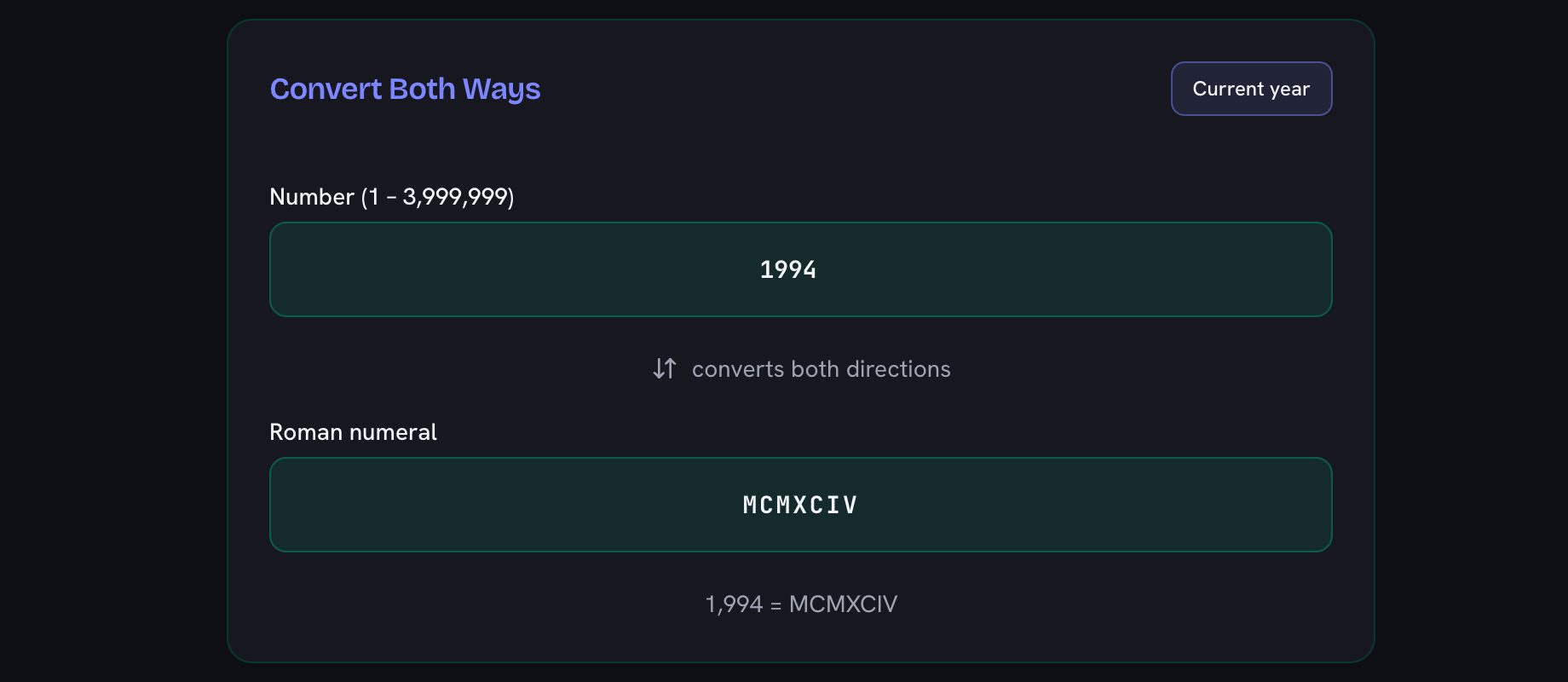
    Type any whole number from 1 to 3,999,999 into the top field of Convert Both Ways. The numeral builds itself as you type (1994 becomes MCMXCIV), and the line under the two fields reads the conversion back. Type a numeral into the second field instead and it runs the other way.

    The Convert Both Ways card with 1994 in the number field, MCMXCIV in the Roman numeral field below it, and the line 1,994 = MCMXCIV underneath
  2. Go past 3,999 for the overline

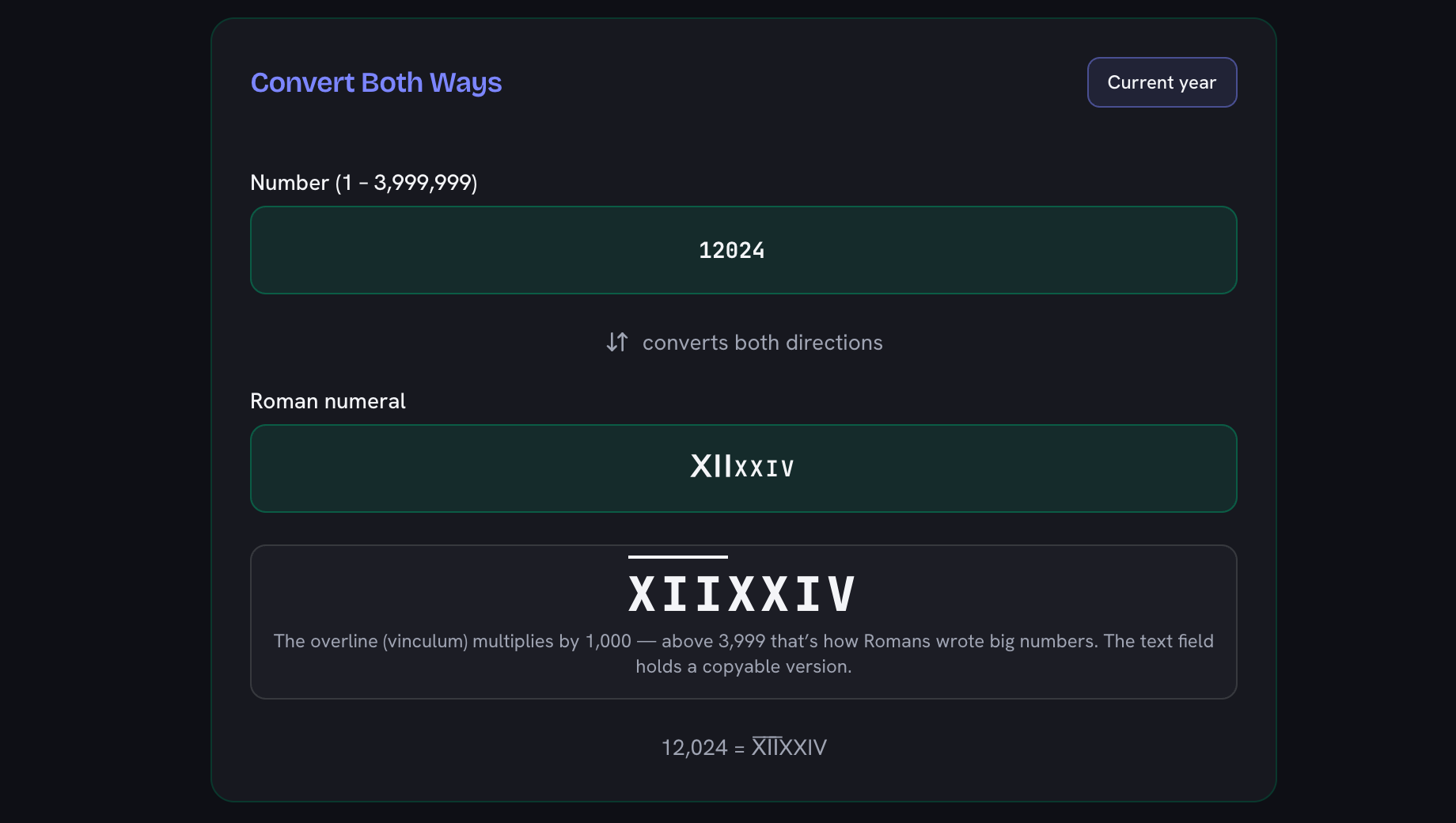
    Standard numerals stop at MMMCMXCIX. Above that the converter switches to the vinculum the Romans used for large numbers: 12,024 shows as XII overlined, meaning twelve thousand, followed by XXIV. The numeral field keeps a version you can copy as plain text.

    The same card with 12024 typed in, and an extra panel showing XII under an overline followed by XXIV, with a note that the overline multiplies by 1,000
  3. Turn a date into numerals

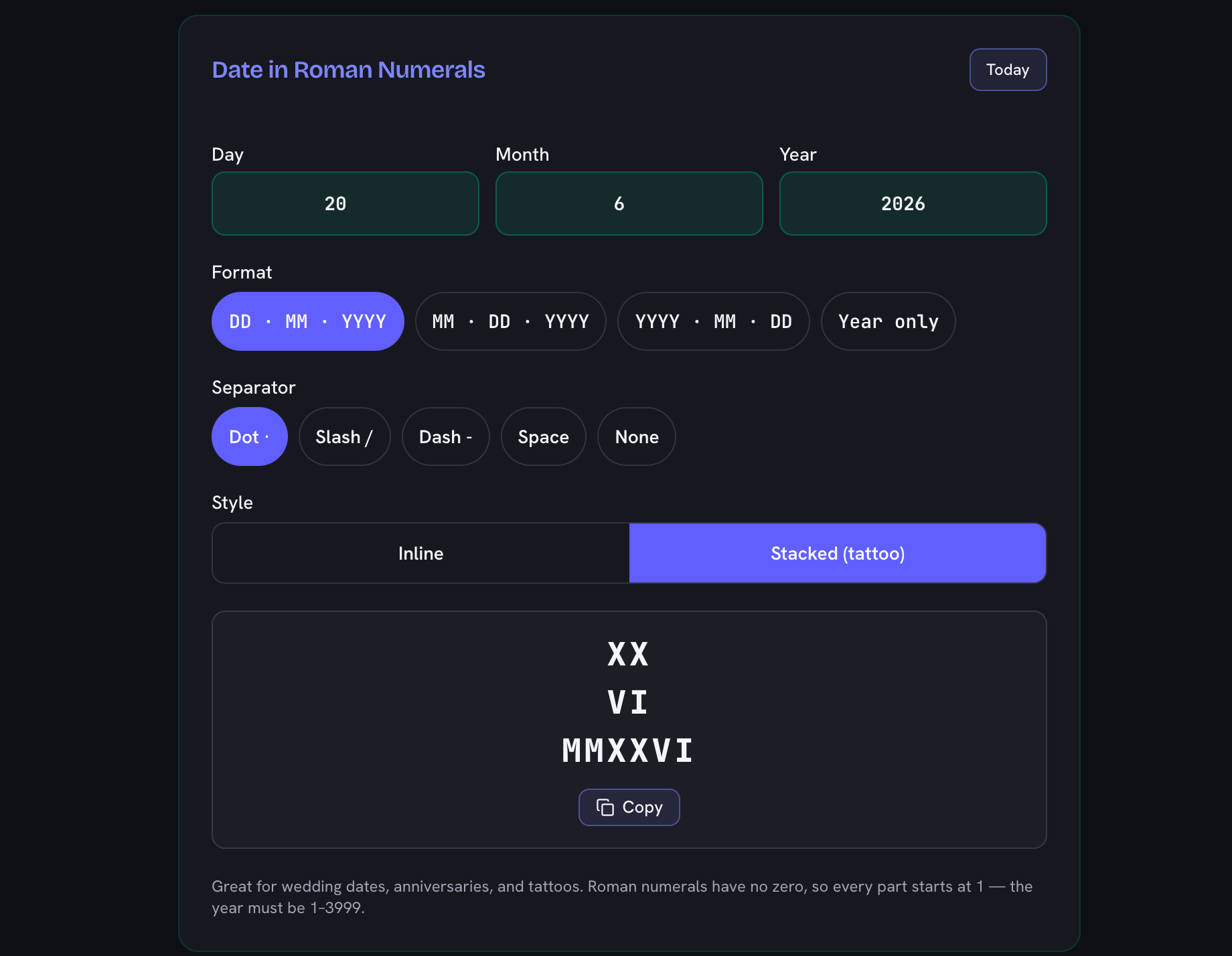
    In the Date in Roman Numerals card, fill in the day, month and year, then pick the order (DD·MM·YYYY, MM·DD·YYYY, YYYY·MM·DD or year only) and the separator. Copy puts the result on your clipboard, and the stacked style gives you the vertical layout tattoos and engravings use.

    The Date in Roman Numerals card set to 20 June 2026 in DD·MM·YYYY order with the stacked style chosen, so XX, VI and MMXXVI sit on three lines above a Copy button
  4. Print the chart

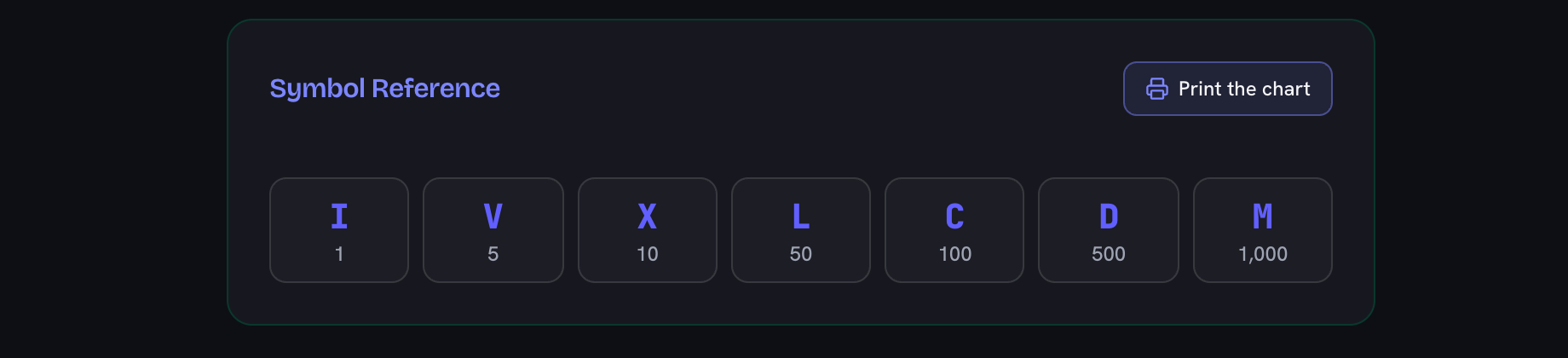
    Print the chart, in the Symbol Reference card, opens a one-page sheet: the seven symbols, 1 to 20, the tens to 100 and the hundreds to 1000. It comes out of the same engine as the converter, so the paper copy cannot drift from the tool. There is a downloadable 1–100 chart further down the page as well.

    The Symbol Reference card listing I, V, X, L, C, D and M with their values, and the Print the chart button beside the heading

Convert Roman Numerals Both Ways

Type a number and read off its Roman numeral, or type a numeral like MCMXCIV and get 1994 back. The converter works live in both directions and validates every input against the strict standard form, so typos and impossible numerals are caught immediately instead of silently misread.

Writing a Date in Roman Numerals

A date is just three small numbers (day, month, and year), each converted on its own and joined together. In day-month-year order, 14 May 2026 becomes XIV·V·MMXXVI: XIV for the 14th, V for the fifth month, and MMXXVI for 2026. The Date in Roman Numerals panel above builds it for you: type the day, month, and year, then pick the field order (DD·MM·YYYY, MM·DD·YYYY, or year-only), choose a separator, and copy the result. Feeding it a specific number? Spin one up with the random number generator and drop it straight into the converter above.

Roman Numerals for Tattoos

A date tattoo in Roman numerals keeps a birthday, wedding, or memorial meaningful but understated. Switch the Date panel to the Stacked (tattoo) style and each part sits on its own line: the vertical layout inked down a forearm or spine. A dot (·) or period is the most common separator, and there is no zero, so every field starts at one. Double-check the numerals before you commit: four is IV, not IIII, and if your design also carries a name or phrase, the word and character counter helps you size the lettering to the space.

Roman Numerals on Clock Faces

Roman numerals ring the dials of countless clocks and watches, and many of them break the rules on purpose, writing 4 as IIII instead of the standard IV for visual balance against the VIII opposite it. If you like the classical look for a classroom or study display, the exam clock pairs a large legible face with live countdowns. This converter sticks to the modern standard form, so it always returns IV.
Example dates in Roman numerals (DD·MM·YYYY)

DateRoman numerals
1 January 2000I·I·MM
14 February 2025XIV·II·MMXXV
20 June 2026XX·VI·MMXXVI
25 December 2024XXV·XII·MMXXIV
29 February 2024 (leap day)XXIX·II·MMXXIV
4 July 1776IV·VII·MDCCLXXVI

Built by the same formatDateRoman engine as the Date panel above. Enter any wedding date, birthday, or anniversary to format your own.

How Roman Numerals Work

Seven symbols carry all the values: I (1), V (5), X (10), L (50), C (100), D (500), and M (1000). Symbols are written largest-first and added together: MMXXVI is 1000+1000+10+10+5+1 = 2026. When a smaller symbol appears before a larger one, it is subtracted instead: IV is 4, IX is 9, XL is 40, XC is 90, CD is 400, and CM is 900. Only those six subtractive pairs are allowed in standard notation, and no symbol repeats more than three times in a row.

Where You Still See Roman Numerals

  • Movie credits and TV copyrights: production years like MMXXVI in end credits.
  • Super Bowls, Olympiads, and monarchs: Super Bowl LVIII, Elizabeth II, Louis XIV.
  • Clock faces: often with the famous nonstandard IIII for 4.
  • Book chapters, outlines, and building cornerstones: anywhere a touch of formality is wanted.
  • Homework: Roman numerals remain a classroom staple, and the symbol reference card doubles as a quick cheat sheet.

Quick Examples

IV = 4, IX = 9, XIV = 14, XLII = 42, XCIX = 99, CDXLIV = 444, MCMLXXXIV = 1984, MCMXCIV = 1994, MMXXVI = 2026, MMMCMXCIX = 3999 (the largest standard numeral). Try a birth year, an anniversary, or a tattoo idea and check it both directions.

Years in Roman Numerals

The most-searched conversions are years: for tattoos, wedding dates, movie credits, and cornerstones. Recent and notable years, converted by the same engine as the tool above:

Recent and notable years in Roman numerals

YearRoman numeral
1492MCDXCII
1776MDCCLXXVI
1900MCM
1950MCML
1969MCMLXIX
1984MCMLXXXIV
1990MCMXC
1999MCMXCIX
2000MM
2020MMXX
2021MMXXI
2022MMXXII
2023MMXXIII
2024MMXXIV
2025MMXXV
2026MMXXVI
2027MMXXVII
2028MMXXVIII
2029MMXXIX
2030MMXXX
2035MMXXXV

Need a different year or date? The converter above handles any number from 1 to 3,999,999, both directions.

Numbers 1–20, tens, and hundreds

NumberNumeralNumberNumeral
1I30XXX
2II40XL
3III50L
4IV60LX
5V70LXX
6VI80LXXX
7VII90XC
8VIII100C
9IX200CC
10X300CCC
11XI400CD
12XII500D
13XIII600DC
14XIV700DCC
15XV800DCCC
16XVI900CM
17XVII1,000M
18XVIII1,500MD
19XIX2,000MM
20XX3,000MMM

Roman Numerals 1 to 100

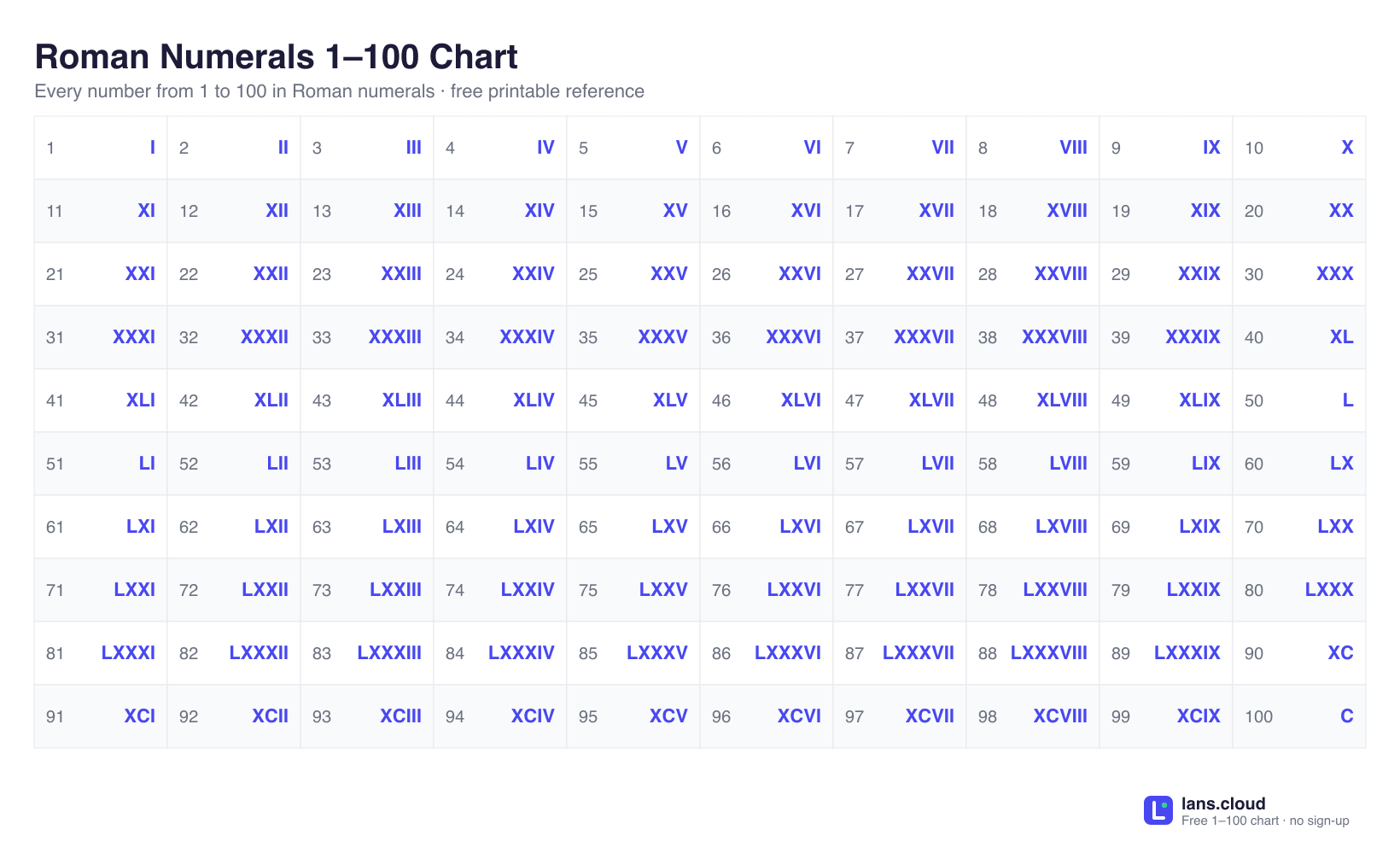
The full one-to-a-hundred run is the range schools drill and the one people look up most often. Every numeral below is produced by the converter’s own engine, so the table matches the tool exactly. Note how 40 (XL), 90 (XC) and 49 (XLIX) use the subtractive rule rather than repeating symbols four times.

Roman numerals 1 to 100

NumberNumeralNumberNumeral
1I51LI
2II52LII
3III53LIII
4IV54LIV
5V55LV
6VI56LVI
7VII57LVII
8VIII58LVIII
9IX59LIX
10X60LX
11XI61LXI
12XII62LXII
13XIII63LXIII
14XIV64LXIV
15XV65LXV
16XVI66LXVI
17XVII67LXVII
18XVIII68LXVIII
19XIX69LXIX
20XX70LXX
21XXI71LXXI
22XXII72LXXII
23XXIII73LXXIII
24XXIV74LXXIV
25XXV75LXXV
26XXVI76LXXVI
27XXVII77LXXVII
28XXVIII78LXXVIII
29XXIX79LXXIX
30XXX80LXXX
31XXXI81LXXXI
32XXXII82LXXXII
33XXXIII83LXXXIII
34XXXIV84LXXXIV
35XXXV85LXXXV
36XXXVI86LXXXVI
37XXXVII87LXXXVII
38XXXVIII88LXXXVIII
39XXXIX89LXXXIX
40XL90XC
41XLI91XCI
42XLII92XCII
43XLIII93XCIII
44XLIV94XCIV
45XLV95XCV
46XLVI96XCVI
47XLVII97XCVII
48XLVIII98XCVIII
49XLIX99XCIX
50L100C

Generated by the converter's own toRoman function at build time. For any number beyond 100, type it into the tool above.

Roman numerals 1 to 100 chart: a 10-by-10 grid showing every number from 1 to 100 with its Roman numeral, from 1 = I through 100 = C, including the subtractive forms like 4 = IV, 40 = XL, 90 = XC and 99 = XCIX.
Roman numerals 1–100 chart: save or print it for the classroom wall. Every numeral comes from the converter's own engine.Download PNG

Frequently Asked Questions

How do I convert a number to Roman numerals?

Type any whole number from 1 to 3,999,999 into the number field and the Roman numeral appears instantly (with vinculum overlines above 3999). It works the other way too: type a Roman numeral and the number appears.

How do numbers above 3999 work?

Standard Roman numerals top out at MMMCMXCIX (3999): M is the largest symbol and nothing repeats more than three times. For bigger numbers the Romans drew an overline (a vinculum) over a numeral to multiply it by 1000, and this converter does the same: type any number up to 3,999,999 and the thousands part appears overlined, with a copyable text version using Unicode overline marks.

Why is 4 written IV and not IIII?

Standard (subtractive) notation places a smaller symbol before a larger one to subtract it: IV is 5−1=4 and IX is 10−1=9. The additive IIII does appear historically, most famously on clock faces, but modern convention, and this converter, use the strict subtractive form.

Does the converter reject invalid numerals?

Yes. Input is validated against the strict standard form, so non-canonical strings like IIII, VV, or IC are flagged as invalid rather than silently guessed at.

How do you write a date in Roman numerals?

Convert the day, month, and year separately, then join them in your chosen order. In day-month-year order, 14 May 2026 is XIV·V·MMXXVI: XIV (14), V (5, for May), MMXXVI (2026). The Date in Roman Numerals section above does it for you: type the day, month, and year, pick DD·MM·YYYY, MM·DD·YYYY, or year-only, choose the separator, and copy the result. Roman numerals have no zero, so every part starts at 1.

What is 2026 in Roman numerals?

2026 is MMXXVI: MM (1000+1000) + XX (10+10) + VI (5+1). Type 2026 into the converter and it appears instantly, or use the Date in Roman Numerals section to add a day and month around it.

How do I write my wedding date in Roman numerals?

Use the Date in Roman Numerals section: enter the day, month, and year of your wedding, then choose the layout (DD·MM·YYYY is the most common for wedding jewellery and prints) and a separator such as the dot (·). For example a wedding on 20 June 2026 becomes XX·VI·MMXXVI. Tap Copy to paste it into an engraver, invitation, or design, and switch to the stacked style for a vertical tattoo layout.

What are Roman numerals for tattoos?

Roman-numeral tattoos usually spell out a meaningful date (a birthday, wedding, or memorial) because the letters look striking and the meaning stays private. Set the Date in Roman Numerals section to the Stacked (tattoo) style to see each part (day, month, year) on its own line, the way many vertical forearm and spine tattoos are inked. A middot (·) or period between numbers is the most common separator. Always double-check the numerals before inking: 4 is IV, not IIII, and there is no zero.

Why do clock faces use IIII instead of IV for four?

Many traditional clock and watch faces write 4 as IIII rather than the standard IV. The usual explanations are visual balance (IIII mirrors the VIII opposite it) and casting convenience for old clockmakers, who could mould identical I, V, and X strokes. It is a deliberate exception: this converter uses the modern standard IV, but IIII on a clock is not a mistake.

What is 2027 in Roman numerals?

2027 is MMXXVII: MM (2000) + XX (20) + VII (7). The years table below the article lists every year from 2020 to 2035 plus notable ones like 1776 (MDCCLXXVI) and 1999 (MCMXCIX), ready to copy.

What is the current year in Roman numerals?

Click the "Current year" button and the converter fills it in for you: 2026 is MMXXVI.

What are the Roman numerals from 1 to 20?

I, II, III, IV, V, VI, VII, VIII, IX, X, XI, XII, XIII, XIV, XV, XVI, XVII, XVIII, XIX, XX. The chart below the article lists them alongside the tens (X to C) and hundreds (C to M), so common school ranges are all covered on one page, and the Print the chart button on the converter gives the same table as a clean printable reference sheet for the classroom wall.

Is it "Roman numerals" or "Roman numbers"?

Both are widely used and mean the same thing: "Roman numerals" is the standard term for the symbols (I, V, X, L, C, D, M), while "Roman numbers" is the everyday phrasing. This Roman numbers converter answers either way: type a number or a numeral and get the other form instantly.

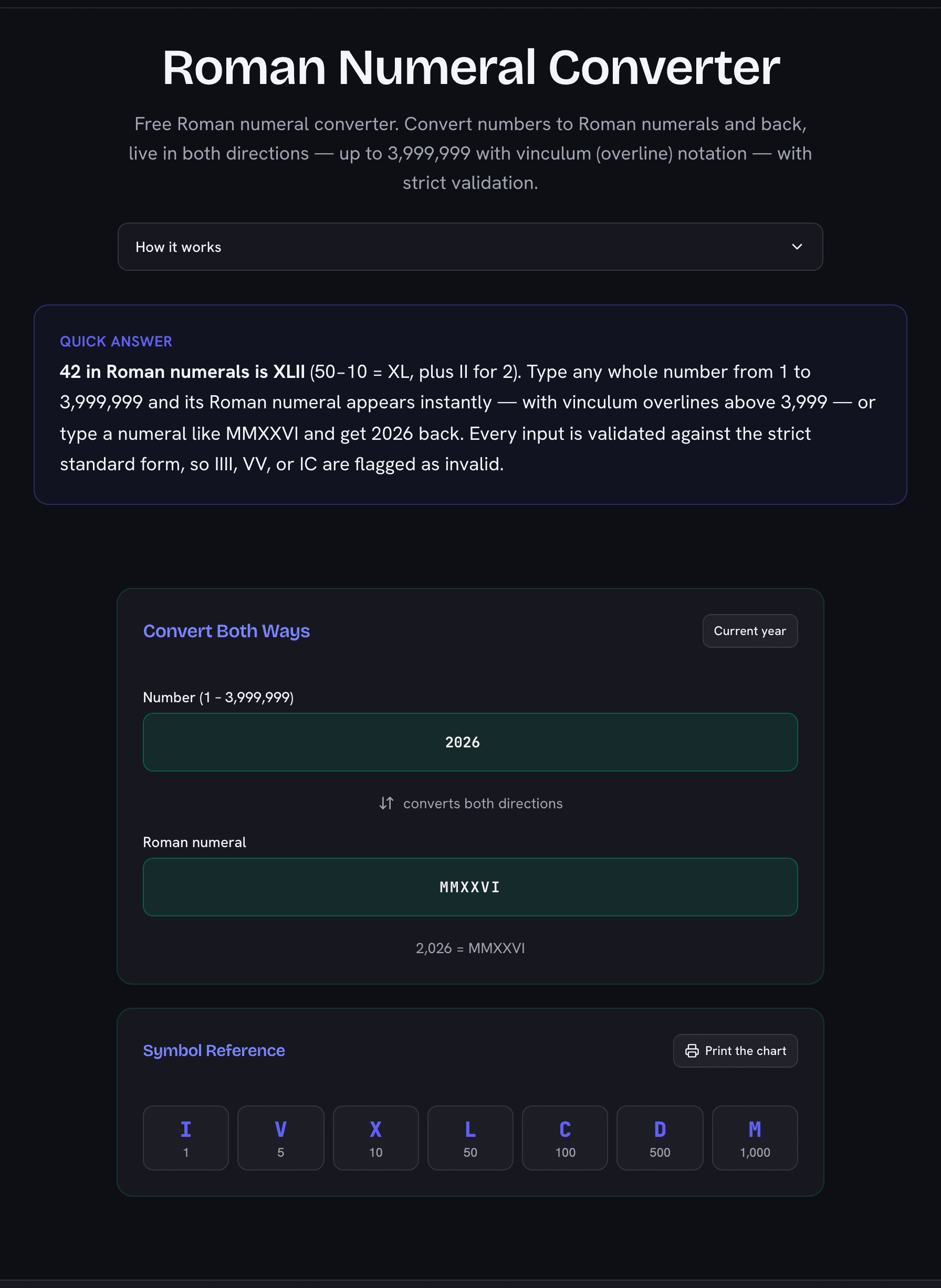
Roman numeral converter translating 2026 to MMXXVI with a symbol reference chart
Live two-way conversion with strict validation: 2,026 becomes MMXXVI.