lans.cloud

UUID Generator

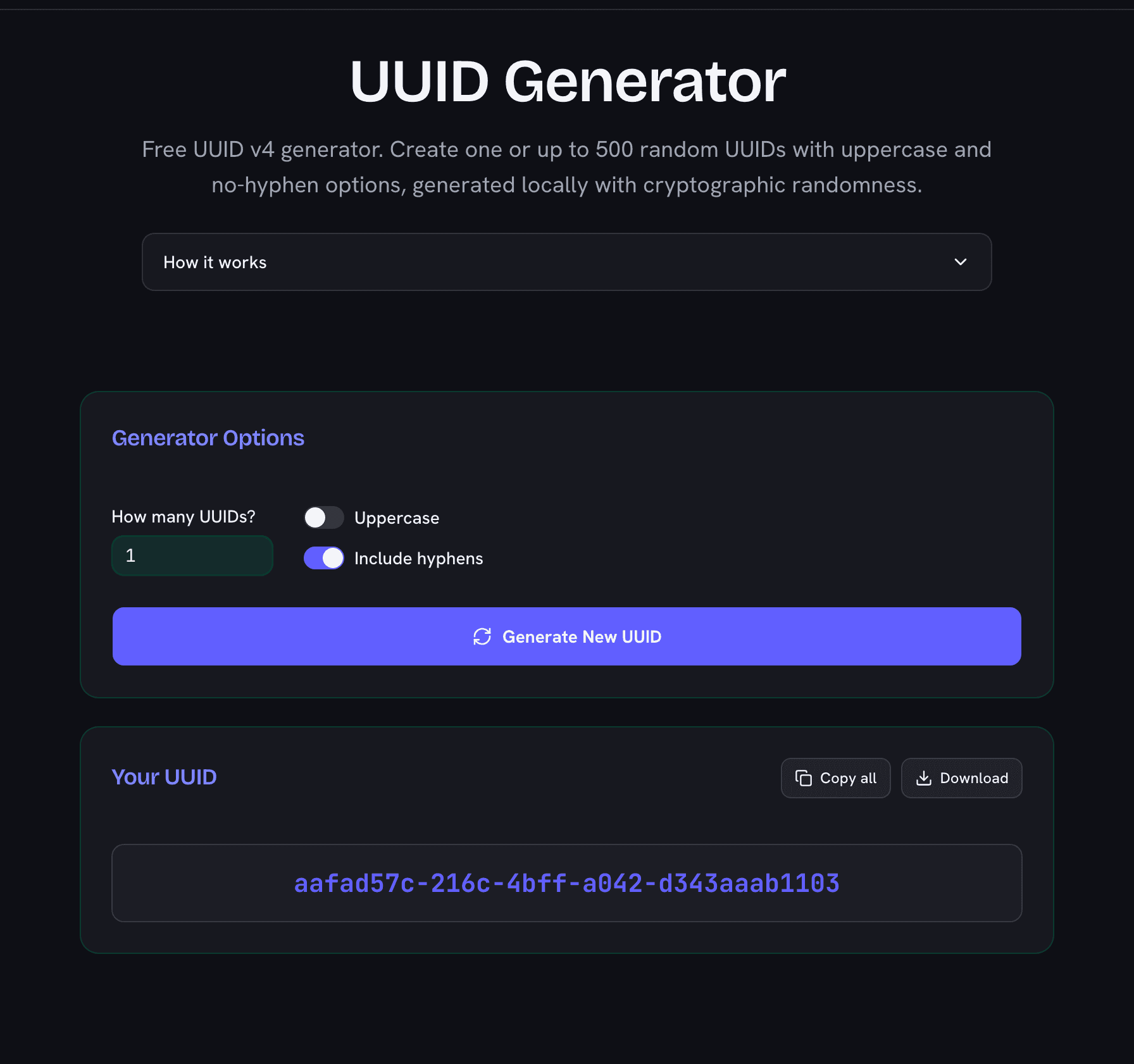
Free UUID v4 generator. Create one or up to 500 random UUIDs with uppercase and no-hyphen options, generated locally with cryptographic randomness.

Generate v4 UUIDs Instantly

This free UUID generator creates RFC 4122 version-4 UUIDs (also known as GUIDs) — singly for a quick copy-paste, or in bulk up to 500 at a time for test data and database seeding. Everything is generated locally in your browser with cryptographic randomness; nothing is requested from or sent to a server.

Where UUIDs Are Used

  • Database primary keys — IDs that can be generated on any client or server without coordination and merged later without conflicts.
  • API request and correlation IDs — trace a request across microservices by tagging it once at the edge.
  • File and resource names — collision-proof names for uploads, temp files, and S3 objects.
  • Test fixtures — realistic unique identifiers for seeding development and staging environments.

Anatomy of a v4 UUID

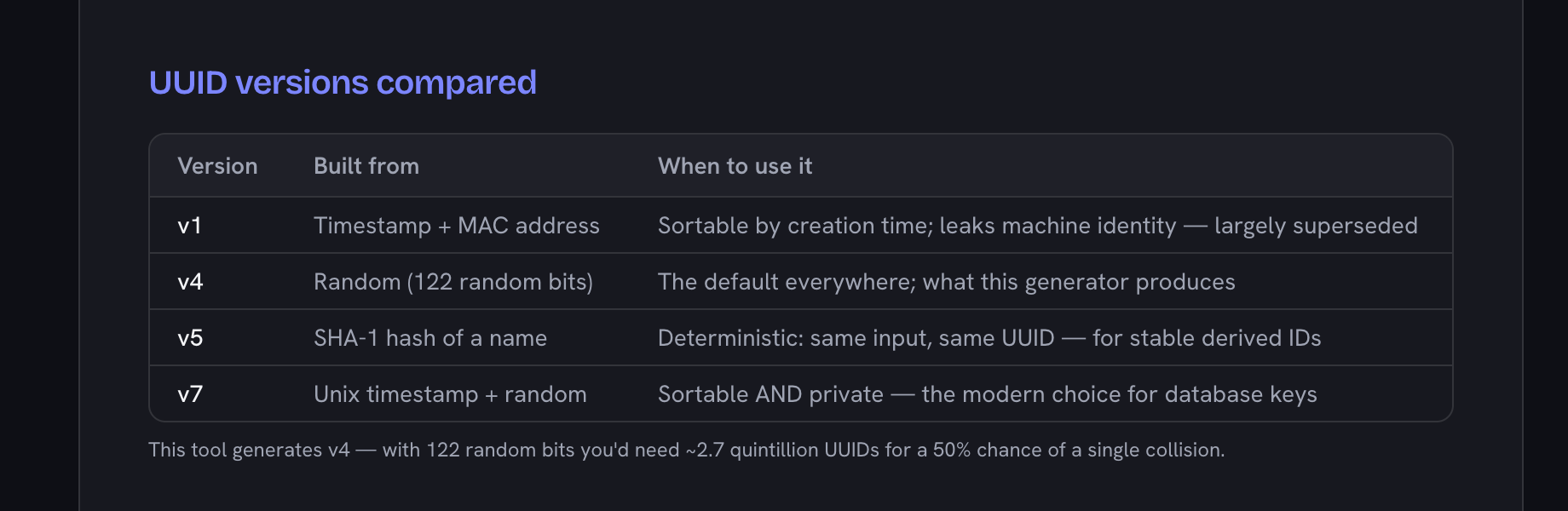
A UUID like 550e8400-e29b-41d4-a716-446655440000 is 32 hexadecimal digits in five groups (8-4-4-4-12). In version 4, the first digit of the third group is always 4 (the version), and the first digit of the fourth group is 8, 9, a, or b (the variant). The remaining 122 bits are pure randomness — that immense space is what makes collisions practically impossible.

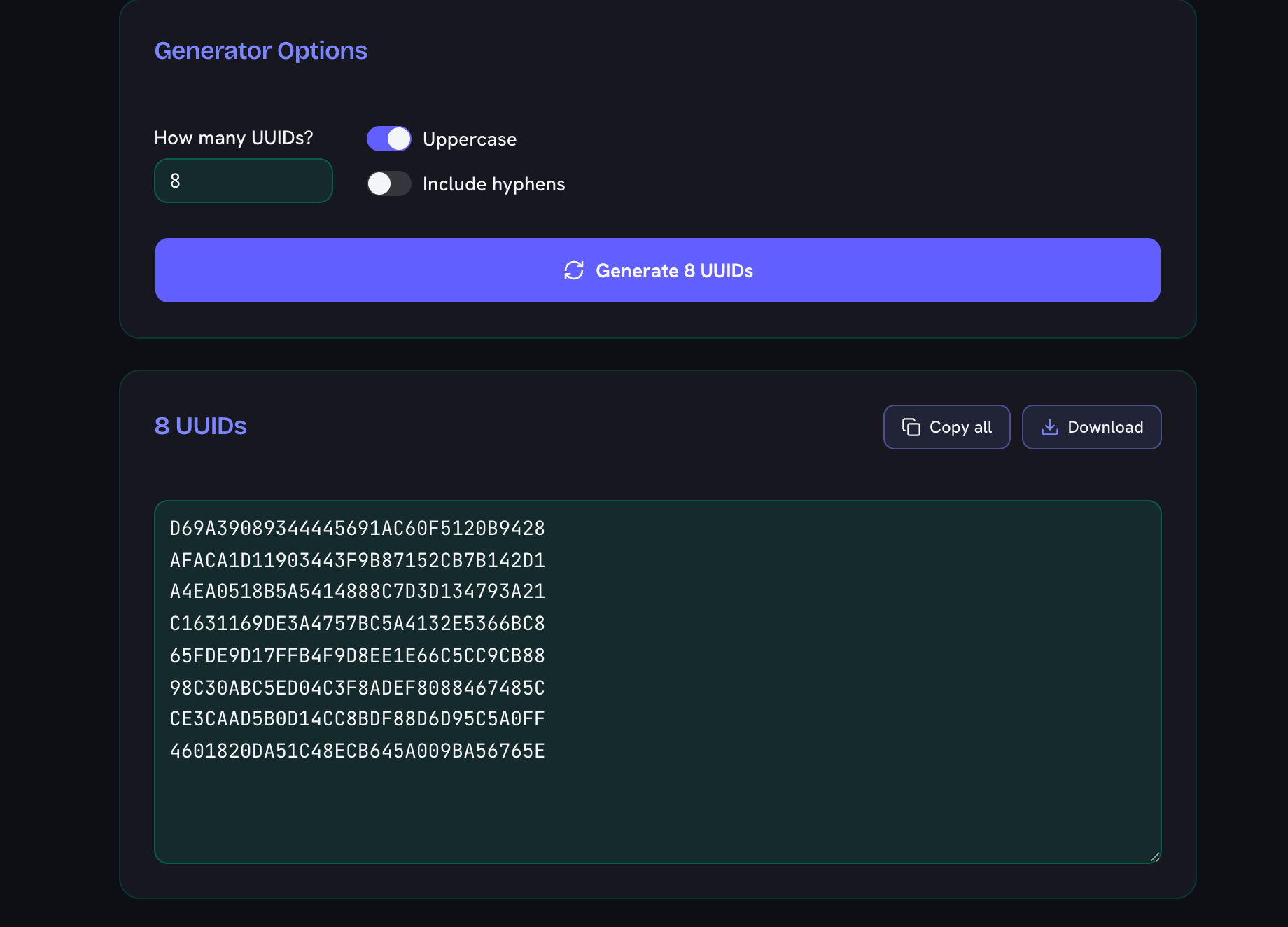
UUIDs are case-insensitive by specification: ABC… and abc… refer to the same identifier. Lowercase with hyphens is the canonical text form; use the toggles if your system expects uppercase or unhyphenated storage.
Frequently Asked Questions

What is a UUID?

A UUID (Universally Unique Identifier, also called a GUID) is a 128-bit identifier written as 36 characters, like 550e8400-e29b-41d4-a716-446655440000. Version 4 UUIDs are generated from random data, making collisions so unlikely they are treated as impossible in practice.

Are these UUIDs really unique?

A v4 UUID contains 122 random bits, giving about 5.3 undecillion possible values. You would need to generate roughly a billion UUIDs per second for 85 years to reach even a 50% chance of a single collision — which is why they are used as database keys and request IDs everywhere.

Is the generation cryptographically secure?

Yes. UUIDs come from your browser’s crypto API (crypto.randomUUID / getRandomValues), the same cryptographic randomness source password managers use — not from Math.random. Generation happens entirely on your device.

Can I generate UUIDs in bulk?

Yes — up to 500 at a time, one per line. Copy them all with one click or download them as a text file for seeding databases, test fixtures, or spreadsheets.

What are the uppercase and no-hyphen options for?

Some systems store or compare identifiers in uppercase (e.g. some Microsoft tooling) or as 32-character hex strings without hyphens (e.g. certain APIs and database columns). The toggles format the output to match whatever your system expects.

UUID v4 generator showing a freshly generated identifier with uppercase and hyphen options
Cryptographically random v4 UUIDs — single or up to 500 at once, formatted your way.