What Stabilizer Actually Does
Cyanuric acid (sold as stabilizer, conditioner, or already mixed into dichlor and trichlor) is sunscreen for chlorine. Without it, ultraviolet light tears free chlorine apart within hours: an unstabilized outdoor pool can lose most of its chlorine over one sunny afternoon. Cyanuric acid bonds reversibly with the hypochlorous acid doing the sanitising, parks most of it in a reserve sunlight cannot reach, and releases it as the working chlorine is used up.
That reserve is the whole trade. Chlorine held in the reserve is not sanitising while it is held, so the more stabilizer in the water, the more total chlorine you have to carry for the same killing power. That is not a rule of thumb; it is the reason the published FC/CYA chart is a set of percentages rather than a set of numbers.
Why More Is Not Better
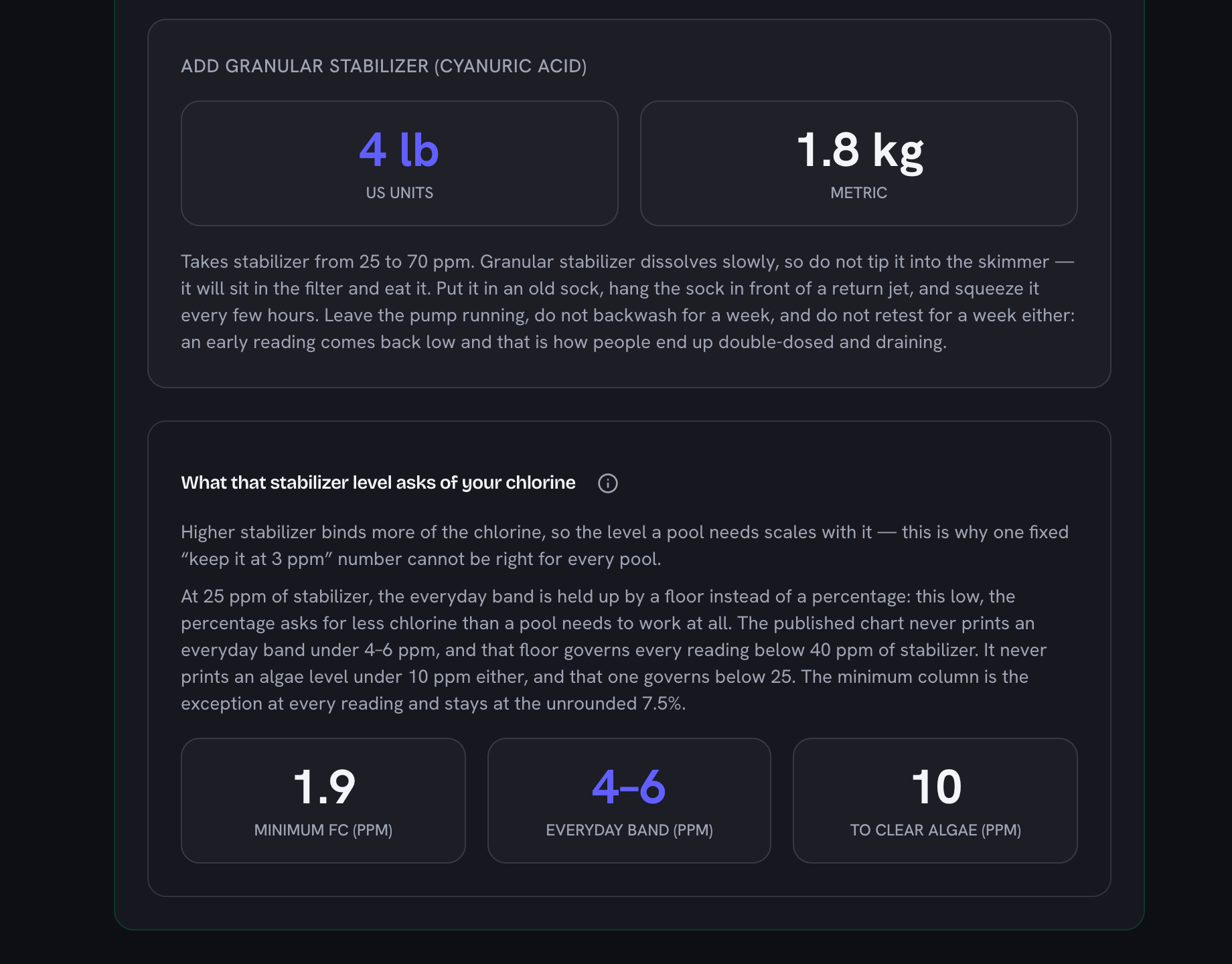
At 30 ppm of cyanuric acid, a pool needs a minimum of 2.3 ppm free chlorine and takes 12 ppm to clear algae. At 80 ppm the minimum is 6 ppm (2.6 times the chlorine for the same pool doing the same job) and clearing algae takes 32 ppm. Nothing about the water got safer; the bill got bigger and the margin for a missed week got thinner. This is why “my chlorine keeps disappearing” is so often a stabilizer problem in disguise: the reading that used to be fine is now below the minimum, and nobody moved the chlorine.
The Puck Trap
Almost nobody adds too much stabilizer on purpose. It arrives with the chlorine. Trichlor is about half cyanuric acid by weight, so a feeder holding free chlorine up by 2 ppm a day adds about 37 ppm of stabilizer over a 30-day month. Dichlor is worse per unit of chlorine: the same run adds around 55 ppm. Two months of pucks on a pool that started the season correct is enough to push it out of the band, which is exactly why a pool that behaved in June fights algae in August on an unchanged routine.
The fix is not to stop using pucks; it is to know what they cost. Test cyanuric acid monthly through the season. Once you are in band, switch the routine chlorine to liquid or cal-hypo, which add none, and keep the stabilized products for the start of the year when the stabilizer is wanted. The pool chemical calculator shows the stabilizer and calcium each product carries on the same screen as its dose, and the pool volume calculator gives the number every one of these doses depends on. Salt-water pools have their own reason to run stabilizer high, and their own arithmetic. The pool salt calculator covers that side.
Getting It Back Down
There is one method and it is water. Draining and refilling dilutes cyanuric acid in direct proportion (half the water out halves the reading) and nothing else does. It is not consumed by chlorine, not broken down by sun, and not removed by any product with published evidence behind it. Do it in stages rather than in one go if the pool is vinyl or fibreglass or the water table is high, because an empty shell can float or crease. And if you live somewhere it rains, the pool has been quietly doing this for you all along.