What a Salt Chlorine Generator Actually Wants
A saltwater pool is a chlorine pool. The generator passes water over a cell that splits dissolved salt into chlorine, the chlorine sanitizes, and it recombines into salt again — which is why the salt level barely moves from month to month and why nothing in the pool “uses it up”. The number you are managing is the salinity the cell needs to work at all: too low and it produces little or no chlorine while the water looks fine for a few days, too high and it warns, shuts down, or wears out faster.
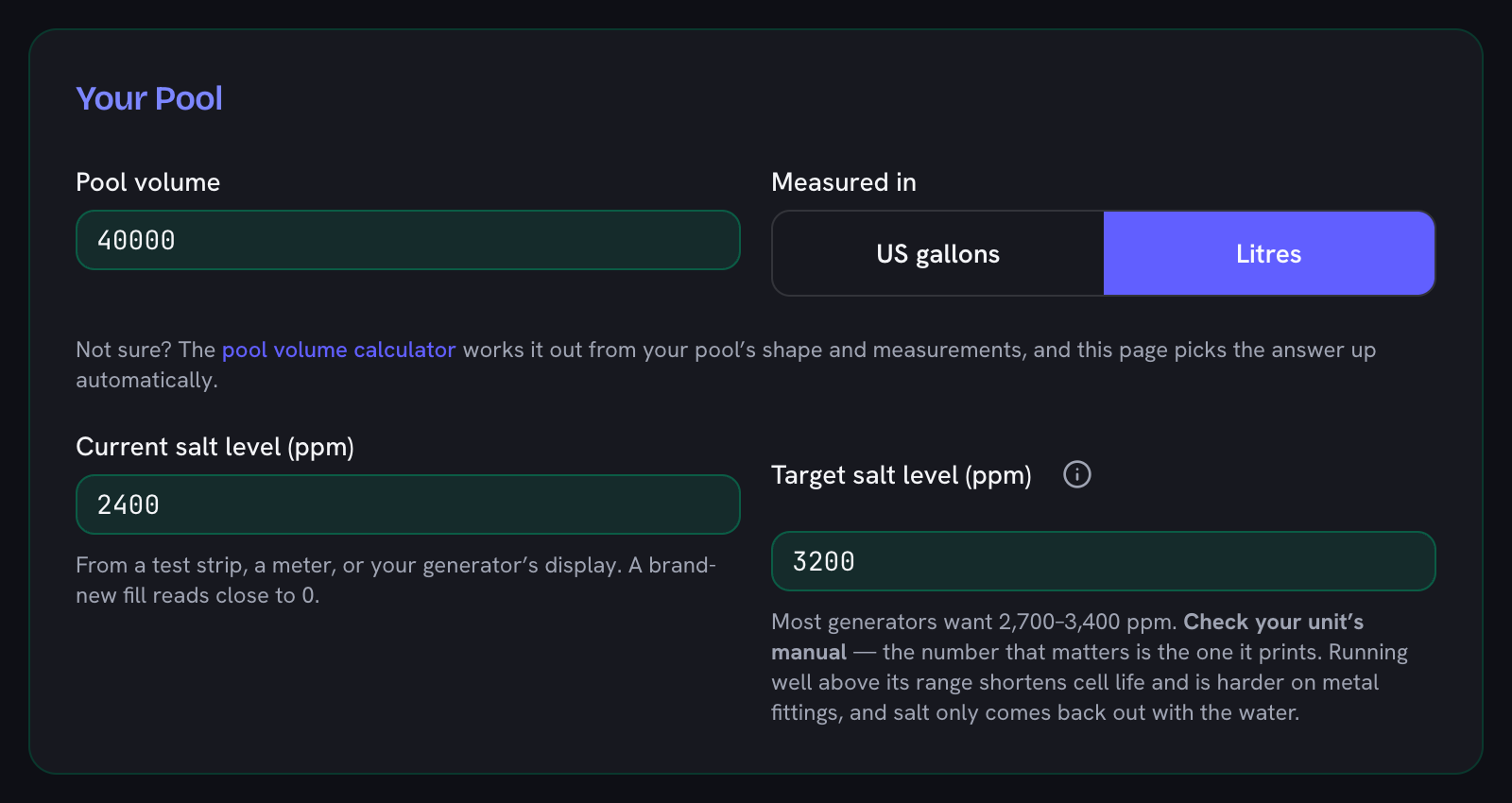
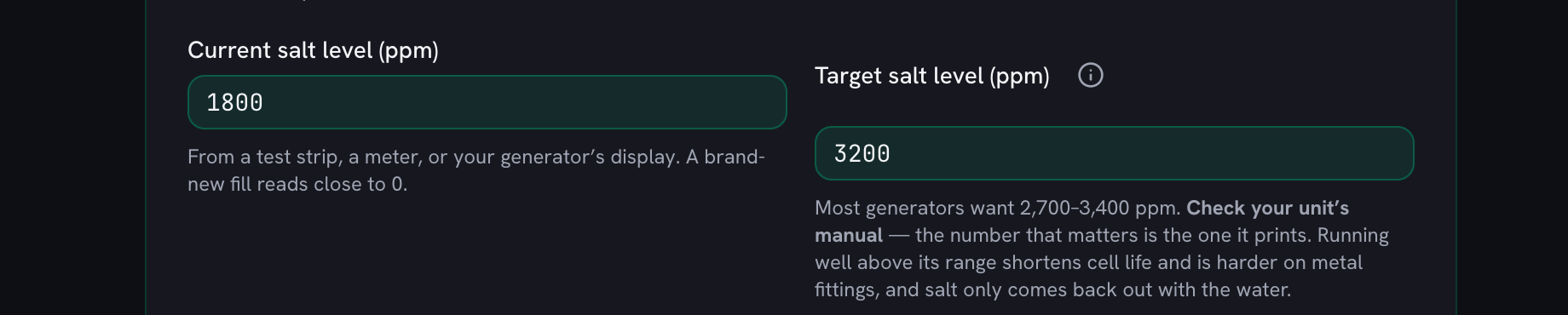
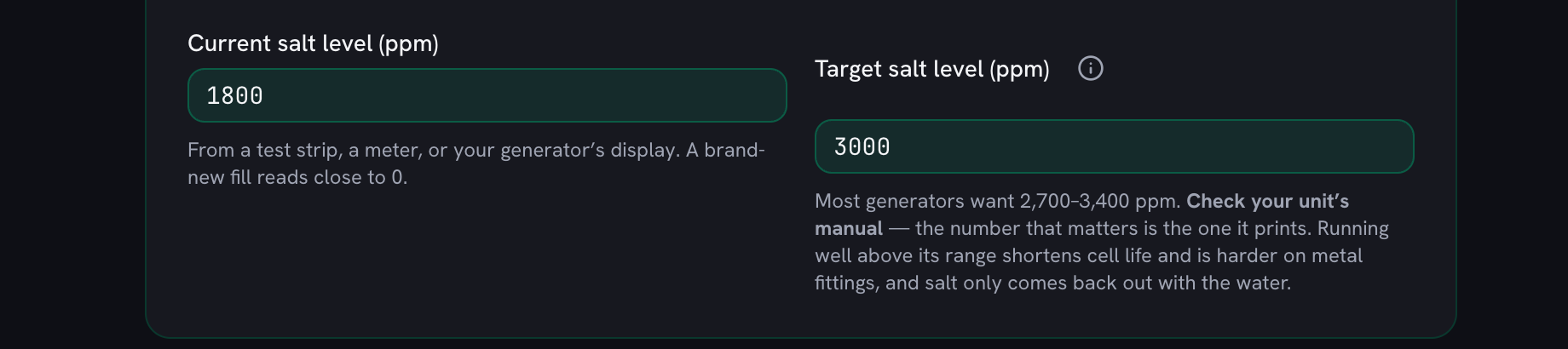
Most residential units sit between 2,700 and 3,400 ppm, and 3,200 is a reasonable middle target — but brands really do differ, so the manual is the authority and this calculator lets you type whatever it says. For scale, a pool runs at roughly a tenth of the salinity of seawater. Can you taste it? Some people can. Sensitivity varies enormously: the most sensitive palates notice salt from around 1,000 ppm, most people somewhere between 3,500 and 6,000, so at a 3,200 ppm target a few of your swimmers will register something — usually described as the water feeling soft rather than tasting salty. Drift above target and more of them will.
Why the Answer Comes Back in Bags
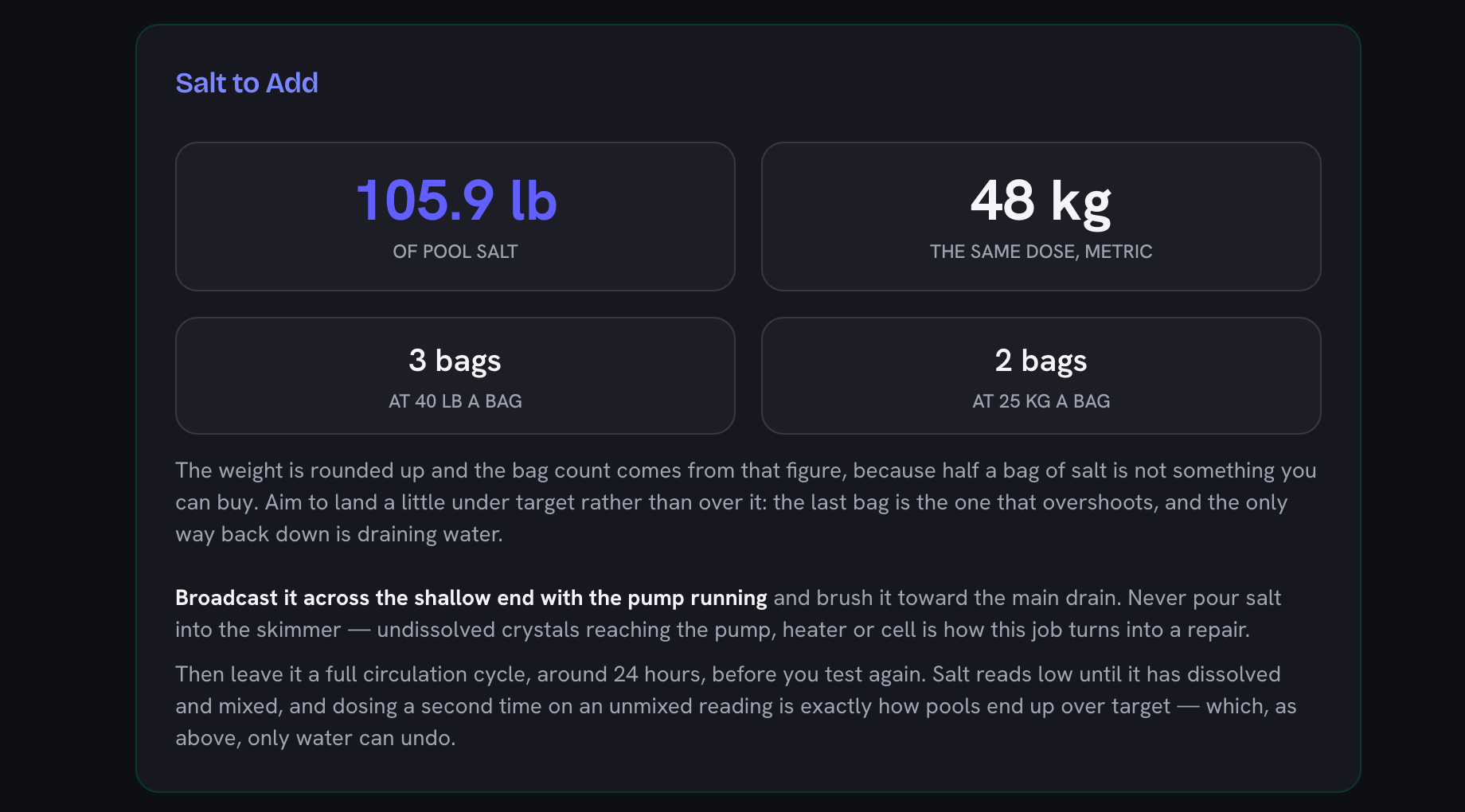
The chemistry is the easy part. One part per million is one milligram per litre, so raising a pool by 1 ppm takes one gram of salt per 1,000 litres, and the whole dose is that multiplied by how far the reading has to move. What actually decides your afternoon is the packaging: salt is sold in 40 lb bags in the US and 25 kg bags in most of Europe, and you cannot buy 2.5 of them. So the result is rounded up to whole bags in both markets, and the advice attached to it is to aim a little under target — an extra bag is far easier to add next week than to take out ever.
Salt Only Goes One Way
There is no chemical that lowers salinity, no filter that catches it, and no amount of running the generator that consumes it. If you overshoot, the only lever is replacing water: drop from 4,000 to 3,200 ppm and you are replacing 20% of the pool. Enter a current reading above your target and the calculator switches to exactly that answer — the percentage and the actual volume, in gallons and litres.
Salt does leave on its own, but only inside water that leaves: splash-out, backwashing a sand filter, a rain overflow, a leak, or a winter drain-down. Evaporation leaves it all behind. So the honest maintenance rhythm is to test after anything that removed water, and not to bother otherwise.
Adding It Without Damaging Anything
Broadcast the salt across the shallow end with the pump running, then brush it toward the main drain so it dissolves in moving water. Do not pour it into the skimmer: undissolved crystals travelling to the pump, heater or cell is how a fifteen-minute job becomes a repair. Give it a full turnover, around 24 hours, before re-testing — salt reads low until it has mixed, and a second dose based on an unmixed reading is the single most common way pools end up over target.
The Rest of the Water Still Needs Watching
Salt is the one reading a saltwater pool adds; it does not replace the others. The generator makes chlorine but it does not manage stabilizer, and a saltwater pool without enough cyanuric acid burns its chlorine off in sunlight faster than the cell can make it. Generators also push pH up over time, which is what the pool chemical calculator is for. And all of it starts from the volume — if you have not measured yours, work it out from your pool’s shape first, or start at the pool calculators hub.
How Much Salt, By Pool Size
The four columns are the situations people actually turn up in: a small top-up after rain, a mid-season correction, a pool that has been diluted hard by a drain-and-refill, and a fresh fill starting from zero. Both tables are computed by the same functions the calculator runs.