The Number Every Other Pool Number Depends On
Almost nothing you do to a pool can be worked out without knowing how much water is in it. Chlorine, acid, alkalinity increaser, stabilizer and salt are all dosed in parts per million, and a part per million is a milligram per litre — so every dose is your volume multiplied by how far the reading has to move. Get the volume 20% wrong and every dose you ever calculate is 20% wrong in the same direction, quietly, for years.
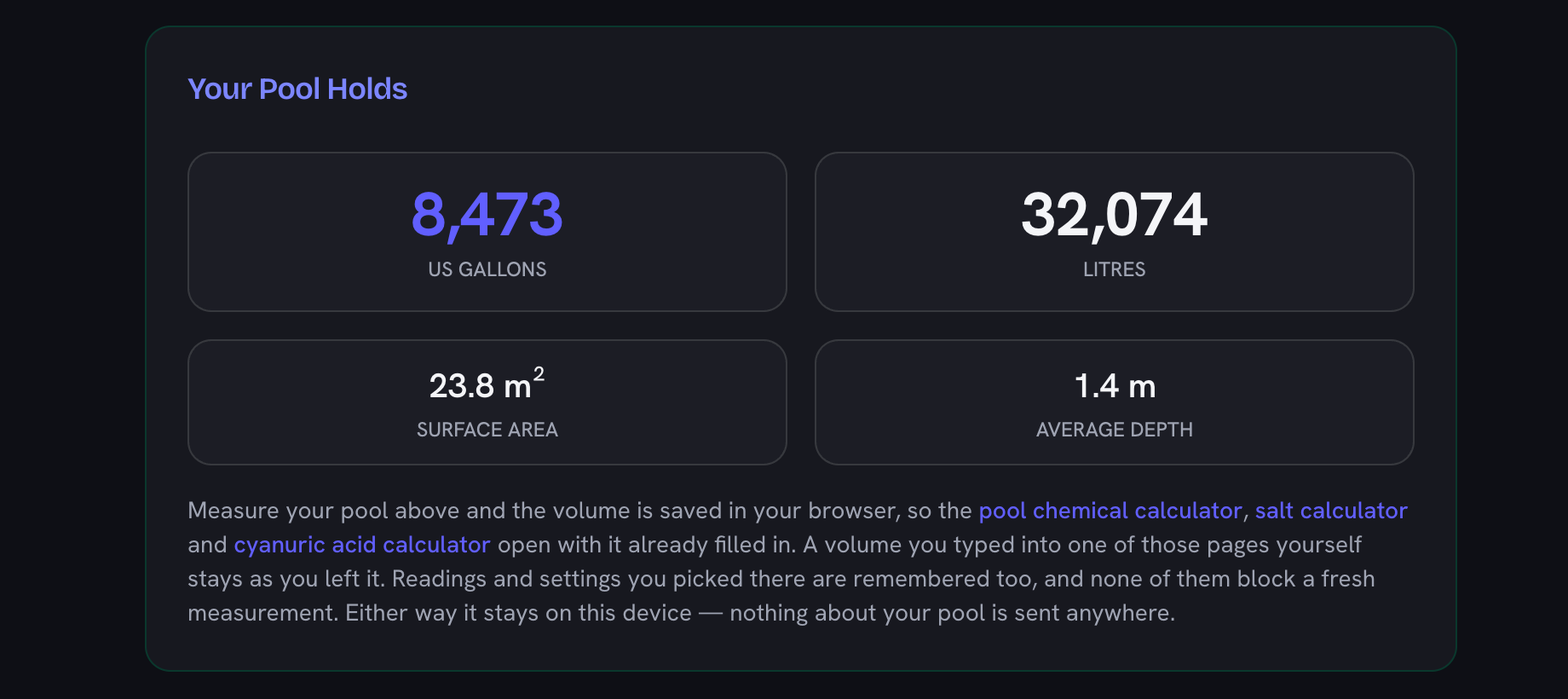
That is the whole job of this page. Measure once, carefully, and the number is done — the calculator keeps it, and the pool chemical calculator, the salt calculator and the cyanuric acid calculator start from it instead of asking you again. If you want the whole set in one place, the pool calculators hub lays out which one answers which question.
How Each Shape Is Worked Out
Three of the four shapes here are exact geometry, and one is an honest approximation:
- Rectangle: length × width. No cleverness available or needed.
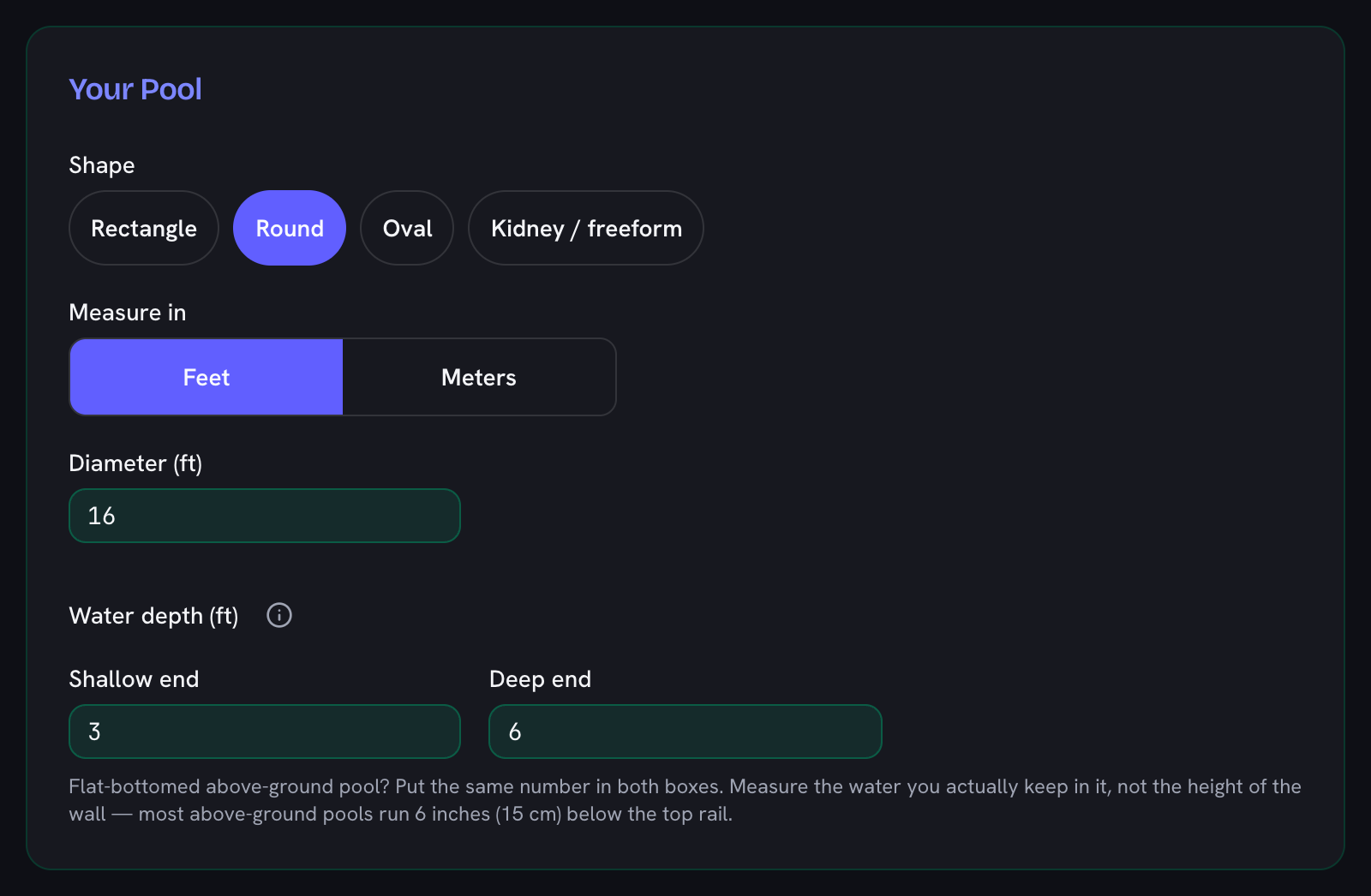
- Round: π × (diameter ÷ 2)². This is the one where people accidentally double their pool by typing the diameter into two boxes, so the calculator only offers one.
- Oval: π × (length ÷ 2) × (width ÷ 2) — the area of an ellipse. Above-ground “oval” pools are usually a rectangle with two half-circle ends rather than a true ellipse, which makes them hold a few percent more than this; if yours has straight sides, measuring it as a rectangle and adding the two end caps gets closer.
- Kidney and freeform: 0.45 × (width A + width B) × length, where A is the widest point and B is across the narrow end. That factor is the approximation manufacturer volume worksheets print, and it lands slightly under a true double-ellipse. Being a shade low is the right direction for a number that sizes chemical doses.
Average Depth Is Where the Errors Live
Volume is surface area times average depth, and averaging the shallow end with the deep end is the convention every manufacturer chart uses. It is exact when the floor slopes evenly from one end to the other. It is generous when the pool has a long flat shallow section and then drops into a short deep hopper, because most of the floor is nowhere near that midpoint depth — on a pool like that, measure the depth at three or four points along the floor and average those instead.
The other common miss is measuring the wall rather than the water. A 52-inch above-ground wall does not hold 52 inches of water. Published charts — and the round table below — assume a 4 ft fill in that wall, which is 4 inches below the rail. Plenty of pools run closer to 6 inches down, and that alone is about 4% less water than the chart figure. Inches count here: a pool filled 3 inches lower than you assumed is about 6% smaller than the number you were dosing against, so measure the water line rather than reading a size off the box.
Gallons and Litres, Both, Always
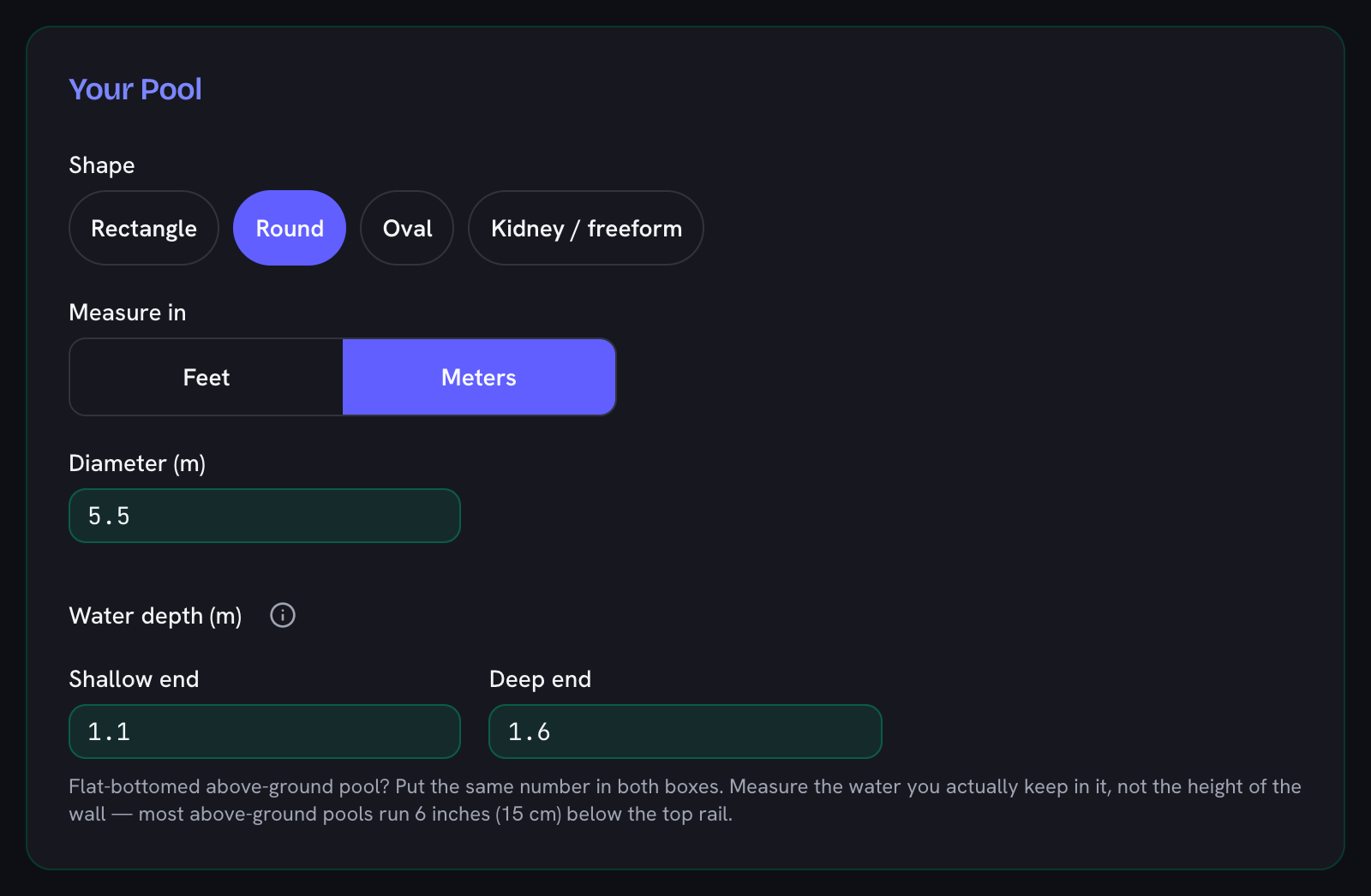
Pool volume calculators tend to pick a side, which is unhelpful the moment your pool is in one country and your chemical label was printed in another. Every result here shows US gallons and litres together. A cubic meter is 1,000 litres, so a 8 × 4 m pool sloping from 1.2 m to 1.8 m averages 1.5 m and holds 48,000 litres — the number a European dosing label wants, since most of them are written per cubic meter or per 10,000 litres.
Common Pool Sizes, Already Worked Out
If your pool is a standard size, the two tables below already have it. They are computed by the same functions the calculator runs, so they cannot drift away from what the tool tells you. Anything non-standard — and every kidney and freeform pool — is what the calculator is for.