Why One Calculator Instead of Six
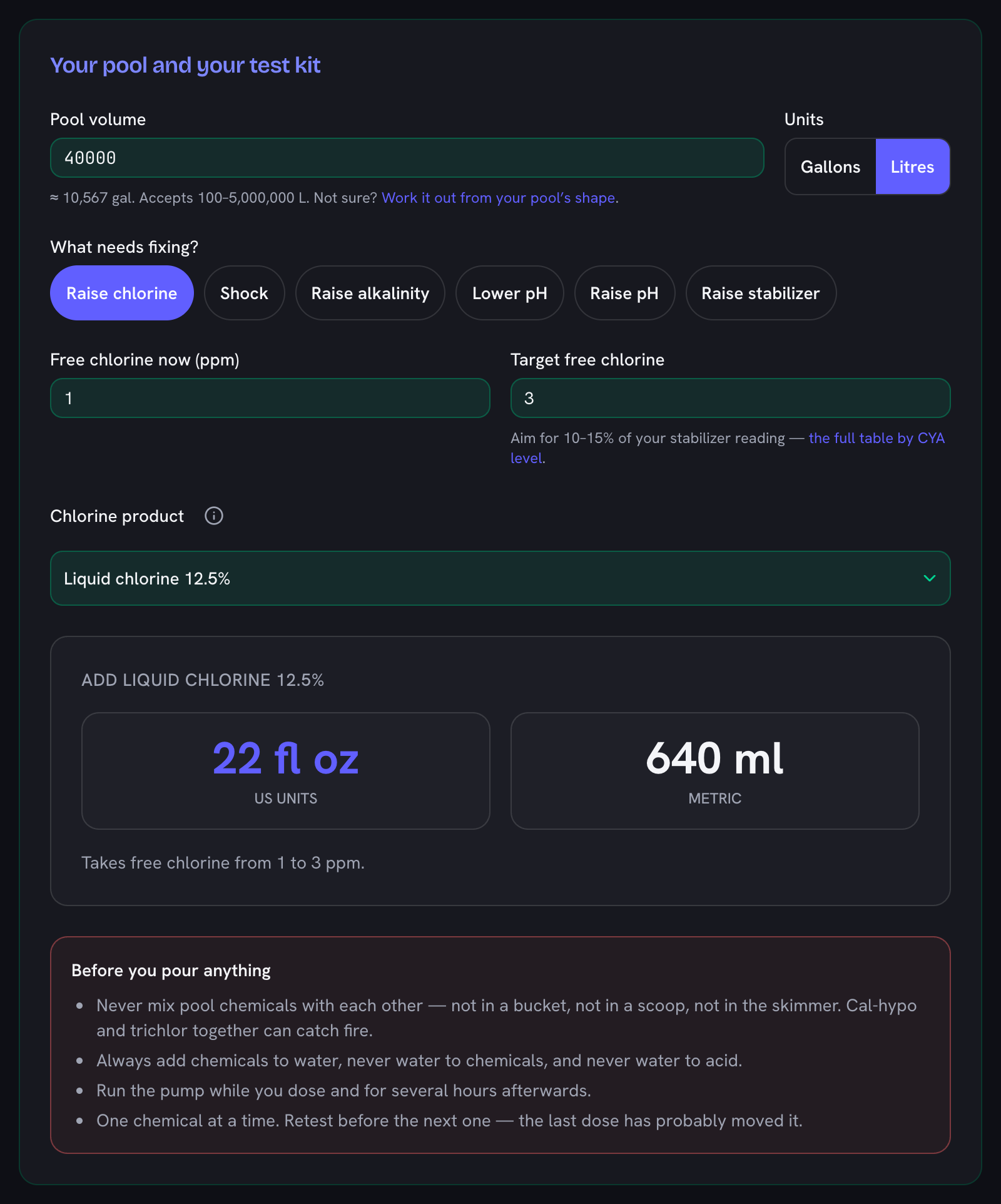
Most pool sites give you a separate page per chemical, and the split quietly hides the thing that matters: the doses interact. Every scoop of stabilized chlorine leaves cyanuric acid behind — dichlor adds 9.1 ppm of it for every 10 ppm of chlorine it delivers — and cyanuric acid raises the chlorine level your pool needs from then on. A puck feeder holding free chlorine up by 2 ppm a day adds roughly 37 ppm of stabilizer over a 30-day month, which is how a pool that was fine in June is fighting algae in August with the same routine. Cal-hypo has its own passenger: 7.1 ppm of calcium hardness per 10 ppm of chlorine, which is nothing in soft water and scale on the tiles in hard water.
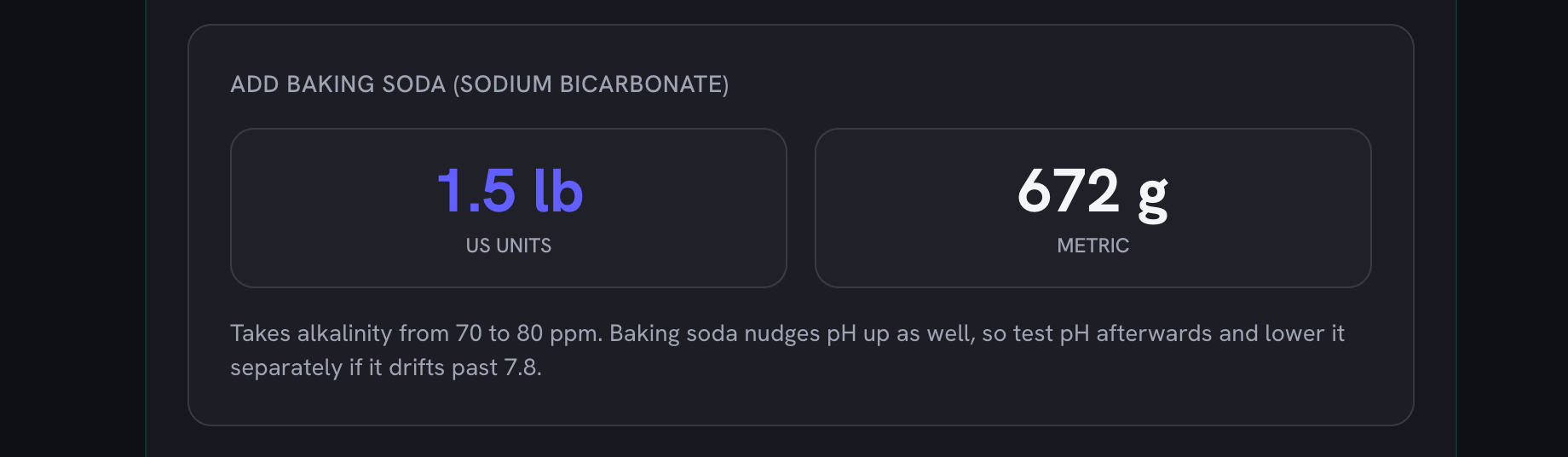
The same tangle runs through the rest of it. Baking soda raises alkalinity and nudges pH up with it. Acid lowers pH and takes alkalinity down too. Soda ash raises both. A tool that treats them as six independent problems will happily send you round in circles, so this one keeps them in one place and names the side effect on the same screen as the dose.
What This Pool Chemical Dosage Calculator Computes
Chlorine, alkalinity and stabilizer are linear: 1 ppm is 1 mg per litre, so the mass of active agent is the change you want multiplied by the volume, divided by the product’s active fraction. That is why strength matters more than brand — 12.5% liquid and 10% liquid differ by a quarter, and 73% cal-hypo does the same work as 65% in 11% less weight.
pH does not work that way, and this is where a swimming pool chemical calculator either earns its keep or misleads you. Pool water is buffered, so the acid a pH move takes depends on how much buffer is in the water — alkalinity, and stabilizer, which buffers too. This page solves the carbonate and cyanurate equilibrium at your readings rather than reading a fixed ounces-per-0.1-pH table, and the difference is not small: at the two ends of a normal alkalinity range the same pH move needs 1.9 times as much acid.
The Honest Limits
The pH figures are estimates and are presented that way. The model assumes 25°C water, no borates, and ignores salt and ionic strength; muriatic acid is computed as the 31.45% (20°Bé) US bottle, so a different concentration needs scaling by the ratio of strengths. Real pools bring measurement error of their own — a drop test resolves alkalinity to about 10 ppm, and every dose here is only as good as the reading you fed it. Treat the result as a first dose, add it with the pump running, wait four hours, and retest. The chlorine, alkalinity and stabilizer numbers are on firmer ground: those are stoichiometry, computed from the available-chlorine percentage each product states on its own label. Where a label’s dosing chart disagrees with what you read here, follow the label — brands round their charts to whole scoops and cups, and they round conservatively, so their figures differ from each other as much as they differ from ours.
The chemistry behind the page is standard and checkable. Product strengths are the figures on mainstream US and EU labels; alkalinity uses the 84/50 equivalent-weight ratio for sodium bicarbonate; the carbonate equilibrium constants are the 25°C freshwater values from Stumm and Morgan; the chlorine and stabilizer relationship comes from the hypochlorous-acid and cyanurate binding work of O’Brien, Morris and Butler (1974), which is what the familiar FC/CYA chart is built on.
Litres and Grams, Not Converted Gallons
Nearly every pool dosing chart online is written for a 10,000-gallon US pool, and metric owners are left dividing by 3.785. This one is metric-native: type litres, get grams, kilograms and millilitres, and read reference tables built on round metric pool sizes rather than the awkward conversions of American ones. Both systems appear on every result, because plenty of people buy a US-labelled product for a pool they measured in metres.
Working through a whole set of readings? The pool volume calculator works out the number every dose on this page depends on, and hands it straight to this one — unless you have already typed a volume in here, in which case yours stays put. The cyanuric acid calculator goes deeper on stabilizer, including the only way to bring it down, and the pool salt calculator covers salt-water generators.