A 5e Travel Calculator That Shows the Math
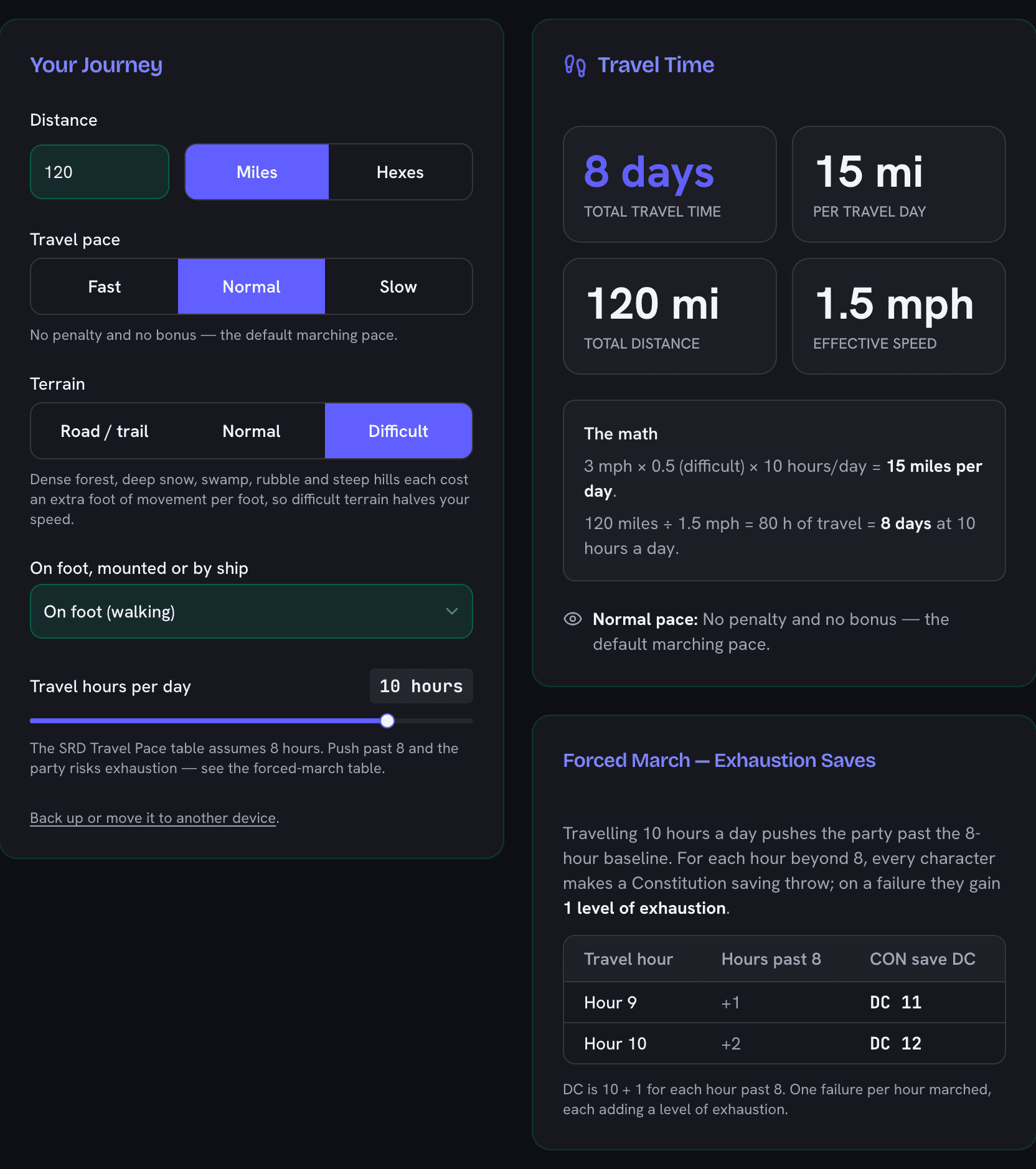
Overland travel is one of the most-skipped rules in fifth edition, usually because nobody wants to stop and do the arithmetic. This 5e travel calculator does it for you: enter a distance in miles or hexes, pick a pace and terrain, choose whether the party is on foot, mounted, or aboard a ship, and it returns the journey in days and hours — with the base speed, the terrain multiplier, the miles per day, and the total travel hours all shown, so you learn the system instead of just trusting a number.
Travel Pace in 5e: Fast, Normal, and Slow
Travel pace 5e comes in three settings. A normal pace covers 3 miles per hour, or 24 miles in a standard 8-hour day. A fast pace is 4 mph (30 miles a day) but imposes a -5 penalty to every character’s passive Perception — you move quickly and miss the ambush. A slow pace is 2 mph (18 miles a day) and is the only pace that lets the party travel while using Stealth, sneaking up on a location or avoiding a patrol. The calculator surfaces each pace’s side effect the moment you pick it, because the trade-off is the whole point of the choice.
Terrain, Ships, and Hex Crawls
Difficult terrain halves your speed: a 24-mile day becomes 12 miles through swamp or deep snow. Roads and open country move at full pace. For a hex crawl, switch the distance unit to hexes and set your map scale — 6, 12, or 24 miles per hex are the common conventions — and the tool converts hexes to miles before computing the time. Travelling by water uses the SRD ship speeds instead of a pace: a sailing ship makes 2 mph and, because ships can sail day and night, 48 miles in a 24-hour day; a galley makes 4 mph and 96. Turn on “sail through the night” and the calculator switches to the round-the-clock travel day.
The SRD Travel Pace Table
The System Reference Document publishes rounded whole-day figures — 30, 24, and 18 miles — for a full 8 hours of travel. This tool works from the per-hour speed (4, 3, and 2 mph) so it can scale to any number of travel hours and any terrain, which is why an exact 8-hour day computes to 32 miles at a fast pace (the book rounds to 30) and 16 miles at a slow pace (the book rounds up to 18) — normal pace lands exactly on the book’s 24. Both the computed and official numbers are shown below alongside each pace’s side effect.
Forced March and Exhaustion
Want to reach the besieged keep before dawn? Push past 8 hours and you are on a forced march. For every hour beyond the eighth, the party covers the extra ground but each character rolls a Constitution saving throw against a DC of 10 + 1 per hour past 8. Fail, and that character gains a level of exhaustion — and exhaustion in 5e stacks fast and bites hard. Slide the travel-hours control past 8 and the calculator prints the full save-DC table so nobody is surprised at the table. The distances below are the ship speeds the water-travel mode uses.
Where This Fits Your Game
Travel time turns a map into a schedule: rations, spell durations, a rival’s head start, the moon phase for the ritual. Once you know the journey takes six days, the wilderness stops being a blank transition and starts having stakes. When you arrive and a fight breaks out, the D&D encounter difficulty calculator rates it easy to deadly, the D&D stat roller builds the travellers, and the dice roller handles every random encounter and navigation check along the road.
This calculator uses rules from the System Reference Document 5.1 by Wizards of the Coast LLC, available under the Creative Commons Attribution 4.0 International License (CC-BY-4.0). No text outside the SRD is reproduced.