lans.cloud Tools

Nether Portal Calculator

Free Minecraft nether portal calculator: convert Overworld coordinates to Nether coordinates and back with the exact ÷8 floor rule the game uses, so portals link perfectly.

Quick answer

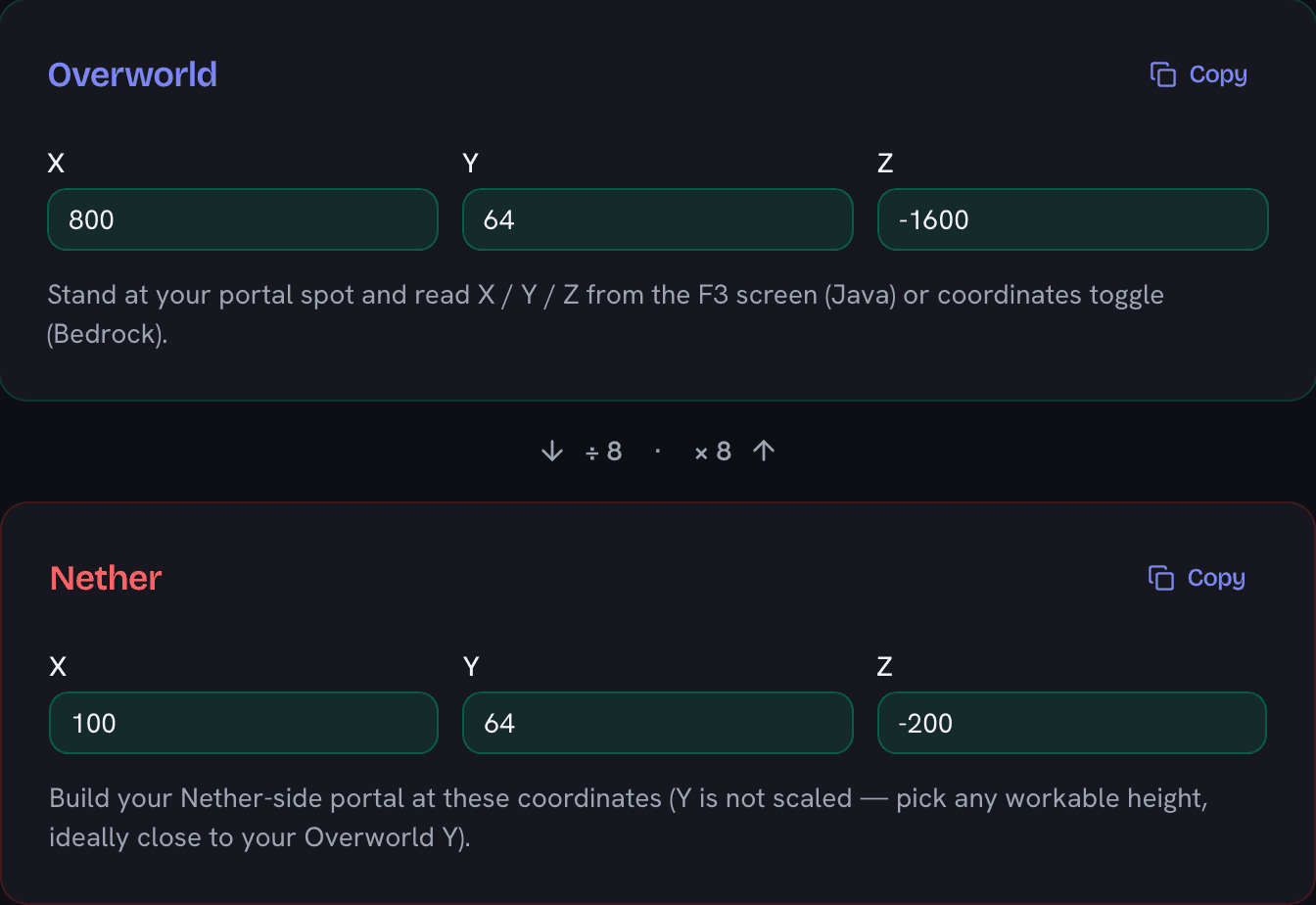
To link Nether portals, divide your Overworld X and Z by 8 (round down) to get the matching Nether coordinates — X 800, Z −1600 becomes X 100, Z −200. Going the other way, multiply the Nether X and Z by 8. Y never scales. Enter either side and the calculator converts instantly, using the exact floor division the game applies (so negative coordinates come out right). Works on both Java and Bedrock.
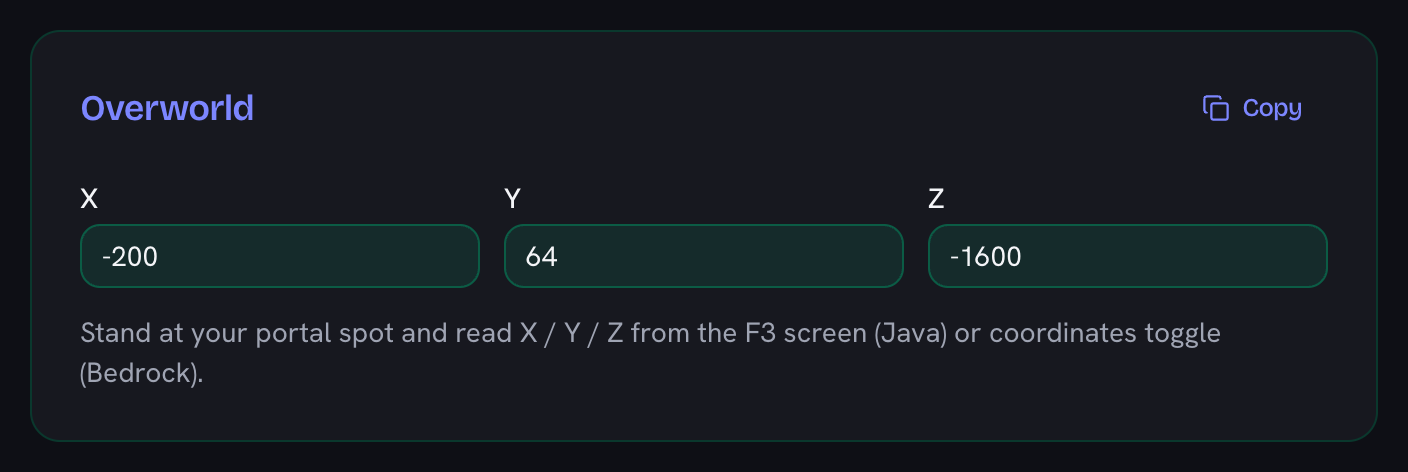
Overworld

Stand at your portal spot and read X / Y / Z from the F3 screen (Java) or coordinates toggle (Bedrock).

÷ 8·× 8
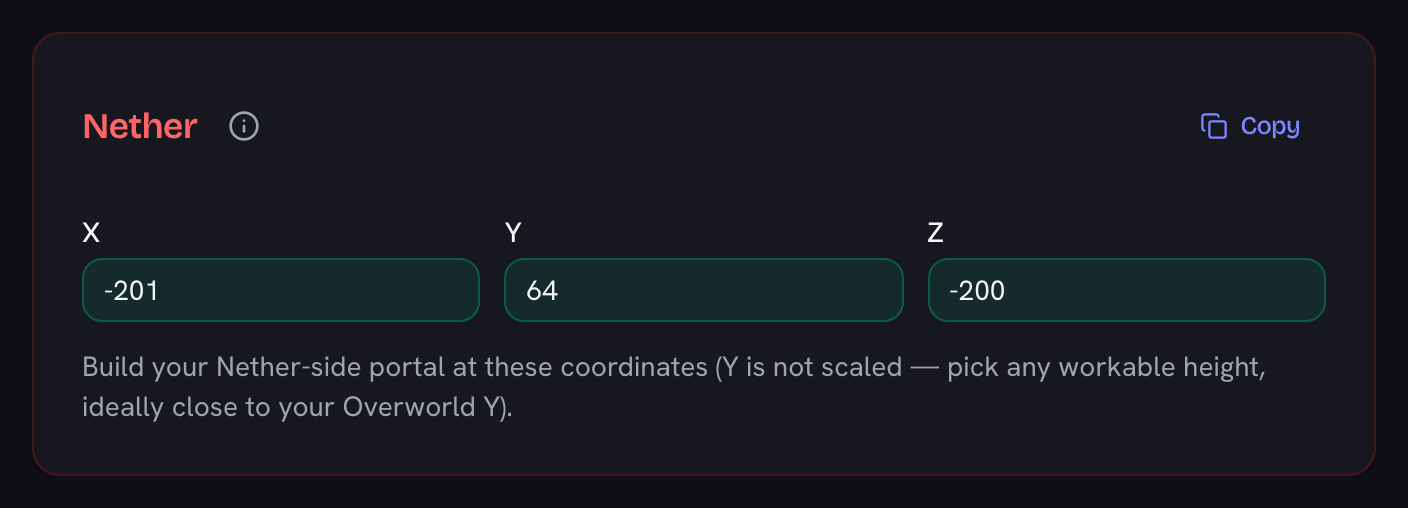
Nether

Build your Nether-side portal at these coordinates (Y is not scaled — pick any workable height, ideally close to your Overworld Y).

Was this tool helpful?
Support this site

More tools

How to calculate Nether portal coordinates

Convert either direction in the calculator above — nothing to press, nothing to install. The whole rule is ÷8 on X and Z. It catches people out in three places: negative coordinates, the Y axis, and the search radius that makes the game link you to the wrong portal anyway.

  1. Read your Overworld coordinates off the F3 screen

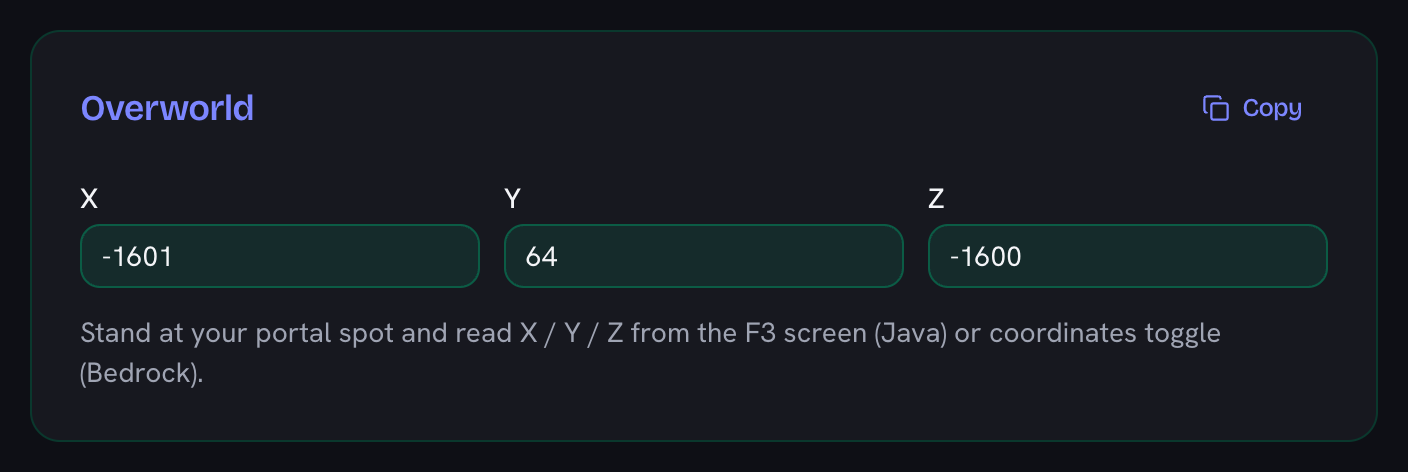
    Stand where you want the portal and open the debug screen (F3 on Java) or the coordinates toggle (Bedrock). Type the X, Y and Z you see into the Overworld panel at the top.

    The Overworld panel with X set to -1601, Y 64 and Z -1600, and the caption telling you to read those off the F3 debug screen
  2. Read the Nether panel — it converts as you type

    There is no button to press. X and Z are divided by 8 and Y passes straight through. The division is floored the way the game floors it, so -1601 comes out as -201, not -200 — that one block is where hand-math disagrees with Minecraft.

    The Nether panel showing X -201 and Z -200 after the divide-by-8 conversion, with Y left at 64 unscaled
  3. Dig to those coordinates and build the frame yourself

    Copy the Nether coordinates from that panel header and travel to the spot rather than letting the game auto-generate a portal, which tends to land somewhere useless like a lava ocean roof. The minimum frame is 10 obsidian; filling the four corners takes 14.

  4. Or work backwards from a portal you already have

    Type into the Nether panel instead and the Overworld panel shows where that portal drops you, multiplying X and Z by 8. It is the quickest way to find out what an existing Nether portal actually links to before you commit to digging.

    The Overworld panel reading X -200 after -25 was typed into the Nether panel, showing the conversion running in reverse

Perfect Portal Linking, Every Time

The Nether runs on an 8:1 scale: one block there equals eight in the Overworld. When you step through a portal, the game divides your X and Z by 8 (or multiplies, coming back), then hunts for the nearest existing portal around that point. Auto-generated portals land wherever the game finds space — often on a lava ocean roof — which is why serious players convert the coordinates first, dig to the exact spot, and build the frame themselves. A hand-built frame needs just 10 obsidian (14 with the corners filled in), so it is worth carrying a spare stack. Enter either side above; the other side updates instantly.

Nether Portal Distance: The Travel Math

Overworld distance vs Nether tunnel distance

Overworld tripNether tunnelWalk time (Overworld)Walk time (Nether)
500 blocks63 blocks1.5 min0.2 min
1,000 blocks125 blocks3 min0.4 min
2,000 blocks250 blocks5.9 min0.7 min
5,000 blocks625 blocks14.8 min1.9 min
10,000 blocks1,250 blocks29.7 min3.7 min
25,000 blocks3,125 blocks74.2 min9.3 min

Walk times at sprint speed (~5.6 blocks/s), straight-line. Ice roads and boats make the Nether side several times faster again.

Hub Building Tips

Pick one Overworld base as the origin, convert every outpost with this calculator, and connect them with tunnels at a fixed Nether Y (many builders use Y 120+, above the ceiling on Java via the roof, or a safe Y 64 corridor). Label each junction with the Overworld coordinates it serves — future you will be grateful. Planning circular hub rooms? The Minecraft circle generator draws the block-perfect outline for any diameter. And since every Nether trip comes home with Blaze Powder, Ghast Tears and Glowstone, the Minecraft potion chart shows what to brew with the haul — while the villager trading chart plans the trading hall your hub tunnels feed.
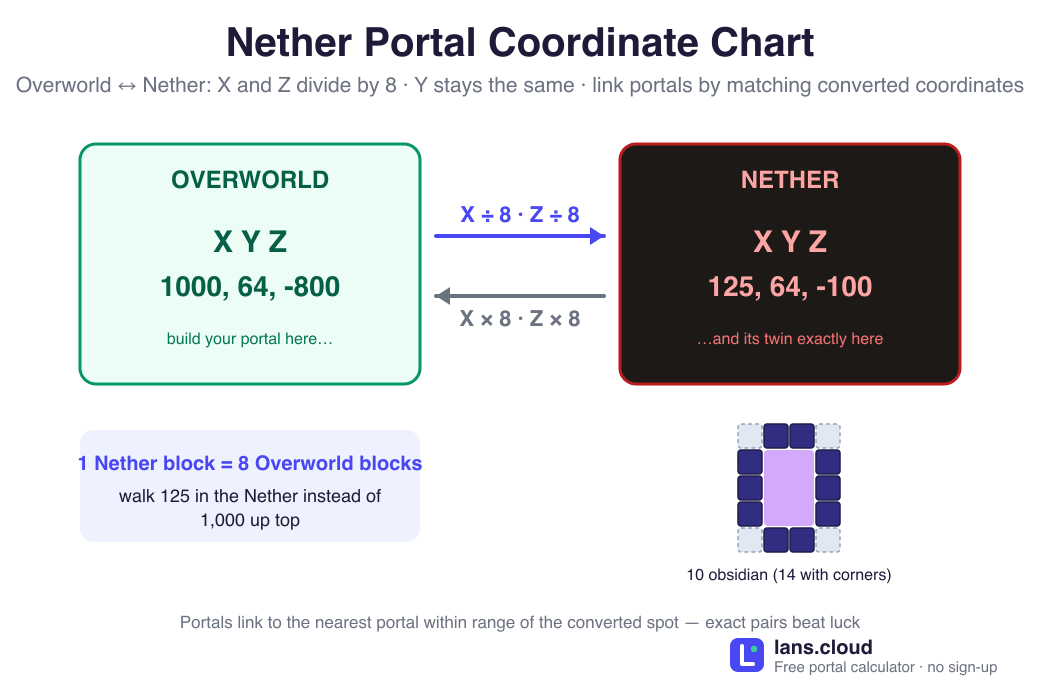
Minecraft nether portal coordinate chart: overworld coordinates 1000, 64, -800 convert to nether coordinates 125, 64, -100 by dividing X and Z by 8 while Y stays the same, with the 1-nether-block-equals-8-overworld-blocks travel ratio and the 4×5 obsidian portal frame needing 10 obsidian (14 with corners).
The ÷8 rule, the travel ratio, and the portal frame in one chart — save it for your next hub build.Download PNG

Frequently Asked Questions

How do you calculate Nether portal coordinates?

Divide your Overworld X and Z by 8 and round down — that is where to build the matching portal in the Nether. Y is not scaled. Going the other way, multiply Nether X and Z by 8. The calculator applies the exact floor-division the game uses, including for negative coordinates.

How much obsidian do you need for a Nether portal?

A working portal needs 10 obsidian — the four corners are optional, so the minimum frame is a 4×5 rectangle with the corners left out. Fill in all four corners and it takes 14. The largest portal the game accepts is 23×23. You do not have to mine any of it with a diamond pickaxe: pour a lava source next to water to cast each obsidian block in place, then light the frame with flint and steel.

Why does my portal link to the wrong portal?

When you enter a portal, the game searches near the converted coordinates for an existing portal — roughly a 128-block radius in the Overworld and 16 blocks in the Nether. If another portal sits inside that search zone, it wins. Fix it by building the destination portal at the exact converted coordinates, and keep separate portal pairs at least 16 Nether blocks (128 Overworld blocks) apart.

Does the Y coordinate change between dimensions?

No — only X and Z scale by 8. The game will happily link portals at very different heights, but matching Y roughly makes your Nether-side build easier to reach and keeps hub tunnels level.

What is the Nether to Overworld block ratio?

The ratio is 1:8 — one block traveled in the Nether covers eight blocks in the Overworld, applied to X and Z only (Y stays 1:1). That is why the converter divides Overworld X and Z by 8 going in and multiplies by 8 coming out, and why long trips are routed through Nether tunnels.

How much faster is Nether travel?

Every block walked in the Nether covers 8 blocks in the Overworld, so a 10,000-block Overworld journey becomes 1,250 Nether blocks — about 4 minutes of sprinting instead of 30. That ratio is why long-distance bases are connected through Nether hub tunnels.

Does this work on Bedrock and Java?

Yes — the ÷8 coordinate scaling is identical on Java and Bedrock. Only the portal search behavior differs slightly between editions, which is one more reason to build both sides at exact coordinates rather than letting the game auto-generate.

Nether portal calculator converting overworld coordinates 800, 64, -1600 to nether 100, 64, -200
Live two-way conversion with the exact floor division the game uses — negatives come out right.