Keg, Dehydrator, or Preserves Jar? The Honest Comparison
Every Stardew Valley farmer hits the same wall: you have a shed full of fruit and a shelf of machines, and no clear answer to what actually makes the most money. This Stardew artisan goods calculator settles it for any crop. Enter what you harvested, toggle the Artisan perk to match your character, and it runs the real 1.6 formulas for all four outlets at once (sell raw, jar it, keg it, or dehydrate it) so you stop guessing and start optimising.
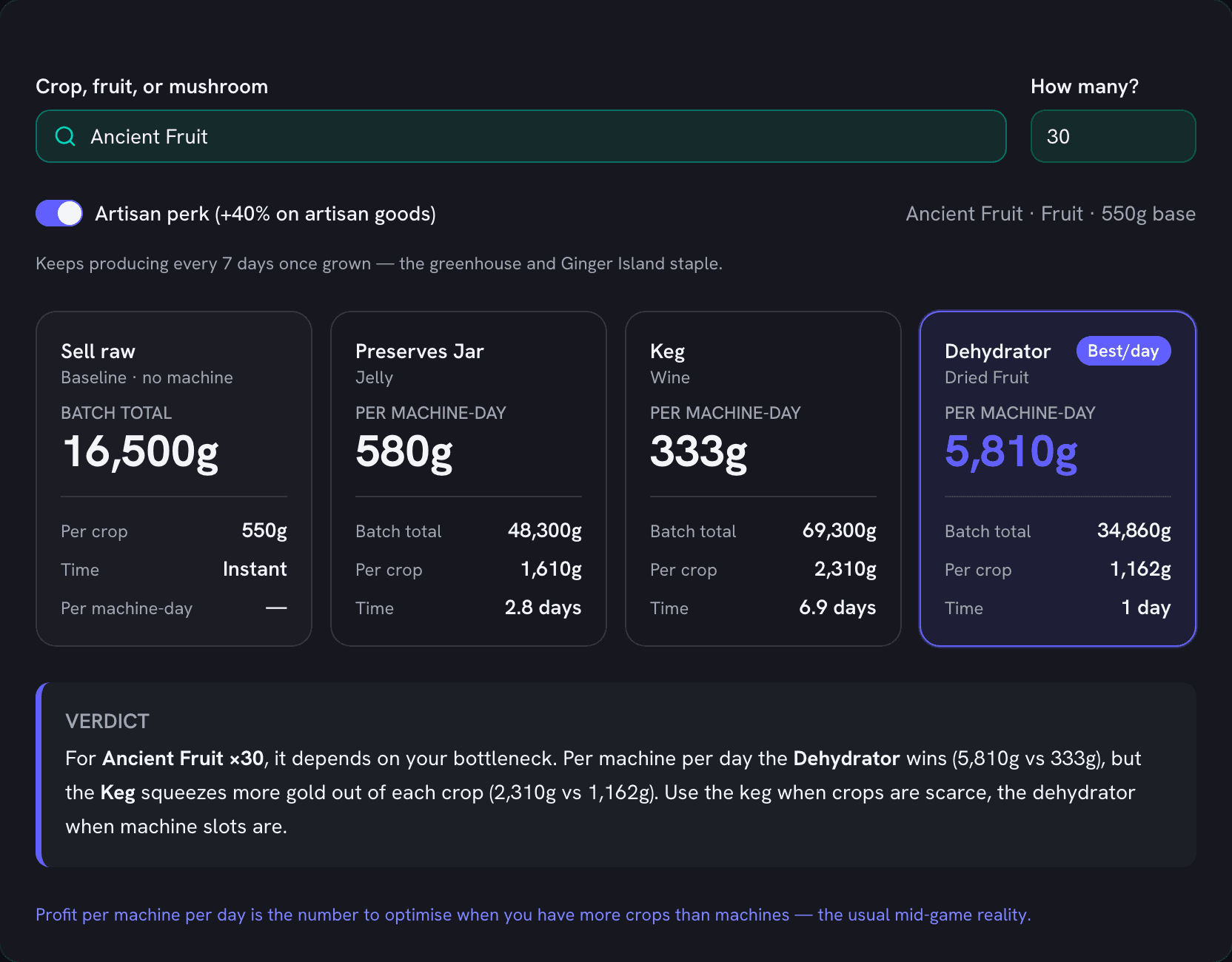
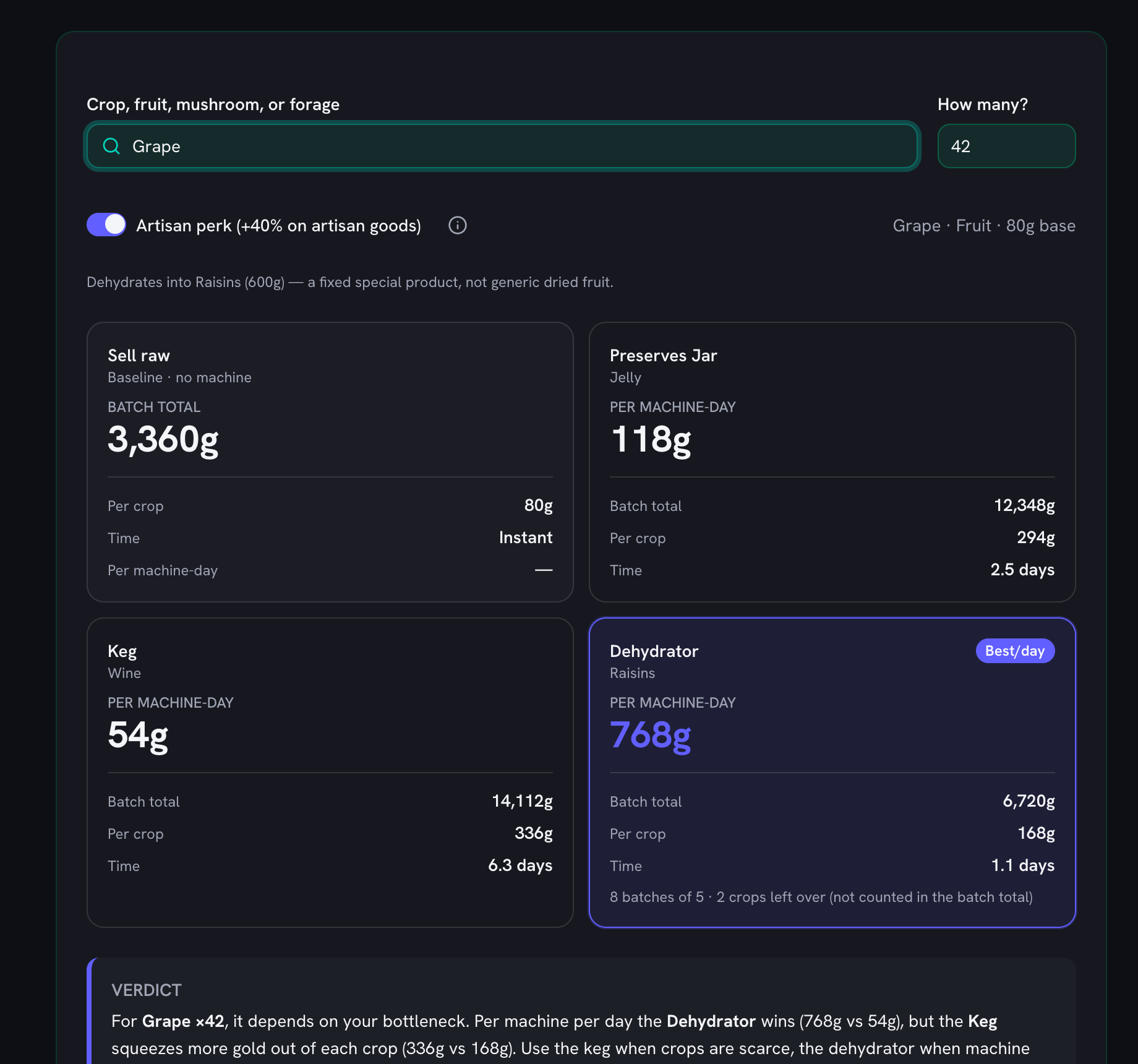
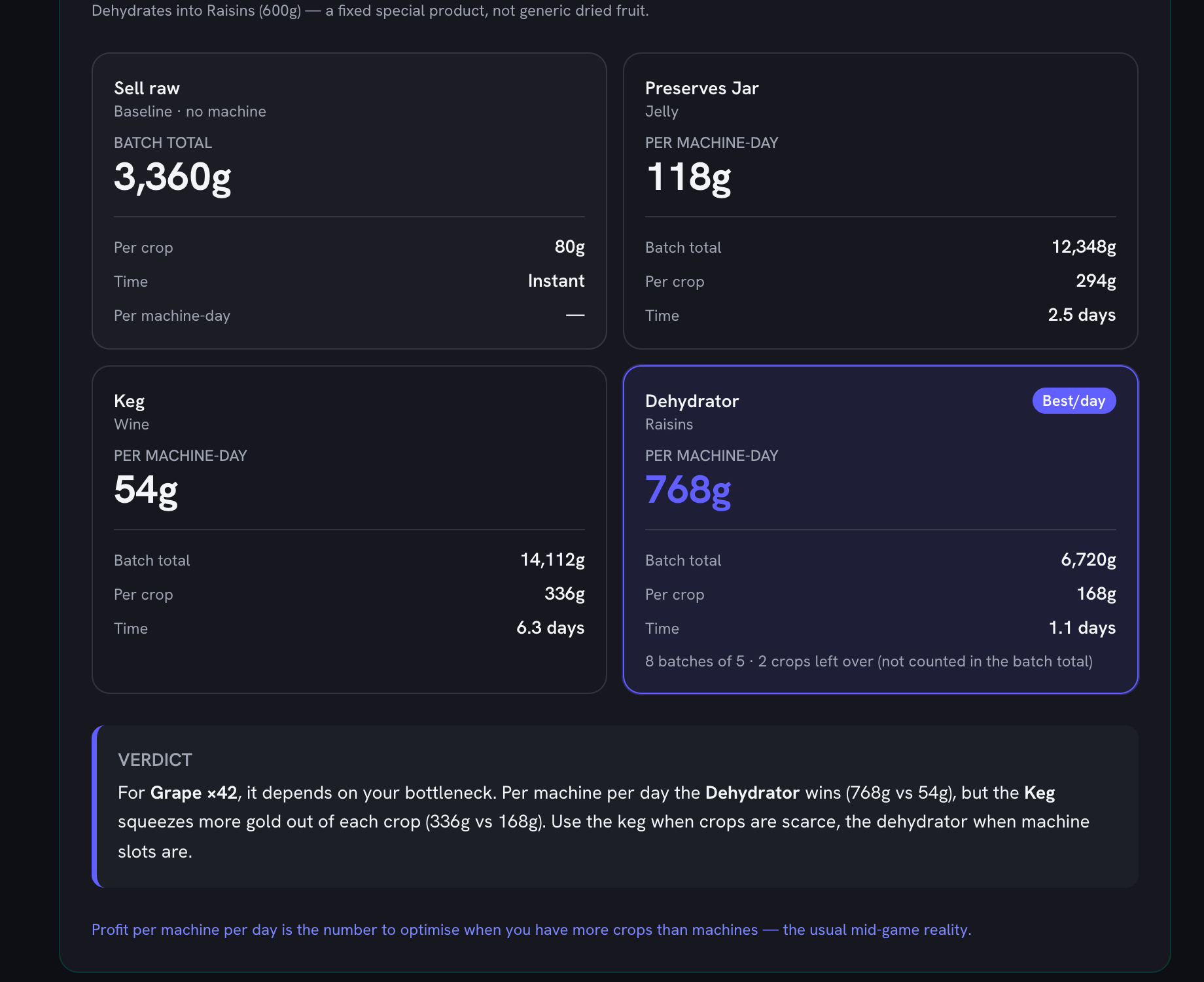
The headline question, is the Stardew dehydrator worth it, has a trap baked into it. A dehydrator sells dried fruit for 7.5× the base price plus 25g, which sounds like it demolishes the keg’s 3× wine. But a dehydrator eats five fruit per dried item. The honest comparison is not 7.5× against 3×; it is 7.5× against 5 × 3×, one dried item versus five bottles of wine from the same five fruit. Put that way, the keg earns roughly double the dehydrator per fruit. So why build dehydrators at all?
Speed and Machine Slots Change Everything
Because gold per fruit is only half the story. A keg holds one fruit for 6.25 in-game days to make wine. A dehydrator takes five and hands back a dried item 1.1 days later, the next morning. Measured as profit per day per machine, the number that matters once you have more crops than machines to process them, the dehydrator pulls far ahead. How far ahead depends entirely on the crop, which is what the next section is for.
An in-game day is not 1,440 machine-minutes, which moves every figure in the table below. Stardew runs an hour at 60 minutes from 6am to 2am and at 100 minutes from 2am to 6am, and machines keep working while you sleep, so a full day is 1,200 daytime plus 400 overnight minutes: 1,600. That is why the wiki’s 10,000-minute wine is 6.25 days rather than seven, and why a 4,000-minute preserves jar comes in at 2.5 days rather than close to three.
The Full Spreadsheet: Keg vs Preserves Jar vs Dehydrator, All 73 Crops
People go looking for a Stardew keg vs jar spreadsheet. This is it. All 73 entries in the calculator get a row, ranked by the best figure in that row, so whatever is worth building a shed around sits at the top. None of it was typed by hand: the rows come out of the code the calculator above runs on, and the last two columns say whether the Artisan perk changes the answer.
The shape of it: the dehydrator takes 31 rows, every one of them fruit or mushrooms, the only two things it accepts. The preserves jar takes 32, all of them vegetables or forage, and it wins them on the clock rather than the price: 2.5 days to pickle against 3.75 to juice. The keg leads just 3: Tea Leaves, Hops and Wheat, whose Green Tea, Pale Ale and Beer are fixed products that brew in anything from a few hours to about a day and a half instead of the 6.25 days wine takes.
The tail is 7 rows nothing will take: 6 flowers, which have no artisan recipe of any kind, and Red Mushroom, which the jar and the dehydrator both turn away because it restores negative energy. It is the only mushroom they refuse, and the only thing on this list that is not a flower and still has nowhere to go but the shipping bin.
A dash means that machine has no recipe for that crop, and there are four ways to earn one. Vegetables and forage have no dried form. Mushrooms have nothing to brew, so the keg column is empty for all 6 of them. Flowers take no machine at all. And Red Mushroom fails the energy test the jar and dehydrator both apply to mushrooms, which is why its row is dashes end to end.